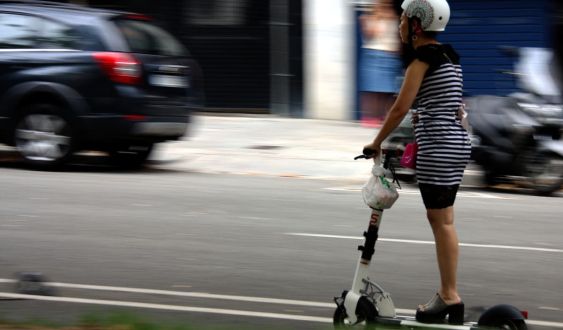
Micromobility in the Barcelona Metropolitan Area
The Acció report points out that "micromobility has become a fundamental element to solve transport problems in cities and is considered a key element for planning future urban management models, in order to solve the current collapsed system." With a population that will reach 2.5 million inhabitants in large cities like Barcelona by 2030, according to recent demographic studies, the document adds that "with increasing levels of air pollution and urban areas constantly congested by vehicle traffic, micromobility could resolve many conflict situations". The Barcelona City Council estimates that micromobility accounts for 3% of the city's current journeys, a figure that will increase by 30% in 2024, a greater increase than that experienced by private vehicle trips (+0.5%), on foot (+4.3%) or by public transport (+2.2%).According to recent demographic studies, the population of large cities like Barcelona will reach 2.5 million inhabitants by 2030Micromobility is gradually integrating with other urban displacement modalities, with the main objective of reducing the ecological footprint. Ferrocarrils de la Generalitat (FGC) is one of the services working on its integration and already has a parking facility with 976 spaces for bicycles and personal mobility vehicles (PMV) at its different stations, in addition to ten secure spaces with a control system to monitor entries and exits (Bicitancat), a hubin Sant Cugat for the charging and repair of electric vehicles, and a new parking lot in Sabadell Nord where VMP coexists with train lines, urban buses, and private vehicles.
Main business cases of micromobility in Catalonia
The micromobility sector has received 222 million euros in the last five years (2017-2021) from 21 foreign investment projects, as well as national investment projects and mergers and/or acquisitions. The companySilence (Scutum Logistic), based in Esplugues de Llobregat, has been the main manufacturer of electric motorcycles in Catalonia for nine years. With a turnover close to 40 million euros in 2020 and an investment of 13 million in three financing rounds, it has a workforce of 200 professionals from multiple sectors (engineers, riders, mechanics or designers) and three particular motorcycle models on the market. As of today, it belongs to the Acciona group.eMobikehas consolidated itself as an electric bicycle rental service since it landed in Catalan territory in February 2019, with an investment of 500,000 euros. Currently, it has a headquarters in Montornès del Vallès, a fleet of 500 bicycles, 15 stations, and four business lines.Cooltrawas born in 2006 in Barcelona to offer a shared vehicle service for individuals, companies, and public administrations. It has received investments of 10 million (June 2021), 7 million (August 2018), and 20 million (July 2017) to boost its growth and expansion.Future investment for the automotive sector
Acció cites a study by the Pacte Industrial de la Regió Metropolitana de Barcelona association, which highlights that 58% of companies in the automotive sector in the metropolitan region are willing to invest in new mobility. To begin with, Seat would take the prize with its commitment to manufacturing vehicles of these characteristics (it offers its own designs of electric motorcycles, electric scooters, and electric quadricycles on the market), as well as the development of shared mobility services, through an agreement with the kicksharing startup UFO, the ridesharing application Komuti, or the MÓtosharing service.
In the international context, the star product that more companies would be betting on is the electric scooter. Ford has entered the business of this vehicle with the acquisition of the startup Spin, while Uber collaborates with the shared micromobility company Lime and Cabify invests in the Spanish startup Movo to promote this type of new displacements in Spain and Latin America.
Add The New Barcelona Post as your preferred Google source for free
Stay informed with the latest news.