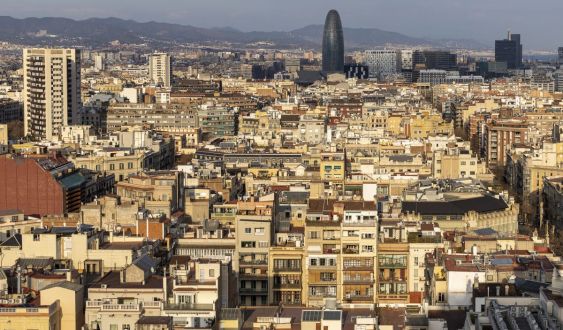
The General Council of the Barcelona Metropolitan Strategic Plan (PEMB) has approved the Metropolitan Commitment 2030, a new roadmap in line with current metropolitan dynamics, which clearly exceed the limits of the Barcelona Metropolitan Area (AMB). The new document, agreed upon with all political, economic, and social actors involved, outlines the main challenges of "the city of 5 million," which includes Barcelonès, Baix Llobregat, Maresme, Vallès Oriental, Vallès Occidental, Garraf, Anoia, Baix Penedès, and Alt Penedès. These are global objectives in terms of housing, social policies, mobility, and the environment, and they involve the development of projects from a new "territorial scale."
Despite the good intentions to promote projects in a metropolitan key beyond the AMB, the general coordinator of the PEMB, Oriol Estela, recalls in an interview with ACN that, currently, there are no ideal spaces to do so, as a consequence of the "administrative complexity" that the coexistence of different overlapping political actors entails.
In addition to the AMB and the municipalities themselves, supramunicipal administrations such as the Comarcal Councils or the Barcelona Provincial Council or the veguería of Penedès have competencies in this territory. For this reason, the PEMB sets 2030 as the date to know "how this territory is to be governed."
Estela predicts that the deployment of the Metropolitan Commitment 2030 may, over time, provide some clues as to what the future territorial organization of the metropolitan region might be. In this regard, the strategic plan determines which aspects make sense to address from the new scale.
The plan, in fact, proposes actions at three levels: replicating successful experiences throughout the territory, scaling AMB or Barcelona city projects to the metropolitan region level, as well as creating new projects that, from their starting point, have this new broad territorial vision.
In this regard, the mayor of Barcelona and president of the PEMB, Jaume Collboni, and the president of the PEMB Executive Commission, Janet Sanz, have agreed that this great metropolis must have a "federal and polycentric" structure, as its urban reality is, taking into account the voice of all its actors—administrations, private sector, and citizens.
Collboni spoke this Tuesday during the General Council of the PEMB, where he pointed out that challenges such as climate change, housing, or business competitiveness must be coordinated from this new vision if they are to be successfully completed.
Janet Sanz, for her part, celebrated the "decisive turn" that the new plan represents, as it will allow leading an integral urban network that exceeds the expectations with which work had been done until now within the framework of the AMB. She says that the AMB has been "a first step" that has allowed laying the foundations for large-scale policies, but that it has now become too small: "It is evident that this is not enough."
The president of the PEMB Executive Commission says that the challenges brought by the 21st century require new governance instruments. "The climate emergency knows no administrative limits or borders," she assures. In this sense, Sanz says that it is necessary to build a "metropolitan sovereignty" from municipalism with more powers and resources.
A plan of eight missions
The new metropolitan strategic plan is structured around eight missions that should serve as a guide for coordinated action in the territory on matters such as innovative and inclusive economy, sufficient income levels, environmental and climate emergency, sustainable and safe mobility, healthy food, territorial cohesion, adequate housing, and cultural vitality.
Each mission also sets out a series of specific objectives to help define actions aimed at achieving them. In economic matters, the aim is to promote technology transfer with the goal that by 2030 the economic fabric of the metropolitan region dedicates at least 1.2% of GDP to private spending on research and development.
Regarding work, the objective is for collective agreements to guarantee salary levels in line with a reference minimum wage adapted to the reality of the metropolitan region. In the climate sphere, the goal is to reduce greenhouse gas emissions in this territory by 45%.
In relation to mobility, the strategic plan proposes a 10% change in the modal distribution of displacements in favor of ecomobility. And in the food sector, the aim is that by 2030 the diet of the population of the metropolitan region will be based 60% on local foods.
Ensuring that low incomes do not exceed 25% in the set of vulnerable neighborhoods is the objective regarding territorial cohesion, while in terms of housing, the aim is to ensure that the population suffering from an economic overload linked to household expenses is less than 30%.
Finally, in the cultural sphere, the metropolitan strategic plan foresees increasing the participation of the metropolitan population in the cultural life of the entire territory by 10%.
Add The New Barcelona Post as your preferred Google source for free
Stay informed with the latest news.
