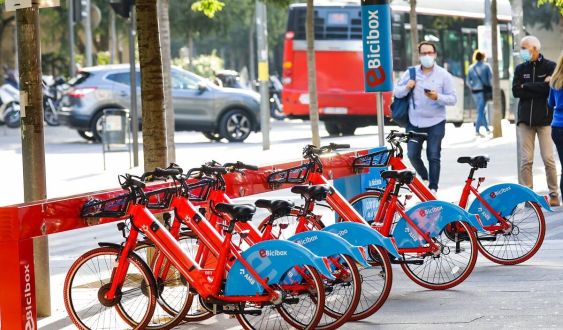
For years, Bicing has consolidated itself as another means of transport in Barcelona, reaching some 130,000 users. Now, about fifteen cities surrounding the Catalan capital will launch their own public shared bicycle network, which still has to define the degree of complementarity it will have with its Barcelona counterpart. The Barcelona Metropolitan Area (AMB) and TMB have kicked off this new service, AMBici, with the publication of its tender, valued at 60.8 million euros. It will begin operating in some municipalities during the last quarter of 2022, with the forecast of completing the deployment by early 2023.
The AMB will lead the metropolitan bicycle network, which will be managed by TMB through the private operator that wins the public tender for a period of eight years. The contract includes the supply, operation, maintenance, and redistribution of the bicycles, as well as the management platform and user support. The deadline for submitting offers ends in mid-February next year, and the award is scheduled for early June.
According to the tender documents, the future metropolitan Bicing will have between 2,000 and 2,600 bikes, all electric, unlike those in Barcelona. The bicycles can be picked up at more than 200 stations between 5 AM and 12 AM, seven days a week.
The stations will be distributed across L'Hospitalet, Badalona, Cornellà, Santa Coloma de Gramenet, El Prat, Esplugues, Sant Feliu, Sant Adrià de Besòs, Sant Joan Despí, Sant Just Desvern, Molins de Rei, Sant Boi, Viladecans, Gavà, and Castelldefels. L'Hospitalet and Badalona will be the municipalities with the most, with 31 and 25, respectively, while at the bottom will be Sant Adrià, Sant Joan Despí (9), Molins de Rei, and Sant Just Desvern (6).
At least half of the stations will have electrical installations to charge the bicycles. Likewise, one-third will be located at metro, Rodalies, FGC, or tram stations, while almost 50% will be in areas where high demand is expected, without the need for a public transport stop nearby. The rest will be in areas with less demand or fewer stations.
People who want to use this service will have two annual fee options, in line with the Barcelona Bicing model. The first will be a flat rate and the second, a pay-per-use rate. Advance booking of bicycles at specific stations will be allowed.
In addition to having the Barcelona Bicing as a reference, the new metropolitan service draws on the experience of e-Bicibox, a shared bicycle service launched in 2018 in 11 municipalities of the AMB. With an offer of 300 bicycles, also electric, it has 48 stations, all of them in modules that are not visible to users, except for three pilot stations in Cornellà, L'Hospitalet and Sant Joan Despí, which are open like those in Barcelona. According to the tender, e-Bicibox is not expected to be disabled until the deployment of the new metropolitan public bicycle has been completed.
Add The New Barcelona Post as your preferred Google source for free
Stay informed with the latest news.
