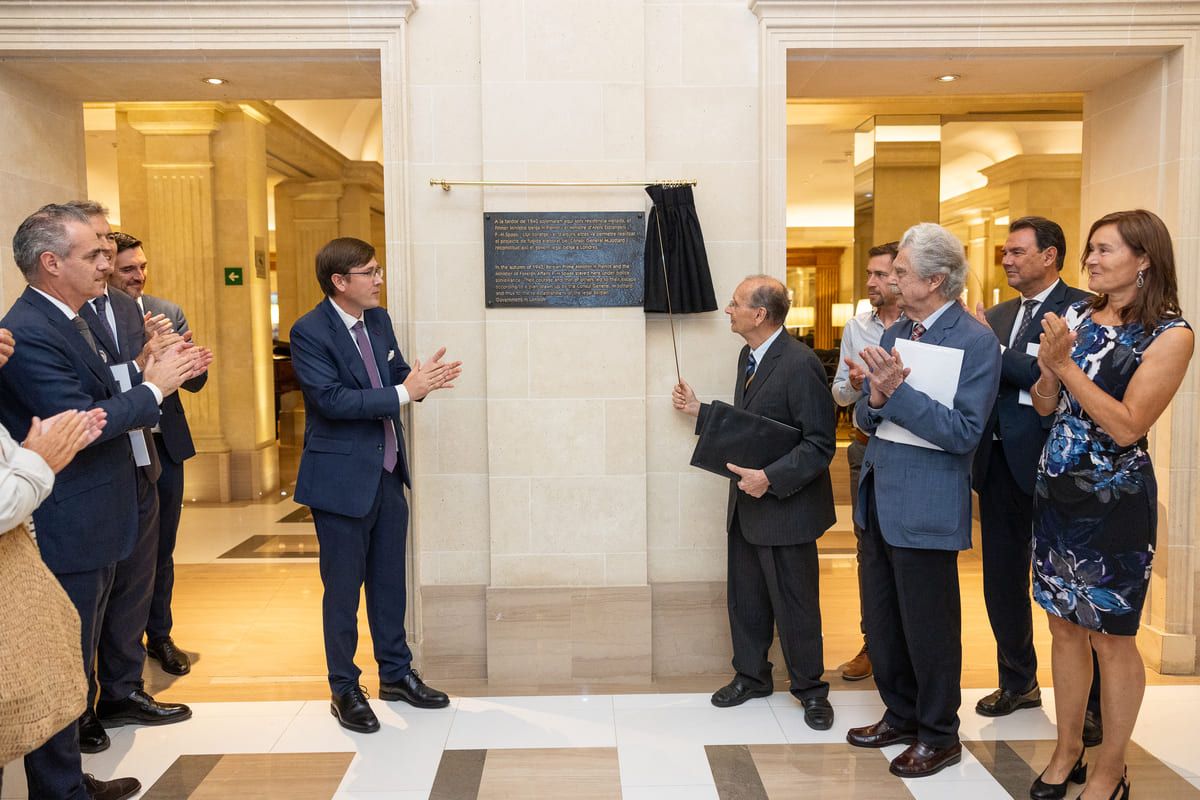
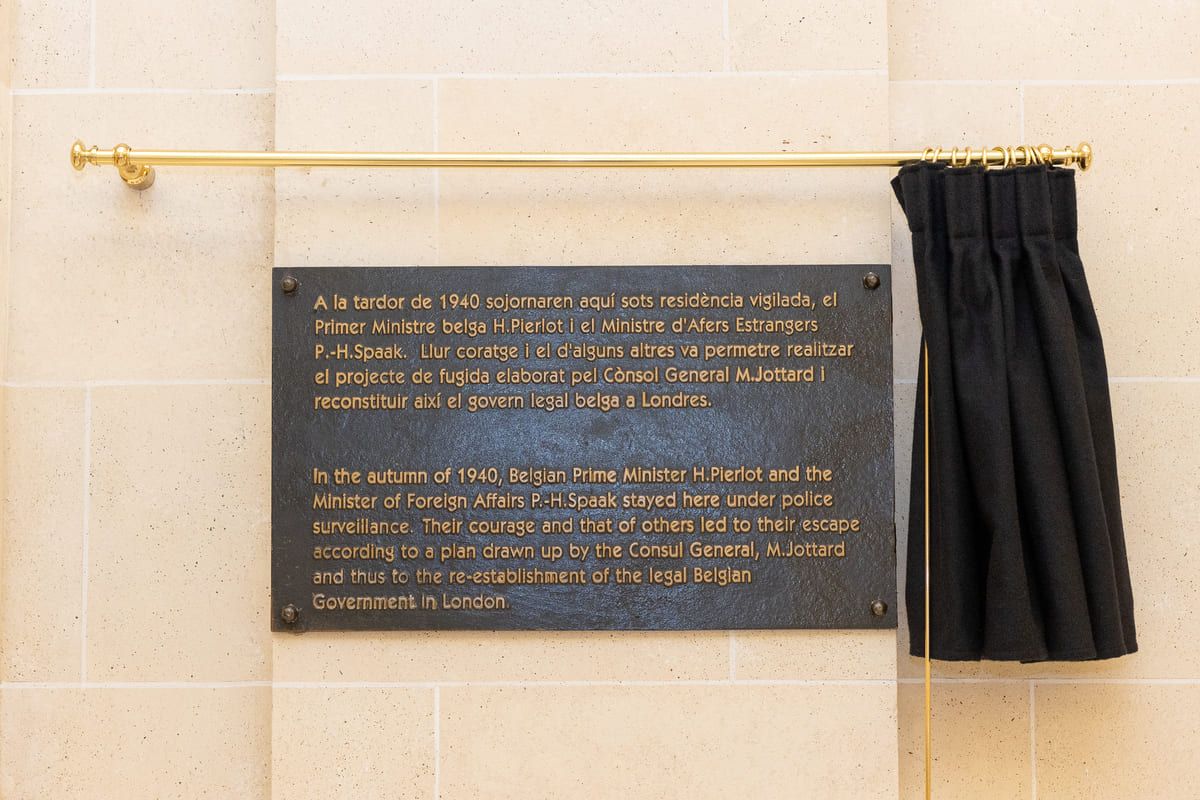
All the commemorative plaques scattered around the city have a story behind them. Some highlight someone's stay in that place. Others inform the curious passerby that such a person was born or lived at a specific address. However, the one installed this week in the lobby of the Hotel Majestic goes further: it not only remembers two illustrious guests, but also commemorates their escape, worthy of being reflected in a novel or a film of war, adventure, and international politics.
The call was for seven in the evening. The Ministry of Foreign Affairs of the Kingdom of Belgium, through its consulate in Barcelona and the Majestic Hotel Group, invited a good representation of the Belgian community in the city and other Barcelonians this Wednesday night to remember an episode that happened in the hotel at Passeig de Gràcia 68-70 on October 19, 83 years ago: the escape from Spain of Hubert Pierlot, prime minister of the Belgian government, and his foreign minister, Paul-Henri Spaak. A dangerous journey between Barcelona and the Portuguese border hidden in the false bottom of a van. A journey that would end with a flight to London to form a government in exile there, as Belgium, like much of Europe, had been invaded by German troops in the spring of 1940, at the beginning of World War II.
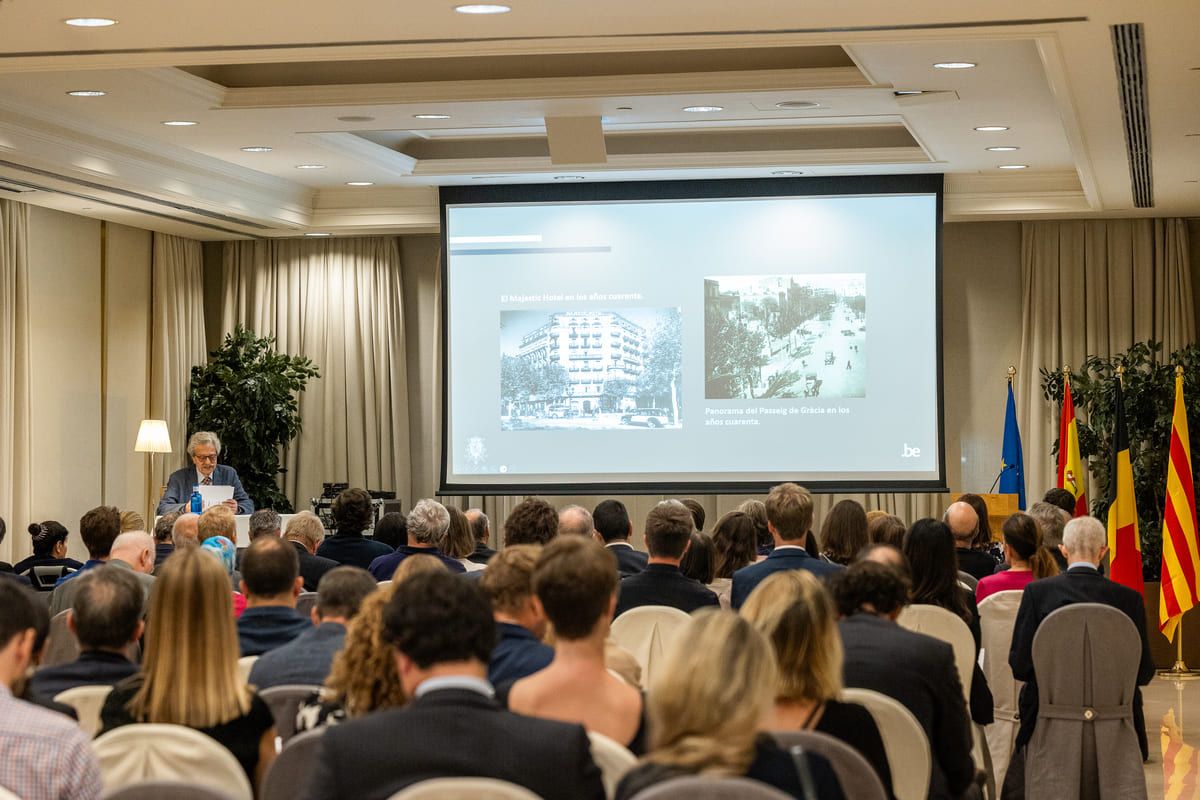
The event was opened by a duo, Malco Par and Pascal Billard, director of the Majestic Group and general manager of the hotel, respectively, who alternated Catalan, Spanish, and French to welcome and contextualize the story: the same hotel, which this year is celebrating its 105th anniversary, eight decades later. Two diplomats followed them: Pierre-Emmanuel Brusselmans, Consul of Belgium in Barcelona, and Philippe Jottard, Honorary Ambassador of Belgium, recalled the importance of the two former politicians' passage through Barcelona, to the point that the history of the current European Union passed through the hotel, as Spaak eventually became one of the fathers of the germ of the Community that progressively grew to become the EU.
Besides the hoteliers and diplomats, the prominent protagonist of the event was Lluís Permanyer, journalist, historian, and unofficial chronicler of Barcelona, who recalled in detail what he knew and what he had found out about the escape of the two Belgian politicians persecuted by the Nazis in Europe and watched by the Francoist police in Spain. Permanyer recounted that the prime minister and the foreign minister left Brussels, like the rest of the government, after being deposed by the Nazi regime. Pierlot and Spaak passed through France heading south on a somewhat zigzagging journey until they reached the Spanish border through Catalonia. Their objective was to reach England, a country that was enduring the German onslaughts, via Portugal. Lisbon remained outside the conflict. Its declaration of neutrality made it one of the last escape routes on the continent for those fleeing Hitler's regime.
The stay in a Barcelona hotel
The Belgians arrived at La Jonquera and were not allowed to pass as they did not have visas. While waiting for them, they were first transferred to Girona and then to Barcelona, where the police received orders to always follow their steps. Officially, they were not detained, although they were under constant police surveillance. The then Belgian consul in Barcelona, Marc Jottard, recommended they stay in a hotel where he himself had lived for a few weeks upon his arrival at his new diplomatic destination: the Majestic. The new guests led a discreet and quite routine life, with walks, visits to the consulate, to Jottard's home, to the cinema (I never saw so many films and documentaries in my life, the foreign minister later confessed), and frequently eating at the restaurant Los Caracoles, an establishment that was already a century old at the time.
What that stay at the hotel, waiting for visas that never arrived, actually hid was an escape plan to Portugal that was carried out in the strictest secrecy and known by only a few people. Among them, the charismatic Alicia Reyes, secretary of the consulate, a friend of hers, an employee of the Majestic, and a handful of other people, both from the hotel and from the Belgian legation's circle, who kept absolute silence and discretion about what was going to happen. Not even the Belgian embassy in Spain, based in Madrid, was informed of the delicate operation. Everyone was risking everything.
To freedom in a Chevrolet van
The story has the makings of an adventure film, although films sometimes fall short compared to reality. The fact is that thanks to the contacts of Alicia Reyes, who was more than just the consulate's secretary, she was the diplomat's right-hand woman, a resourceful woman and a very active person helping the resistance against the Nazis, the idea of converting a Chevrolet van into a hiding place for the two Belgian politicians became a reality. Maurice Heining was in charge of modifying the cabin to install a false bottom where Pierlot and Spaak would travel, going from being housed in the Majestic to spending about 23 hours of travel in a minimal and enclosed space where a hole had even been made to urinate while moving.
The escape plan was accelerated by the coincidence of circumstances that tensed the atmosphere: on October 15, the Francoist army executed Lluís Companys, president of the Generalitat de Catalunya, arrested weeks earlier by German military police agents in a house in La Baule-les-Pins, near Nantes, to then hand him over to the Francoist authorities. Simultaneously, Heinrich Luitpold Himmler, leader of the feared Nazi SS, scheduled a trip to Madrid and Barcelona for those dates. The escape had to be imminent or the lives of the Belgians would be threatened.
With Maurice Hening at the wheel and the politicians hidden, the Chevrolet van started and only stopped to refuel. Along the way, to dissimulate, the driver even took on board Civil Guards who were patrolling on foot. A forced deference that made the journey somewhat less dangerous. Meanwhile, in Barcelona, the police officers in charge of guarding the prime minister and the foreign affairs minister had cut short their service: accustomed to both their routines, they went to watch a Barça match at the Les Corts stadium in the early hours of the escape. The next day, upon going to the Majestic, they did not find them. As hours passed, they became alarmed: they had possibly escaped, although they did not inform their commissioner until much later: they did not dare to interrupt the bullfight their boss was enjoying. Meanwhile, Spaak and Pierlot crossed the border into Portugal after 23 hours and were then able to reach the British capital by air.
All of that are now anecdotes that also seem taken from a script, although in reality that escape was a dangerous operation that directly involved the formation of the Europe we know: in 1944 the government in exile was able to return to Brussels from London after four years. Pierlot led a new, albeit short, government of national concentration and Spaak became the first president of the UN assembly. He was also the initiator of the Benelux customs union and the drafter of the founding charter of the United Nations. He also presided over the Organization for European Economic Cooperation, the Council of Europe and was the father of the European Coal and Steel Community, the basis on which the European Economic Community and the current European Union were built.
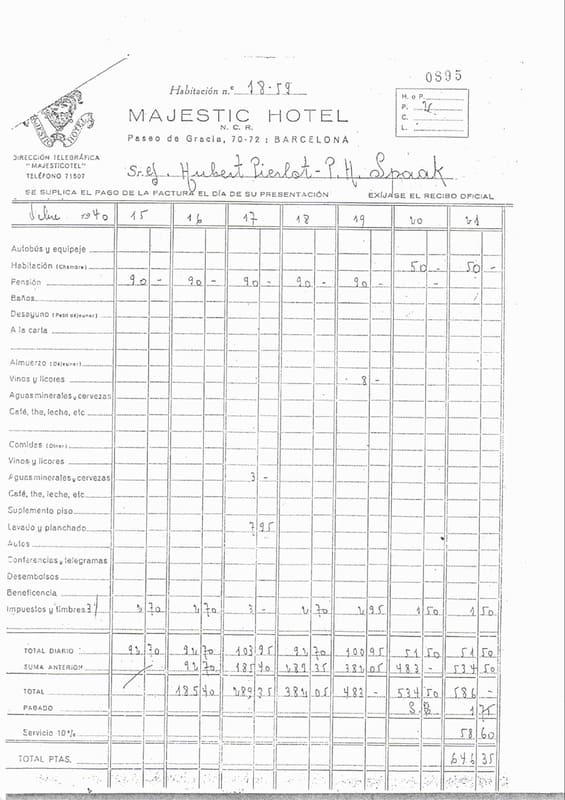
And all that after escaping the Majestic leaving everything behind: the beds made, the suitcases in the room, the car parked on Paseo de Gràcia and the bills for the stay unpaid. The debts were immediately assumed by the consulate. They were paid after police interrogations and even arrests of several hotel employees and even non-diplomatic consulate staff in the days following the escape. By then, the two protagonists of the story were already in the United Kingdom.
All this adventure has been remembered this week in the same establishment, which displays a plaque commemorating this cinematic adventure that ended up being key to the history of this continent. A story that happened in and through Barcelona.
Add The New Barcelona Post as your preferred Google source for free
Stay informed with the latest news.