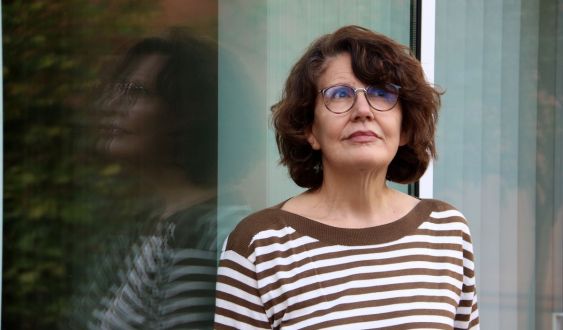
Imma Monsó (Lleida, 1959) debuts in Anagrama with La maestra y la Bestia (The Teacher and the Beast), a coming-of-age novel led by a shy only child who reads everything she sees and suffers in advance. Focusing on the first years of life as the most determining of the decades that follow, the story is enveloped in an ingenuity that has been lost today, amidst the morass of information and the ease of knowing everything, or at least believing it. With the suffocating silences and confusing half-truths of the post-war period in the background, the plot grows as the veil falls from young Severina.
"The novel gathers all my past losses," says writer Imma Monsó about a story she began writing four years ago and events have been leading her. Her mother, who was going to be the protagonist, passed away before the pandemic. And, at that time, she also stumbled upon her father's name in a book that led her to look for him in the lists of those repressed by the dictatorship, finding the file of the court-martial he was subjected to when the Civil War ended for having been secretary of the CNT. She was shocked to discover her father's political past and imagine everything he had had to go through, even more so for not having known absolutely anything beforehand.
"I had no intention of talking about my parents, but, in the end, I ended up doing it, as usually happens," explains Imma Monsó. She wanted the main character to be her mother as a young woman when she arrived as a teacher in a village in Alta Ribagorça, where she met her father and lived many anecdotes that she later told her. But she ended up putting herself in her mother's shoes through Severina: "You start writing trying to rescue one thing and the opposite happens."
The Teacher and the Beast thus becomes a novel with an intense and intimate emotional charge from the first page, with a seven-year-old girl about to have her candles blown out who already knows that everything around her will one day be gone and, therefore, she will lose it. Her journey then begins to prepare for pain and helplessness, a premonition that comes true when her parents die too soon. Despite her solitary nature and her sudden isolation, Severina feels the need to reach out to others and let herself be loved. With a gray dictatorship that allows few options, the way she will find to achieve this will be to become the teacher of a surly mountain village where providential characters like Justa and Simeó, the Beast, will guide her in her learning.
All this, without forgetting the writer's humor, recalls her new editor, Isabel Obiols. "For me it is essential, also when I read. And I notice when it's missing. Humor comes from putting distance to the things you do with passion, because it creates a close-far game that gives agility," Monsó details. And, although it has autobiographical echoes, the author focuses on fiction to build a story that is presented as a "winter tale," as its title suggests. Snow, one of Severina's childhood dreams, rises as a character, but also as a symbol of the idealization she herself made of Vilaller, the town where her father grew up, hidden under the name of Dusa. She stopped going after her father's death when she was eight years old, being, moreover, "far, far away."
Imma Monsó's first novel with Anagrama, published in Catalan and Spanish, with the writer's translation, is accompanied by the reissues of Tot un caràcter and Un home de paraula. Although she never rereads her work, "you end up saturated and close it," in addition to the fear of finding errors, she did it this time and it was less bad than she expected: "I haven't changed that much, the important things I had inside."
Add The New Barcelona Post as your preferred Google source for free
Stay informed with the latest news.
