In 2009, Wynwood Walls became the most transformative urban art project in the world, by converting a degraded neighborhood in Miami into an international tourist and artistic destination by making available more than 7,000 square meters for the creation and exhibition of the best urban art. Since then, hundreds of artists have participated in the space, transforming those empty walls into a large open-air gallery.
In Berlin, the East Side Gallery occupies a 1,300-meter section on the east face of the Wall, which was saved from demolition for this purpose. Today it is considered the longest open-air art gallery in the world, containing 103 murals painted by artists from various continents, including the famous "kiss" between Honecker and Brezhnev.
In 2015, the ephemeral Dismaland was founded, a crazy idea by urban artist Banksy consisting of a peculiar amusement park located in Somerset, England, where more than 58 artists personally invited by the author participated with works that expressed a critical spirit towards Disney parks.
Now it's Barcelona's turn. Did I say Barcelona? Sorry: I meant Santa Coloma de Gramenet. Given that this municipality has jurisdiction over the aquifer land of the Besòs river, beyond how the project may expand towards Sant Adrià or towards Vallès, the municipal initiative of the project has been led by Mayor Núria Parlón (and without having to condition, as others have done, its construction on her party winning the municipal elections). She expressed this at the inauguration of the event, where she was asked not only about the aforementioned controversy but also about Santa Coloma's involvement in the project, which is resounding and total.
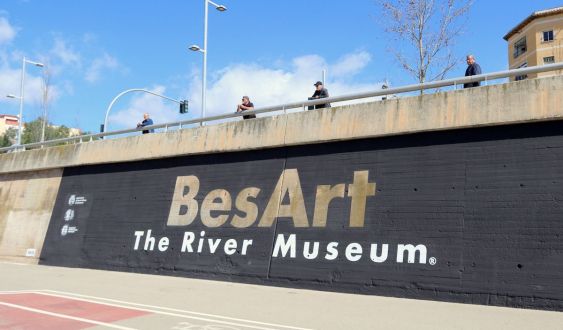
The Barcelona metropolitan area has been trying for some time to cooperate on aspects that go beyond metro lines or shared basic services, and to promote a project that truly puts this area back on the world map. The BesArt project, the "largest urban art museum in the world" (with more than 18 kilometers of route from Vallès to the Mediterranean), is not only a project to develop the area: it is probably the missing piece for "Barcelona" (understood in a broad sense) to reconcile with contemporary art beyond Macbas, Plensas, and Mocos. Something big, please. Something that is not merely testimonial or for show, that is alive, that is minimally avant-garde and minimally connected with the most popular creativity. Well, we have it here now.
During the industrial era, cities lived with their backs to their river mouths, depositing everything they had left over there. Now, city rivers flow into spaces recovered for nature, but also for human use. The Besòs has gone from being the most polluted river in Europe in the 70s and 80s, to an environmentally protected river park administered through inter-institutional collaboration. But the Besart project now aims to fill the river park with the most renowned urban art signatures worldwide and, at the same time, open the space to all citizens to develop their creativity.
The Barcelona metropolitan area has been trying for some time to cooperate on aspects that go beyond metro lines or shared basic servicesIf Heraclitus said that "you cannot step into the same river twice," now the idea is that you cannot see the same BesArt twice: its promoters (the Real Círculo Artístico of Fèlix Bentz, the Santa Coloma City Council of Núria Parlón, and the Mediterranean Street Art Association, with David Hernández as ideologue and Beto Agustí as indispensable facilitator) intend that the diverse expression of urban art in the area forms a constant current of changes, following the course of the variable sensibility of our time. Of free access and with a mostly fluid content, with works of both painting and graffiti, as well as sculpture, performing arts, sports, permanent works and ephemeral works, and all of this in a recovered natural protection environment, with full coexistence between human activity and the Mediterranean biosphere.
If it goes ahead, it will be a project that is at once metropolitan, cosmopolitan, ultra-local, and planetary. There had been talk for some time about the need for an art fair in Barcelona, or at least a major contemporary art festival, in a city that seems to lose its eagerness for contemporaneity with the last brushstroke of Miró or Tàpies. We will not fix our idleness by commissioning Jaume Plensa some doors here or another thinking head there, but by connecting with the most spontaneous and innovative expressions of known or emerging urban artists. From a "no man's land" we could move to "waters for all," and I would say that just for the idea, which is one of those that seems incredible it hasn't been proposed before, everyone should try to collaborate as much as possible. Let's see if for once we know how to put the Mediterranean back at the center, from where it should never have left, and without having to invoke artificial projects like the snow of phantom Games. Let's see if we know how to naturally reconnect with our contemporaneity, lost for too many years. And let's see if Barcelona, this time and by the way, learns from the proactivity of the cities in its outskirts.
Add The New Barcelona Post as your preferred Google source for free
Stay informed with the latest news.
