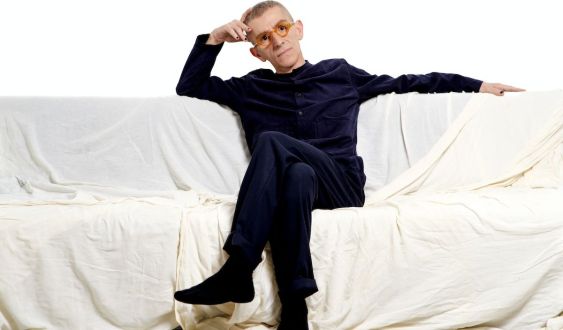
Moreno Bernardi speaks hypnotically, slowly, like waves coming and going (or like leaves on a tree). An Italian choreographer and director, he has lived in Barcelona since 2001 and is premiering Paradise at the Teatre Akadèmia in mid-May. He is also currently preparing Alberto Conejero's The Odyssey, which will be presented at the end of July as part of the Grec Festival, in the Sala Atrium.
In addition, he is working on a project that will rethink choreography, for ten dancers. Bernardi knows himself, he knows what he is talking about andknows that the gesture is everything.But, paradoxically, he also perfectly masters the art of explaining himself with words.--- Let's see, where are we? What is Lo Spazio?We are, basically, in my house. Balmes Street 171, ground floor. This is my house in the sense that here I decided, in 2019,along with Elsa Peretti, create an artistic research center. It was born out of the need for people to find me: those who sought me out to work with me, to study with me, or simply to confront me. Today people do not meet physically.--- That is perfectly possible, yes.There is a lack of places where we can meet, waste time, confront each other. When we have a space to see each other, then the curves, the hyperbolas, all the possible textures that an artist can experience, then transform into a project, a collaboration, a format, a beautiful idea. And so, little by little, Lo Spazio has transformed not only into an artistic residency center, but into a creation center for the company, for me, and for all collaborators. Many do not reside in Barcelona, but all are great artists and almost all of my generation. And all of them, probably, need to return to the concept of a workshop.--- Return to the physical.I believe this place is a struggle or a manifesto against the concept of time in the modern era. In the art world, as in other sectors, you are continuously asked for production. And in the end, the times of a creative process coincide with a production schedule. That is the theory. But I have never functioned that way.--- So, how do you function?--- Although I am hyperactive and produce a lot, it is precisely because I distinguish very well what a production calendar is from what a creative process is. And Lo Spazio is an artistic center, a center of creativity. That this creativity then takes a form, whatever it may be, to transform into an artistic result, is another matter. For me, there are fundamental differences between the artistic process and the creative process, and sometimes, they are confused. I started the artistic process at three years old, without knowing it. I started to be a little more conscious at ten, when I saw that I didn't play soccer because I took dance classes.--- Did that already indicate something, then?I am a man of study, of the workshop, where I am creating and experimenting every day of the year, every day of my life. At a given moment, an idea arises, and creative processes come into play in favor of that idea. Then, in three weeks, I can put together a work, but perhaps I have been incubating it for twenty years. It is a slow time of dedication. When I say this is my home, it is because I spend most of my time here.--- Well, I always see you alone here. Artistically, sometimes I feel alone. But I know it's not true: first, because I created it with Elsa and, second, because my solitude as an individual I resolve with the complexity I have as an artist. And in that sense, I always have something to do. There isn't a single day when I don't find a reason or an inspiration to do something."In a creative process, the more useless what you are doing seems, the more useful it will seem when you reach the final result"--- Is art useful?I very much believe in doing useless things. In many aspects, in many areas, but above all in art. The artistic process must have many useless things, or things considered useless under a norm of functional life. But an artist's life is not functional. And it creates its own norms, its own rules. The artist needs useless things, to waste time, to fall in love with their mistakes, because there, perhaps, they find the idea of life.--- It is never entirely useless.No, as long as you are aware of what you are doing, because it coincides with who you are. From a social point of view, the concept of useless exists precisely because it is not what most people do. In a creative process, the more useless what you are doing seems, the more useful it will seem when you reach the final result, which is the art you offer to others. At that moment, it has to be useful. I am not an entertainment artist.--- But this space you have here is a privilege. There are many people in the theater world who don't have this time, and who are indeed trapped in calendar duties, commitments, commissions. And the link with Teatre Akadèmia allows you to be the one who controls the calendars, right?To a certain extent. The relationship with Teatre Akadèmia is simply a continuous collaboration over the last few years, but it is not the only theater we collaborate with. In that sense, Teatre Akadèmia gives me more flexibility than others, due to the bond. But no, the privilege does not consist of that: the privilege is that I have decided to live this way. That is my privilege. It is my decision. The point is that, when no commission is requested of me, I am not lost. Therefore, when a request is made to me, they find me active and prepared.--- Can one avoid falling into production for production's sake?Twenty years ago, in Italy, the world of theater was experiencing an absolutely golden age, with months-long world tours. Many have become comfortable with their work being determined by whoever commissions it, whereas my work must make me strong, create my identity, make you interested in me. Of course: when you ask me for something, I will respect your rules. As long as they don't betray mine.--- Do you consider yourself more of a director or more of a dancer at this moment?I am all those things. I am a chaos that I try to organize. Direct, compose, dance, act, write, create... I change the form according to desire; I look for the language according to what I want to say, how I want to say it, at what moment in my life. But agreed: if we avoid labels for a moment, I believe my soul belongs to dance.
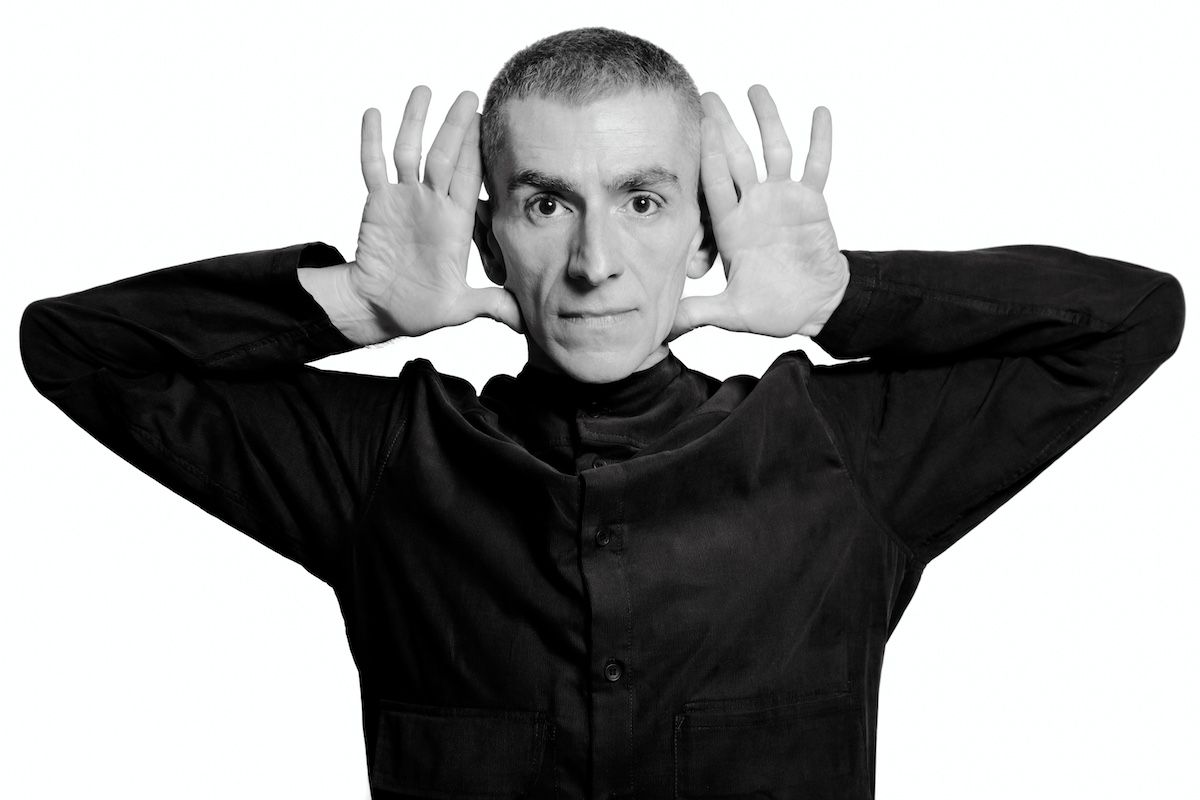
"The fundamental basis of a language is how it interprets life"--- I think you pay a lot of attention to the language, to the musicality of the language.The language is an absolutely extraordinary musical structure. When it is said that language represents a culture, it is an obvious fact that we should reflect on more. In art, the what and the how are synonyms. Language is a natural artistic expression of the individual, even of those who are not artists. We have invented an artistic and creative language to be able to communicate with words. It was not an engineering investigation that determined the grammar and syntax of a language.--- It arises spontaneously. The same phrase said in Italian, in Catalan, in French or in English, if we only look at the what, they all say the same thing (that's what translation is for). But if we delve into the music of each one, there are not only important nuances. The fundamental basis of a language is how it interprets life. To talk to myself I don't need a language. I can meditate, listen to myself, dance.--- Interpreting is not translating.To interpret you have to know how to translate, but also to know the semantics and the soul of the knowledge behind the language you are using. Every time I have done Shakespeare, since I have been in Barcelona, I have always done it in Catalan.--- But it was also Elsa Peretti who said: let's bring classic works that had never been translated into Catalan, right?Elsa said it, but with an openness that those who interpreted her did not have. Elsa was a great artist, who fostered possibilities, especially for new authors. But when it came to translating, it was more a matter of sound. There are phrases that we liked in French, others in English, others in Italian, others in Catalan, others in Spanish, because of how they sounded. I am more fluent in Spanish, because I am a perfectionist and, until my Catalan is absolutely perfect, I probably won't open my mouth in Catalan. But when we do shows in Catalan, I myself act in Catalan with the interpreters. And there I have a lot of fun, because even the Catalan interpreters discover things about their language. Because those sounds that fascinate me about Catalan, I give them even more weight, I underline them, I breathe them differently.--- Everything is feeling.Exact: it has nothing to do with the world of ideas. Culturally, we are different in our feelings. What love or affection means to a German is not the same as for a Catalan or an Italian.--- What is the difference between theatrical language and dance language? In theater we have the word; in dance we have movement. Movement allows you to contemplate something without anyone naming it. And that makes you, an adult, suddenly perceive something exactly as you perceived the world before you learned to speak.
"The difference between a caress and a slap is only the rhythm: the gesture is the same"— I had never seen him like that.Most people who are not used to dance sometimes say: "Oh, I don't understand dance." But you, as a child, didn't have the concept of understanding the world. You didn't know where you had arrived. When we come into the world, everything seems like science fiction to us. We don't know what a flower is, what a chair is. Not even the color red.— Do you recommend going back to childhood?Do not take a childish attitude, but rather an attitude that has to do with the imaginary, with the fantasy that you decide to use to understand yourself and others. The difference between a caress and a slap is only the rhythm: the gesture is the same. By changing the rhythm, weight, and force, you go from caressing someone to hitting them. That is the power of dance.— And that is another type of language.If I say the wordhouse, on one hand the concept of home appears, but on the other, the concept you have of home is not mine. For conceptual or linguistic reasons. Whereas in dance, even if we are observing the same thing, we deduce another type of imaginary that precisely touches our soul. It's a difference that enormous.
"Teaching forces me to discover my tendency towards isolation"— And merge them?For me it doesn't make much sense, because even in the movement of theTanztheaterGerman, of which I am a son (I grew up directly with Pina Bausch and all German choreographers), dance-theater was not the fusion between theater and dance.Tanztheaterit is the theatricality of dance, that is, the interpretation of how much theatricality movement can have in the choreographic world. Dance forces you to live, and the word forces you to name. It is a continuous dialogue. Dance is always life. It is everywhere. The word is not always present between two people, because they can remain silent.— How would you define your style?I don't know. I probably will never want to define my style. I come from contemporary dance and my teacher was Carolyn Carlson, with whom I trained in expressionist dance, in Nikolais' technique, in the importance of having democratically revolutionized the roles between legs and arms, between feet and hands, between the ground and what is above. A world where verticality is the connection ---as if it were a tree--- between what I receive (the roots) and where I want to go (the branches). I have a great love for cultures related to oriental arts, particularly Japan. And, finally, I need to connect with the world of the dead, with the world of feelings, even those that do not belong to me but that, by history, are here.— Is dancing a way to take off your mask?I like the oriental concept of a mask. For us, the mask is what we put on. In contrast, in oriental culture, it is the last layer we can take off. It is an expression: the mask, precisely because it covers something, expresses something. I continuously try to cover, to reveal that which I cannot control and which I hope will move the audience.— You are also a professor at the Institut del Teatre.I really like teaching. I continuously confront myself with new generations. Teaching forces me to discover my tendency towards isolation. It forces me to be generous, which is a value I believe in. Because if I have learned a lot, it is because I have had very generous teachers, who have offered me time, knowledge, a smile, attention. I have been lucky not to have teachers of theno, but masters of thetry it every day. Also, teaching forces me to listen to the students, and I like that very much.
Add The New Barcelona Post as your preferred Google source for free
Stay informed with the latest news.
