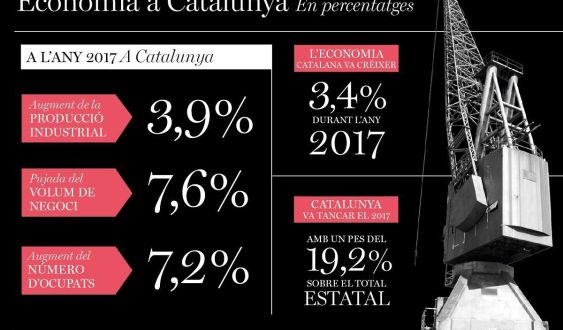
The Catalan economy grew by 3.4% in 2017 according to estimates from the Catalan government and the Statistical Institute of Catalonia (Idescat), and by 3.3% according to national accounting data from the National Institute of Statistics (INE). In any case, and despite fears due to political uncertainty, Catalonia closed an exceptionally good year, with growth above the Spanish average (and a relative weight of 19.2% of the total state), and also exceeding the eurozone average by one point. This growth adds to those registered in 2016 and 2015 (3.5%) and consolidates a recovery in activity that began to emerge in 2014, when a GDP increase of 2.3% was recorded. The strong performance of tourism, the recovery of the construction sector, and the relative improvement in domestic demand are some of the factors that help explain this growth story, but undoubtedly the true key to this momentum lies in industry and exports.
The GVA (Gross Value Added) of the industrial sector accelerated last year, reaching 4.8% year-on-year in the fourth quarter and closing 2017 as a whole at 3.7%. Industrial production increased by 3.9%, turnover by 7.6%, and the number of employed by 7.2%. These figures are slightly more modest than those of 2016 but highlight the strength of a key sector in emerging from the crisis. In fact, industrial exports were one of the few lights that helped compensate for the almost absolute darkness generated in the worst years of the crisis by the shutdown of domestic demand. It was precisely this internationalization that prevented industrial production from plummeting, and when domestic consumption began to reactivate in 2014, this production was further strengthened. It is true that industrial GVA has not yet recovered pre-crisis volumes – the declines in 2009 and 2010 were very sharp – but no one doubts that it is this industrial base that has allowed Catalonia to anticipate the economic recovery compared to the average pace in the rest of Spain.
Industry in Catalonia has also distinguished itself in relation to its economic environment. Between 2014 and 2016, the growth in value added of Catalan industry was 1.8 percentage points higher than that of the eurozone.
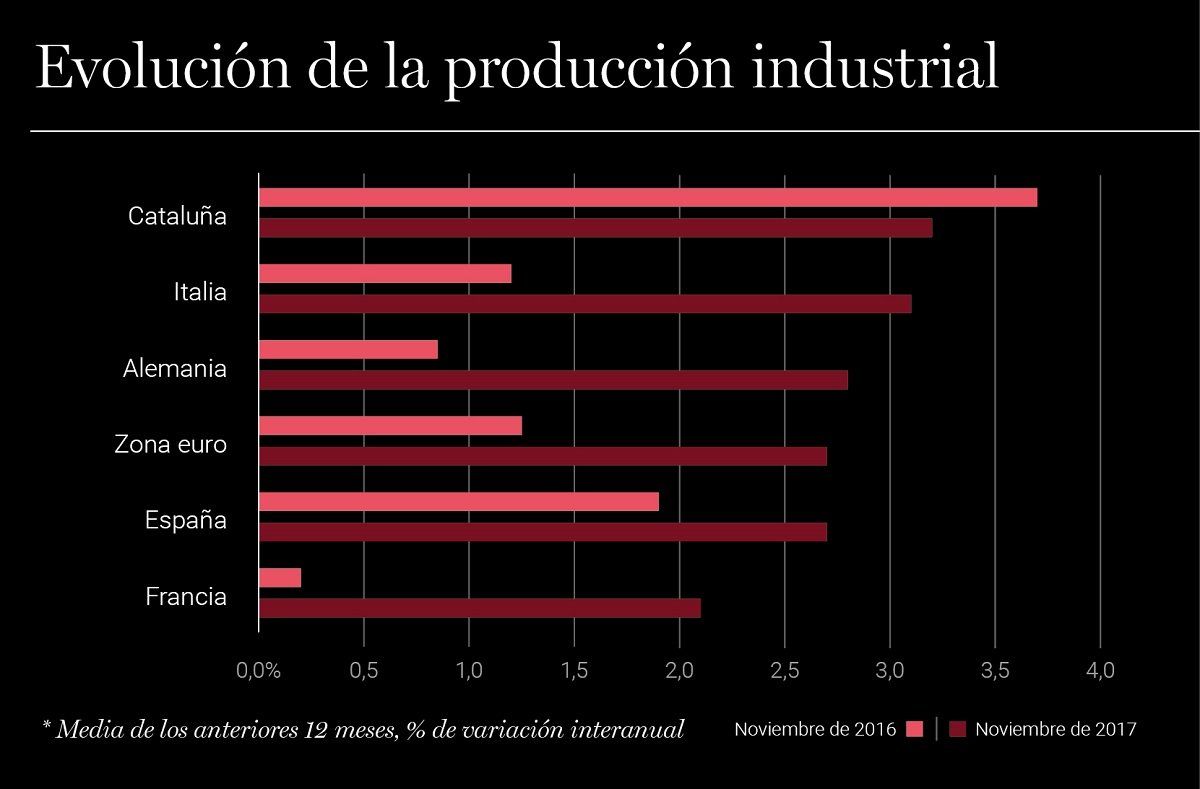
This prominent role has allowed the industry to once again puff out its chest and reclaim its role as an economic engine. It hasn't always been this way. During the years of economic boom and the real estate sector's explosion, industry became a secondary sector. The weight of industrial GDP on total GDP went from exceeding 25% in 2000 to around 17% a decade later. This is not surprising if one considers that while the Catalan economy grew at cruising speed during the first years of the new century, industry maintained rather modest rhythms, nothing like the explosion recorded by construction and services. Most municipalities fought to attract real estate or logistics investment projects, but it seemed no mayor wanted to be photographed inaugurating a factory.
The role of the ugly duckling had been building for years, well into the beginning of the last decade. The turn of the century was accompanied by massive announcements of delocalizations – especially in consumer electronics and other labor-intensive subsectors – which generated the feeling that industry was exhausted and that other more friendly, less polluting sectors with more immediate results (and why not say it, with much juicier margins) had to be prioritized. Manufacturing seemed to be only for Asian and Eastern European countries, with cheaper labor, and while industry entered an apparent decline, other activities took over as the engine of the economy.
But the tables have turned again. With the bursting of the real estate bubble, bricks went from being highly desired to being little less than the devil, and industry re-emerged as a sector that could generate employment, and that was internationalized enough to keep going with foreign demand without depending on domestic consumers. Recent years have served to confirm this thesis, because beyond powerful tourism, industry and its exports have been the oxygen balloon for the Catalan economy, and what has made the activity of the port of Barcelona grow to record figures.
This does not mean, however, that the manufacturing sector does not present challenges, and some very important ones, for the future. To begin with, it will be necessary to see how the impulse action from the administration materializes. After the effective Tripartite Strategic Agreement and campaigns to "clean up" the sector's image by emphasizing the white-coat industry, the previous government, together with social agents, pushed forward the National Pact for Industry with a budget of 1.800 million euros until 2020. The political situation and the lack of government, however, do not bode well for an easy deployment. On the other hand, the industry faces the challenge of truly making Dual Vocational Training work, essential for generating profiles of qualified workers. The sector also has the challenge of assuming high energy costs, which reduce competitiveness compared to the competition in Europe. But industrial activity also has the challenge of facing a true revolution with the incorporation of robotization and the so-called Industry 4.0, and in an improvement of its productivity. There are many pending tasks that will undoubtedly mark the most immediate future of the sector, but what seems to no longer be in doubt – we will see how long it lasts – is that industry is and must continue to be an engine of growth.
Add The New Barcelona Post as your preferred Google source for free
Stay informed with the latest news.