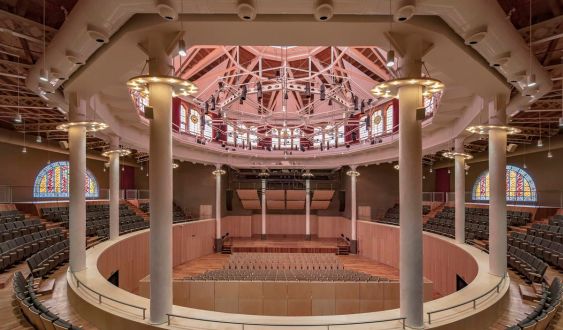
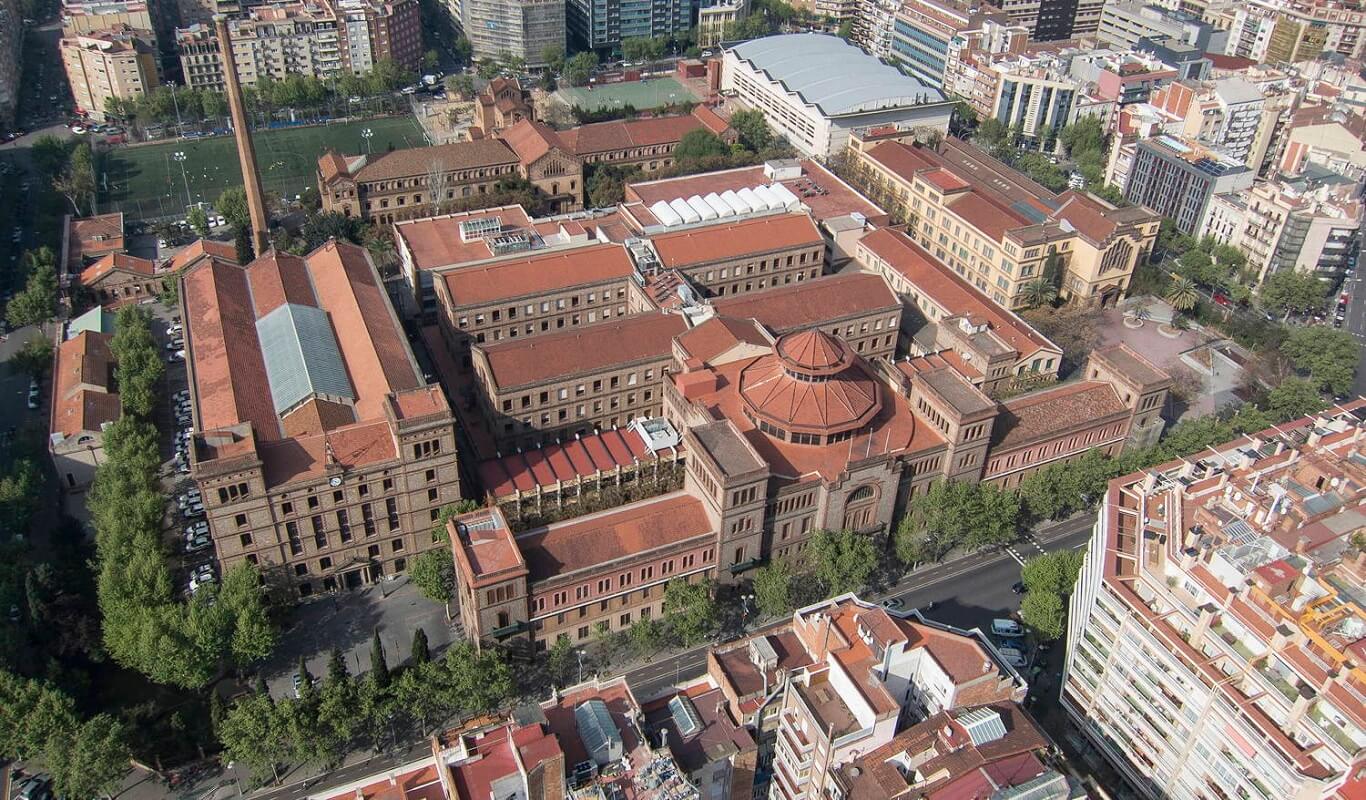
There are works that are hard to finish, and Barcelona has quite a bit of experience with that. The Industrial School has just opened an incomplete part of the complex, located in the central building, which is accessed via Urgell street. This building began construction in 1926, but the economic crisis and the change of political regime with the end of Primo de Rivera's dictatorship left unfinished the space beneath the dome that crowns the facade and was meant to become the paraninfo ---academic assembly hall--- of the educational institution. Ninety years later, the works have concluded, allowing the space to be set up as a multipurpose hall with capacity for 600 people, where congresses, concerts, plays, fashion shows can be held... Many possible options that will allow Barcelona residents to discover this new space in the city.
The reactivation of the works in the paraninfo occurred in 2017 and the work extended until 2020. The Barcelona Provincial Council has been in charge of directing the conditioning of this space, which has involved an investment of eight million euros. The supramunicipal institution has owned the Industrial School since the early 20th century, where it wanted to create a technical education center. Previously, it had been a textile factory, owned by the Batlló i Batlló brothers. The complex was inaugurated in 1870, but had a short factory life, ceasing operations in 1889.
Despite this, the Industrial School stood out early on for its architectural value, which has become one of the city's emblems. Behind the construction of the Batlló factory is the prestigious Valencian architect Rafael Guastavino, who achieved success when he emigrated to the United States thanks to the popularity acquired by one of his main elements, a brick vault that incorporates iron and cement. In the US, he was responsible for the vaults of Grand Central Station and the Queensboro Bridge in New York.
Guastavino's style was respected in the central building of the Industrial School, that of the assembly hall, which was not part of the original factory structure and began to be built in 1926, when the imminent International Exhibition of 1929 caused a construction fever in the city. Joan Rubió i Bellver imitated the stone and brick textures found in another building on the premises, that of the Clock. The architect designed an entrance crowned with a dome, which was to be the roof of the assembly hall. The works on the facade and the entrance were finished, but the same did not happen with those of the assembly hall.
Until the Barcelona Provincial Council decided to condition this space between the entrance and the dome of the central building, what was to be the assembly hall had been forgotten and it is only remembered that it served the army to store material for university militias, a modality that allowed university students to combine their studies with military service.
Already renovated, the first use of the assembly hall has been the first in-person plenary session of the Barcelona Provincial Council since February 2020, which took place this Thursday. Traditionally, they are held at the main headquarters of the organization, the Can Serra building, located on Rambla Catalunya. But the pandemic has made the space unviable, as it does not allow for guaranteeing the necessary safety distances.
Second local resilience plan
In the plenary session of the Barcelona Provincial Council, a local resilience plan has been unanimously approved, endowed with 50 million euros, which is intended to economically reactivate the municipalities of the province after the impact of the coronavirus crisis. This plan is the second part of the one approved by the organization in May 2020, with a budget of 100 million euros and which has already been executed almost 100%.
Unlike the first, focused on addressing the emergency, the new shock plan aims to promote sustainable local development and address new needs that have arisen with the pandemic, such as digitalization, as explained by the president of the Barcelona Provincial Council, Núria Marín. It will adapt to the needs of each municipality and is expected to have immediate application, with the aim that the actions financed will be completed next year. Likewise, an increase in the budget in the coming months is not ruled out, depending on the needs of the city councils.
Add The New Barcelona Post as your preferred Google source for free
Stay informed with the latest news.
