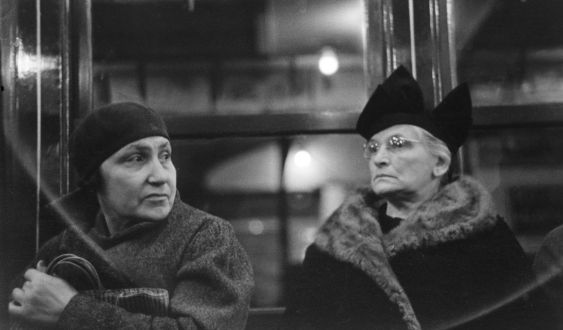
Walker Evans did not simply photograph the reality of his time: he captured the illusion that reality can be shown without mediation. Perhaps that is why he has gone down in history as one of the great documentarians of the 20th century. However, it is precisely the aspiration to neutrality that makes his work something more complex and valuable, also timeless. Evans looks as if he is not intervening, as if the camera were only a mirror that allows nature itself to manifest, without artifice or grandiloquence: a pure showing of what is there.
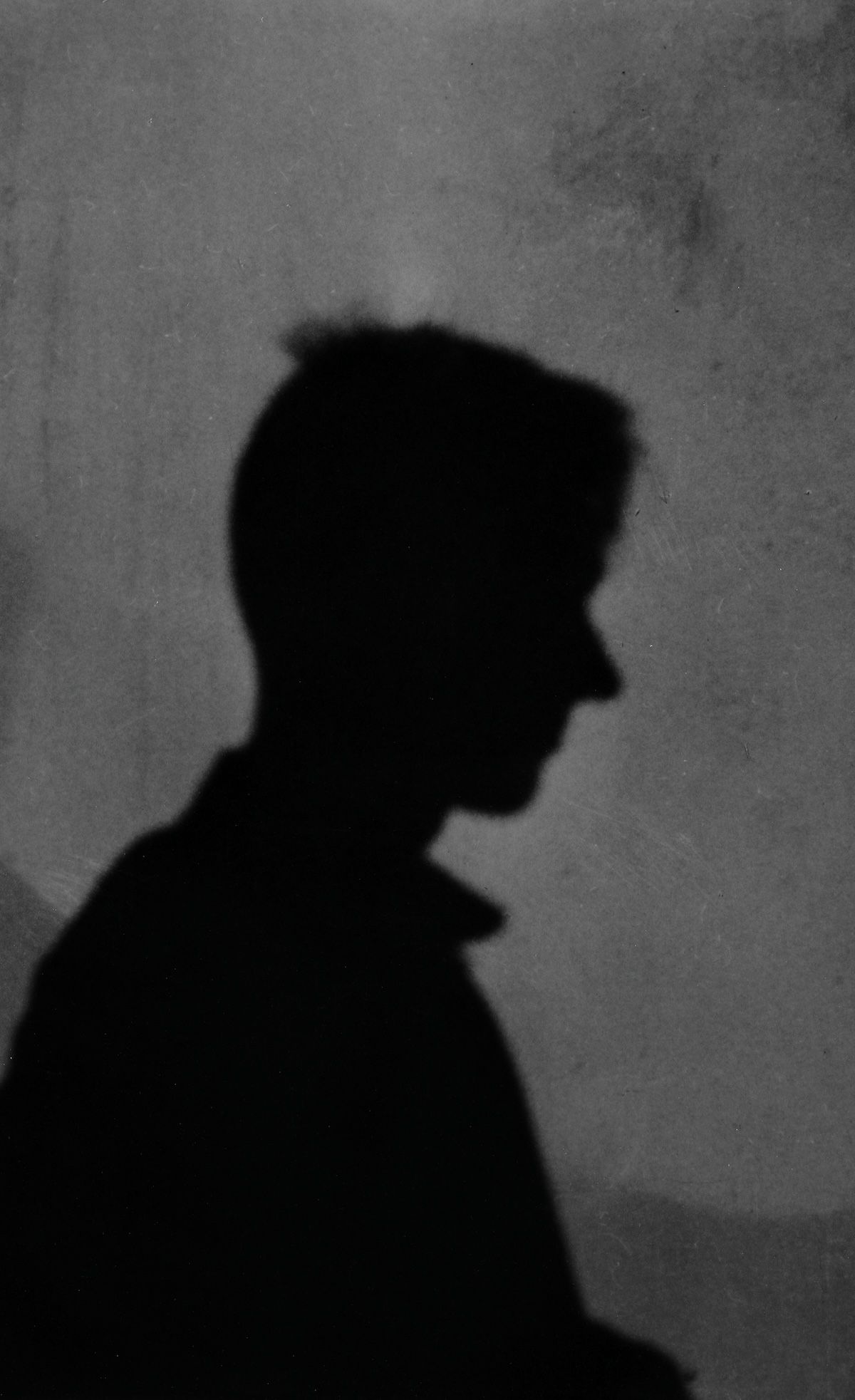
It so happens that the observer is necessarily included in his image, forming part of the whole he represents. But the eye or lens that captures reality tends not to see itself looking at it. Exceptionally, in his first photographs ---when he was in France---, we discover a young Evans portraying his own fixation on reality, as protagonist and artificer. From the shadow of himself emanates a positive truth; even if he did not know, yet, that this action would transmute into a profession.
The images gathered in the retrospective that the KBr in Barcelona offers until May 24 focus on the 1930s and 1940s, a period in which Walker Evans took his most iconic snapshots. Images that insist on that apparent transparency, on the disappearance of the medium that allows registering what exists. Sober black and white frames, in which nothing seems forced. With punctual exceptions -his images of Cuba under American rule, for example- the camera does not stumble upon reality or provoke it. At most, the viewer can ask, "what is the point of representing this?" Which is not a minor or indifferent question, quite the opposite: the withdrawal of his subjectivity is consolidated as a characteristically magnetic presence. "Stare. It's the way to educate the eye, and something more. Stare, pry, listen, eavesdrop. Die knowing something. You are not here long," Evans suggested. What we contemplate in his photographs ---objects, people or signs with indications--- only mean something to those who accept the challenge of also considering their possible insignificance.
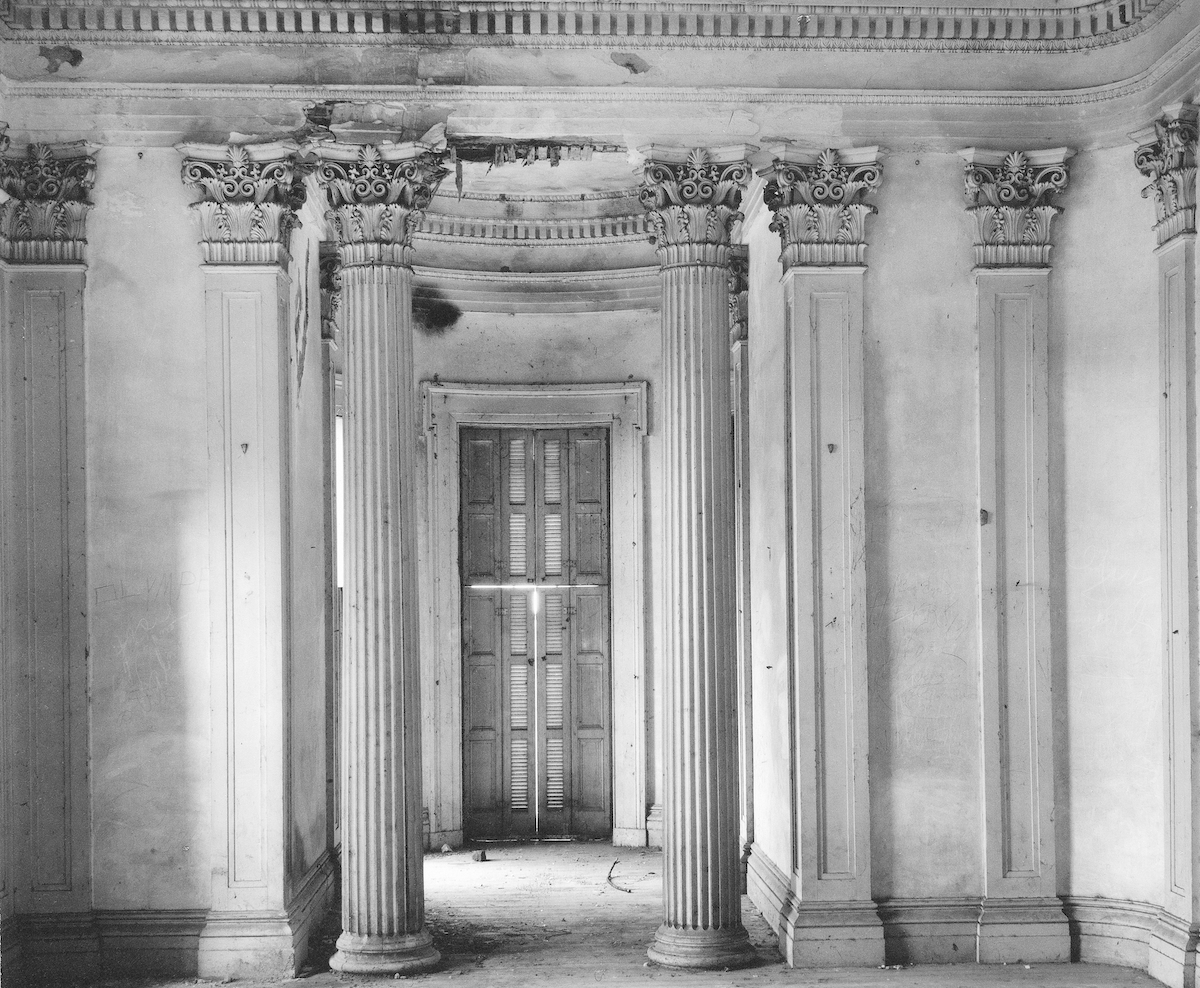
"There are no manifest hierarchies in Evans's work: a face, a wall, a shop window or an abandoned object share dignity"It is enough to recall the famous portraits that Evans captured incognito in the New York subway: exposed in striking anonymity, individuals emerge through a perfectly imperfect frame, which reveals the spontaneous character of the pose. We also think of the freshness testified by the geometries of the buildings, first in New York and later Chicago. In apparently prosperous neighborhoods and in others that do not seem so much, with futuristic architectures for the time or anchored in a tradition already ancestral then.
The truth is that there are no manifest hierarchies in Evans's work: a face, a wall, a shop window, or an abandoned object share dignity. The layout of a city, chaotic or orderly, vibrates with the same reality as a person's expression. A car, a sign, a remnant of "something" on the ground… everything is part of the same fabric. More than being portrayed, these things are intuited as destined to exist to return our gaze sotto voce, instigating our inalienable capacity for representation.
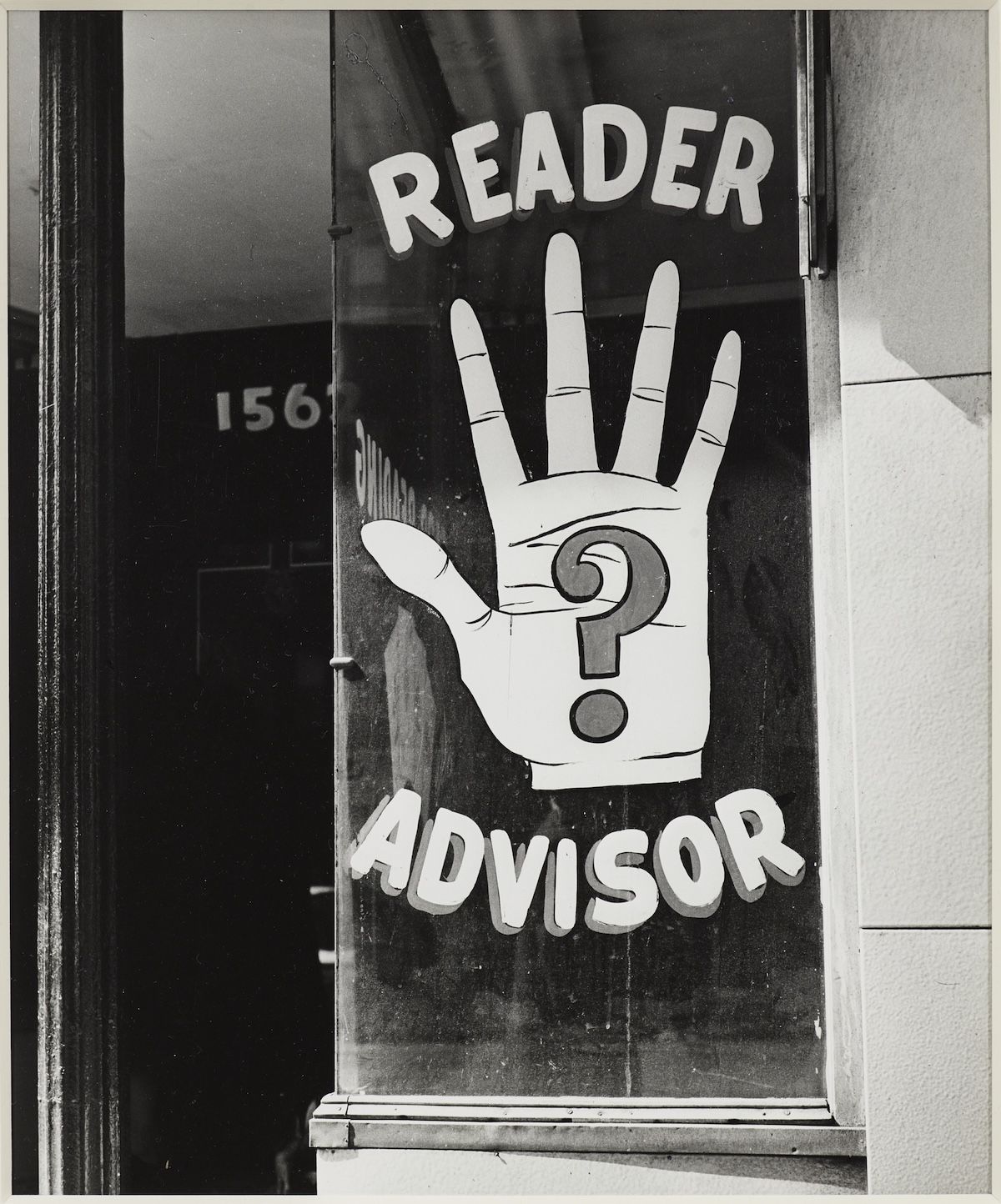
Here shines one of the most subtle operations of Walker Evans's proposal ---one that does not seem to distinguish pure showing from artificial simulation---, and which we cannot help but compare to the functioning of the human mind, responsible for the constitution of reality from images. Something that Nicholas of Cusa intuited in the 16th century using the notion of coniecturae and which, by completely different means, neuroscience has confirmed in recent decades. It is synthesized in the algorithmic dictum that warns of the unconsciously performed daily projection: we do not see what is there, but we see what we are. That is why the photograph chosen for the catalog cover ---the advertisement "Reader advisor", which displays a large question mark in the palm of an open hand--- seems so eloquent, as does the exhibition's title itself, Now and Then. Photographs do not tell stories in a conventional sense. There is no explicit narrative and, yet, each image seems charged with narration: something has happened before, something will happen after… but off-screen.
The viewer completes that void in the present -with their presence- reconstructing or interpreting what is not shown. In that gesture lies the validity of Evans. His photographs are not just documents of a world that was already past in his time, in an archaeological sense, but ---precisely because of that invitation to timelessness--- they configure a kind of genealogy of attention, which suggests the viewer's exercise.
Perhaps its most uncomfortable relevance lies in reminding us that there is no innocent image, nor one that is significant on its own; that every image not only requires an interpretation, but presupposes it. The gaze seeks and finds, in order to, by occupying itself with something it identifies and believes it knows, ratify the existence of the one who looks. In a context saturated with images like ours, Evans's work acquires renewed interest. More than evoking a lost purity ---a tempting, but too easy, nostalgia---, it reveals a still active mechanism.
"A kaleidoscopic accumulation of narcotizing simulacra blurs, nowadays, the boundary between the dream world and wakefulness"Today we use images to fix experience or awaken wonder; also, of course, to validate ourselves by circulating them within the framework of compulsive consumption, which very conveniently replaces reality, as ----on the other hand, from literature--- Cervantes or Flaubert already taught us. The difference is not in the genetic impulse, but in speed and scale. If Evans slows down the gaze, enigmatically dislocates space-time, we accelerate it much more unconsciously ---and generally scarcely artistically--- with a swipe.
His photographs seem to suspend time, ours fragment it into the infinite continuum of reels or stories: a kaleidoscopic accumulation of narcotizing simulacra, blurring the line between the dream world and wakefulness, unfolding from (and at the service of) the instinctive. The same false-paradox persists: the more we rely on the image as direct access to reality, the more we depend on the mediations that make it possible, and which we almost never control. Evidently, we also cannot completely do without the image, because it constitutes our reality, and the "absence of world" is not easy to bear, except in meditative states.
At the same time, the torrent of representations today is of such magnitude that those true "states of exception" are posed as refuges for mental and emotional health, insofar as they safeguard our ability to fix attention. Guy Debord's old diagnosis is more pertinent than ever, regarding the situation of the individual entertained in the consumption of simulacra that he naively believes to be of his own choosing: "the more he accepts to recognize himself in the dominant images of need, the less he understands his own existence and his own desire." Even more directly: "insofar as his life is now his product, the more separated he is from his life" remaining subject to the consumption of others, for the benefit of others. An alienation that is relieved with more simulacra, avoiding all friction with the present thanks to virtual pastimes. Quite the contrary, and happily, Evans' images incite contemplation, leading us back to the time of presence. The place where life beats, and the enigma endures.
Add The New Barcelona Post as your preferred Google source for free
Stay informed with the latest news.