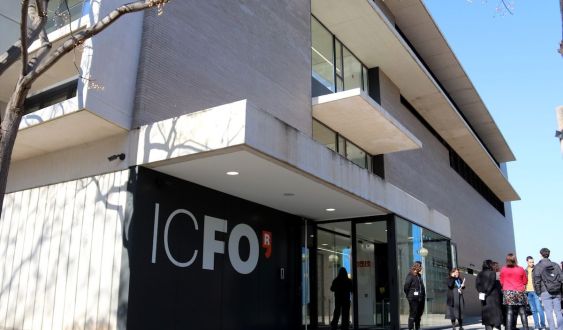
The Institute of Photonic Sciences (ICFO) raises its hand. Since its birth on the Campus Nord of the Polytechnic University of Catalonia (UPC) in 2002, the center has been gaining ground, with its relocation a few years later to Castelldefels, where it has carved out a niche in the Mediterranean Technology Park. Now, as the complex scientific research carried out within its four walls gains prominence, it is preparing to make a leap in scale with more square meters dedicated to research.
The first piece was unveiled this Wednesday with the inauguration of a second building for ICFO, a few steps from its current headquarters. The new facilities feature cutting-edge photonics laboratories, with an area of 4,400 square meters spread over four floors. Operational since last autumn, the building has involved an investment of 15 million euros.
ICFO's history is linked to Castelldefels, as its mayor, Manuel Reyes, recalled at the inauguration ceremony, but also, and above all, to a specific name. Without forgetting its founder and main promoter, researcher Lluís Torner, the institute also owes much to the late Dr. Pere Mir Puig, founder of the Cellex and Mir-Puig foundations, responsible for the two homes of the research center. The Cellex-Nest building, where ICFO has been located since 2012, with an area of 14,000 square meters, was paid for by the Cellex Foundation, while the one that has just been inaugurated was funded by the Mir-Puig Foundation.
The contributions made by both foundations over the years total some 40 million euros. According to ICFO, this figure makes it the largest philanthropic donation to science made in Spain. "It is a luxury for a country to have people who know how to create prosperity by building profitable companies and want it to revert to society. This does not happen every day," remarked the President of the Generalitat, Salvador Illa.
On the first floor of the new building, there is a cleanroom that updates the only one ICFO had until now, built in 2004 and which had become obsolete. With 600 square meters, it represents a key equipment to advance European sovereignty in the field of photonic chips. In fact, thanks to it, ICFO has been chosen by the European Commission to coordinate the PIXEurope project, a pilot line to design and manufacture photonic chips, used in phones and computers, but also in sectors such as health and automotive.
China, Taiwan, and Korea lead this market, with Europe only making prototypes on a very small scale. The PIXEurope project will serve to advance in that direction, with a budget of about 400 million euros, of which about 50 million will be for the Castelldefels institute. In the rest of the floors of the new building, there are laboratories and offices. Specifically, a cutting-edge quantum computer is available that allows exploring properties of quantum materials.
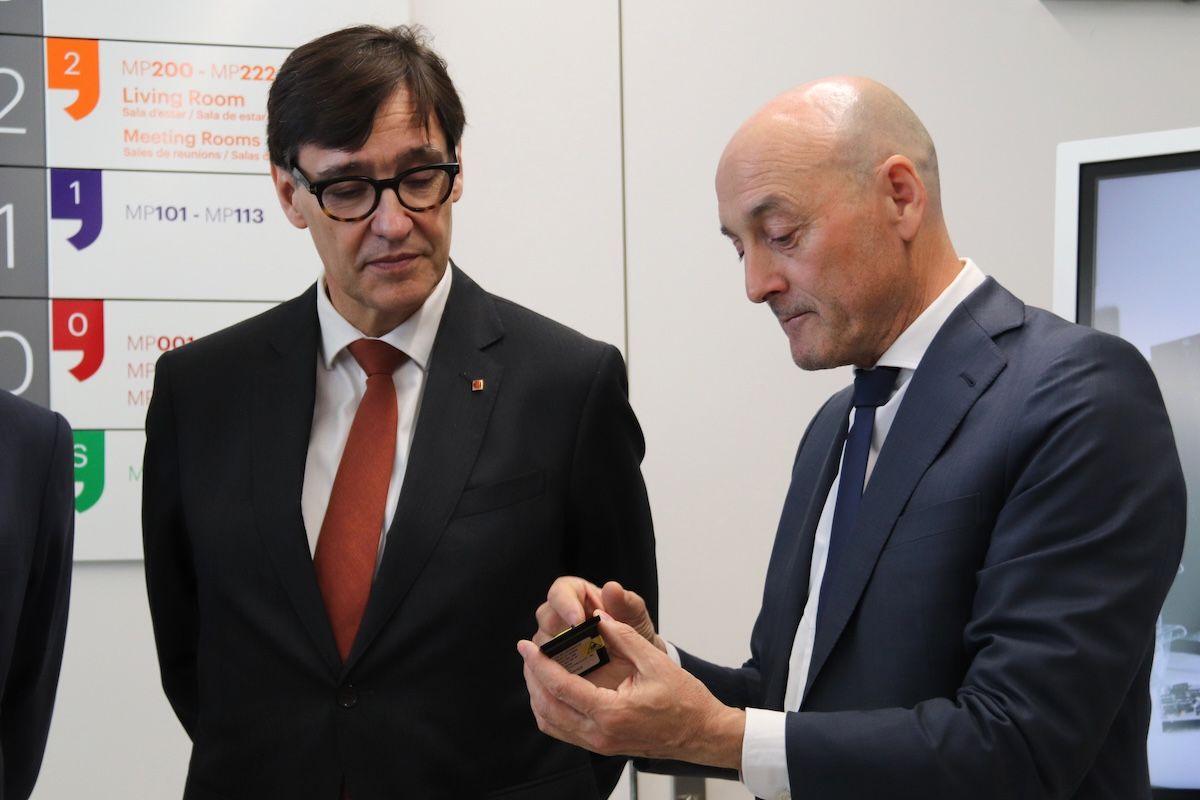
The Mir-Puig building will not mean more hirings, but rather a qualitative leap in the research carried out by the institute, as highlighted by its founder and former director, Lluís Torné. A few months ago, Oriol Romero-Isart replaced him in the position. Currently, ICFO's staff stands at 500 workers, of whom 150 are doctoral students.
But this is not the only pending piece that ICFO has in hand. At the beginning of 2023, a new window of opportunity opened for the research center with the concentration in 22@ of the Universitat Oberta de Catalunya (UOC). This movement left free a building that the university occupied in the Mediterranean Technology Park of Castelldefels, which passed into the hands of ICFO after an agreement with the Generalitat and the Barcelona City Council. Although years have passed, this expansion project has not yet materialized, due to a lack of sufficient resources to adapt the building into laboratories. With 3,500 square meters, it will mean reaching a total area of more than 21,000 square meters for ICFO when it becomes a reality.
Add The New Barcelona Post as your preferred Google source for free
Stay informed with the latest news.
