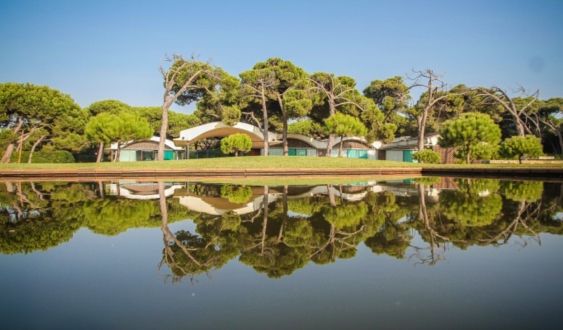
The Generalitat has agreed to declare Casa Gomis, better known as La Ricarda and located in the Llobregat Delta, a Bé Cultural d'Interès Nacional, in the category of Historic Monument. The declaration also delimits its protection area and includes several original pieces of furniture that are part of the monument, which is privately owned and located in the municipality of El Prat de Llobregat, right next to Barcelona Airport.
Casa Gomis was designed by the architect Antoni Bonet and is considered one of the seminal works of modern architecture. It was built in 1957 at the request of the Gomis-Bertran family on a large estate located by the sea, in the middle of a pine forest, now urbanistically protected by the Natura 2000 Network of Special Protection Natural Areas.
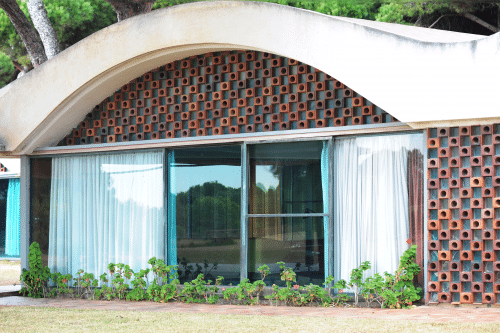
The most relevant element that identifies La Ricarda is its large vaulted roof, a form that represents a modern reinterpretation of the historic and traditional Catalan vault. "The architecture of Casa Gomis links with the foundations and rationalist European principles, both from a constructive point of view and for its spatial configuration, with a conception of fluidity and interior dynamism characteristic of the values of the modern movement," states the Generalitat.
Antoni Bonet was a member of the Group of Architects and Technicians for the Progress of Contemporary Architecture (GATPAC) and a collaborator of the Sert and Torres Clavé studio. The architect, who worked for a time in Le Corbusier's studio in Paris, designed La Ricarda between 1949 and 1956, when he still resided and worked in Buenos Aires, in close collaboration with the owners of the estate, Ricardo Gomis and his wife Inés Bertrand. Before doing this work, Bonet had already applied his reinterpretation of the Catalan vault in the so-called Casa Berlingieri, in Punta Ballena, Uruguay.
Single-story and horizontally structured, Casa Gomis was conceived as a family summer home, located by the sea, and surrounded by pine trees a few kilometers from Barcelona. It consists of several pavilions connected to each other, yet independent, with undulating roofs, brick partitions that provide thermal insulation, and earth-colored ceramic pieces. The rationalist architectural complex is completely open-plan and intimately linked to the landscaped outdoor spaces. "At all times, a visual relationship with the exterior is established, in such a way that the landscape, light, and Mediterranean color invade and are present in the interior, forming an indissoluble part of the architecture," explains the Govern in its declaration of Cultural Asset of National Interest.
About 40 meters from the building is the water tower, also designed by Antoni Bonet as a 15-meter high water tank, which acts as a vertical counterpoint to the horizontality of the house. This element has also been included as a historical monument.
The La Ricarda estate, which takes its name from a lagoon of high ecological value, was acquired in 1895 by the textile industrialist Manuel Bertrand and today remains in the hands of the descendants of various branches of this family. During the Franco regime, the house became a refuge for intellectuals, such as Antoni Tàpies, Joan Miró, Joan Brossa, and John Cage. Among many others, they founded Club49, of which Ricardo Gomis was also a member, with the intention of recovering the artistic avant-garde born during the Republic and interrupted by the Civil War.
The Prat de Llobregat City Council periodically organizes guided tours of Casa Gomis. The next one is scheduled for April 17 and also includes an appetizer (25 euros) or a meal (34 euros) made with local gastronomic products.
Add The New Barcelona Post as your preferred Google source for free
Stay informed with the latest news.
