
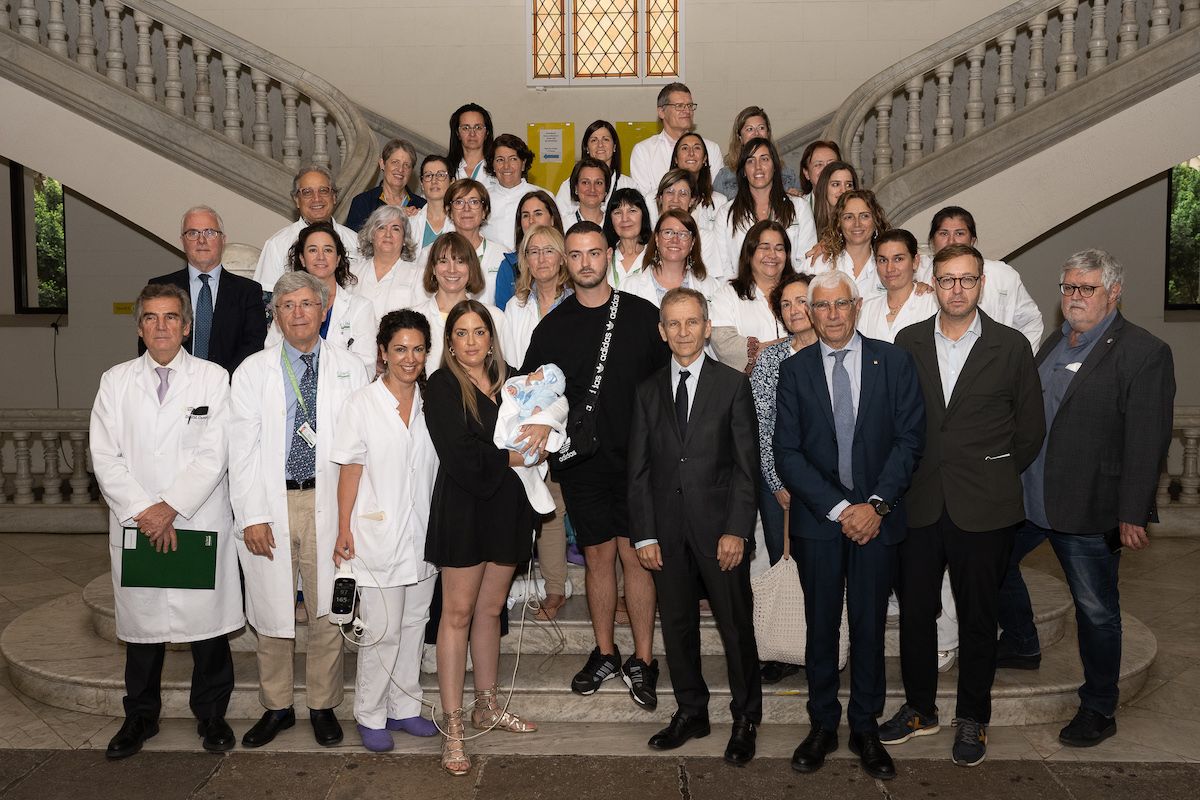
Tamara Franco has given birth to the first baby born in Spain after a uterus transplant. Since she was very young, she had wanted to be a mother, but, at 15, she learned that she couldn't be. "It was a strong blow," recalls the 34-year-old patient. Franco has Rokitansky syndrome, a congenital disorder of the female reproductive system that affects 1 in 5,000 women worldwide. These women are born without a uterus, so they do not have periods and cannot get pregnant.
Franco's journey began in 2015, when she decided she wanted to get pregnant. She and her partner went to public health services in Murcia and Valencia, where they found no solution, so they contacted Hospital Clínic, sending an email to Dr. Francisco Carmona, head of the Gynecology service. The next day, they received a response and began a long and complicated process, passing all necessary tests and receiving approval from various ethics committees, taking into account that it is an experimental surgery, very complex and not without risks. With the patient's sister willing to donate her uterus, the transplant, the first in Spain, was finally performed at the public center in Barcelona in October 2020, lasting a total of 20 hours.
Two months after the transplant, the patient had her first period, which the doctors point out was the first sign of the intervention's success. Franco underwent assisted reproduction treatment and managed to get pregnant on the second attempt, but had a miscarriage at eight weeks. With the pandemic complicating an already difficult process, on the third embryo transfer, the young woman became pregnant with little Jesús, who was born on March 10.
The delivery had to be brought forward because Franco had preeclampsia, a complication that can be associated with fetal growth below what is expected, explains Dr. Figueras, head of the Maternal-Fetal Medicine service at Hospital Clínic. Once the condition was diagnosed, detected when a pregnant woman has high blood pressure, it was decided to schedule a C-section in the 30th week of gestation, performed without any complications, and the baby was born weighing 1,125 grams with correct lung maturation and neurological protection.
After two and a half months admitted to the Maternity ward, Jesús now weighs 3,210 kilos, a weight considered optimal for a 40-week baby, and will go home this Monday, the day Franco would have been due. Her mother, once her wish was fulfilled, had her uterus removed, thus avoiding having to continue with the immunosuppressant treatment that any transplant patient must follow to avoid organ rejection.
Jesús is one of 50 children born worldwide after a uterus transplant, an operation that has been performed a hundred times. According to Carmona, the surgery tested at Clínic can only be performed in about ten hospitals worldwide. "It has allowed us to position ourselves in the world's first division and allows us to work with a very important future dimension," he remarks, opening the door to applying the successfully tested technique in women with absolute uterine factor, that is, those whose uterus does not function well because they have suffered an illness or have some malformation.
"Today is a day of celebration that highlights our healthcare system and our hospital, which tries to be pioneering and innovative," adds its general director, Dr. Josep Maria Campistol. According to Carmona, more than 100 women have contacted the Barcelona center to undergo a uterus transplant in recent years. In addition to Franco, another patient has been transplanted. Currently, two more are under study.
Add The New Barcelona Post as your preferred Google source for free
Stay informed with the latest news.
