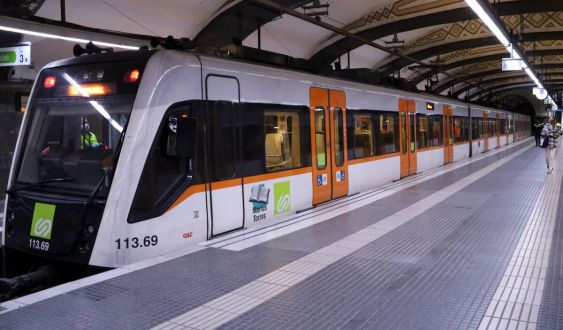
The Vallès line of Ferrocarrils de la Generalitat de Catalunya (FGC) gains capacity and begins to operate like a metro, with frequencies ranging from two and a half minutes to five minutes during peak hours. The improvement in the service connecting Barcelona with Sant Cugat del Vallès, Terrassa, and Sabadell comes after an investment of 120.4 million euros, which has been used to acquire new trains and adapt the infrastructure. All of this is to increase capacity to up to 110 million annual trips, 37.5% more than currently.
As of this Friday, between Plaza Catalunya and Sant Cugat stations, trains run every two and a half minutes during peak hours, from seven-thirty to nine-thirty in the morning. From Sabadell and Terrassa, the two branches that depart from Sant Cugat, there is a new train every five minutes, double the number of circulations there were until now. With the new frequencies, the screens on the platforms no longer show what time the next train arrives and instead indicate the minutes remaining, as is done on the metro. The rest of the day, the frequency of passage increases to five minutes from Sant Cugat and ten minutes from Sabadell and Terrassa, with reinforcements to reduce waiting times in the afternoon, between five and eight from Monday to Thursday and between three and eight on Fridays.
The new Vallès line service also means the loss of lines S5 Sant Cugat, S6 Universitat Autònoma, and S7 Rubí, which become trains of lines S2 Sabadell and S1 Terrassa. This also implies that all trains always stop at all stations, as happens on the metro. Until now, the different lines skipped some stops, which allowed for a faster journey. According to the company, users who make the journey from start to finish will see an additional three to four minutes added. Likewise, line L7 maintains its current route from Avenida Tibidabo to Plaza Catalunya. L6 and L12 also remain the same, up to Sarrià and Reina Elisenda.
The investment of more than 120 million to bring the Vallès line to maximum capacity is concentrated, with 99.5 million euros, on the purchase of 15 new trains, which has allowed the total fleet to grow to 61 units. Manufactured by Stadler in Valencia, the trains are characterized by being made up of four cars and having a capacity of up to 580 users, with almost 200 seats.
Regarding the infrastructure works, the Plaza Catalunya station has been remodeled, lengthening the tracks, redesigning the accesses and expanding the lobbies, and the Sarrià station, with the removal of one of the four tracks to achieve a wider central platform. The FGC workshop in Rubí has also been expanded to guarantee the maintenance of the entire new fleet, with almost 2,000 more meters, and the capacity of the Sant Cugat junction has been increased, now allowing 48 circulations per hour.
Add The New Barcelona Post as your preferred Google source for free
Stay informed with the latest news.
