Just before entering the first room of the exhibition, a Carles Porta projected on the wall warns us that "everything we will see is real" and that "reality and death do not understand sensitivities." These are the same phrases that, accompanied by aerial shots of Barcelona from a drone's view and dramatic music, precede each of the television chapters of Crims. An American-style introduction, ideal for starting to darken the atmosphere. A prologue that condenses in a few seconds the impeccable production level of the true crime that has conquered the homes of Catalonia.
Crims, a program that Catalunya Radio premiered in 2019 and became a mass phenomenon thanks to the television adaptation broadcast by TV3 (and the subsequent Spanish version broadcast by Movistar +, translated as Crímenes), now moves to the main floor of the Palau Robert in Barcelona, with an exhibition that aims to immerse the visitor in the gloomy atmosphere of the cases narrated in the program.
But before delving into the Crims exhibition format, how to explain the success of the television Crims, a program capable of retaining 3.6 million viewers since February 2020 and accumulating 35 million views on all digital platforms?
In Catalonia, a murder is still an exceptional event, a convulsion that comes to disturb the peaceful and predictable monotony of our lives. As much as the darkness of the Crims cases may transmit the opposite, it is worth remembering that we live in one of the regions with the lowest rate of violent crimes in the world, with a rate of 0.8 homicides per 100,000 inhabitants, which is equivalent to about 50 murders each year. To put it in perspective, in the United States this figure rises to 6.5 and in Mexico –a country that registers more than 20,000 violent deaths a year– the rate is 28.3.
Our fascination with blood could be explained by the anomalous nature of these outbreaks of violence, and perhaps also, by the suspicion, more or less unfounded, that at this precise moment, a ruthless killer may be sharpening his knife a few meters from home.
The audience records of Crims indicate that the format has managed to capitalize on the morbid curiosity aroused by the most gruesome cases of our recent history, fleeing from the formalism imposed by documentary codes to become a story for adults. Of course, based on real events.
The Palau Robert exhibition, organized by the General Directorate of Diffusion of the Generalitat and curated by Carles Ortet, has been one of the most media-hyped inaugurations of the year and will remain open to the public until April 10 of next year. The exhibition aims to be an immersive experience in which fans of the program can live a physical extension of its narrative universe, giving prominence to the three axes that sustain each chapter: criminals, investigators, and victims.
In the words of Carles Porta, who collaborated in the production of the exhibition, "There is an added value in touching, seeing and feeling things." In Crims, entertainment intertwines with the harshness of the facts and the pain of the victims. This delicate balance takes shape throughout the exhibition, where terrifying flashes coexist with pages of judicial summaries and a space dedicated to the memory of the dead. To bring the exhibition closer to all types of audiences, whether followers of the program or not, a QR code allows visitors to explore the exhibition in the style of an escape room adapted to our smartphone, replicating the clue-game structure proposed by the television format.
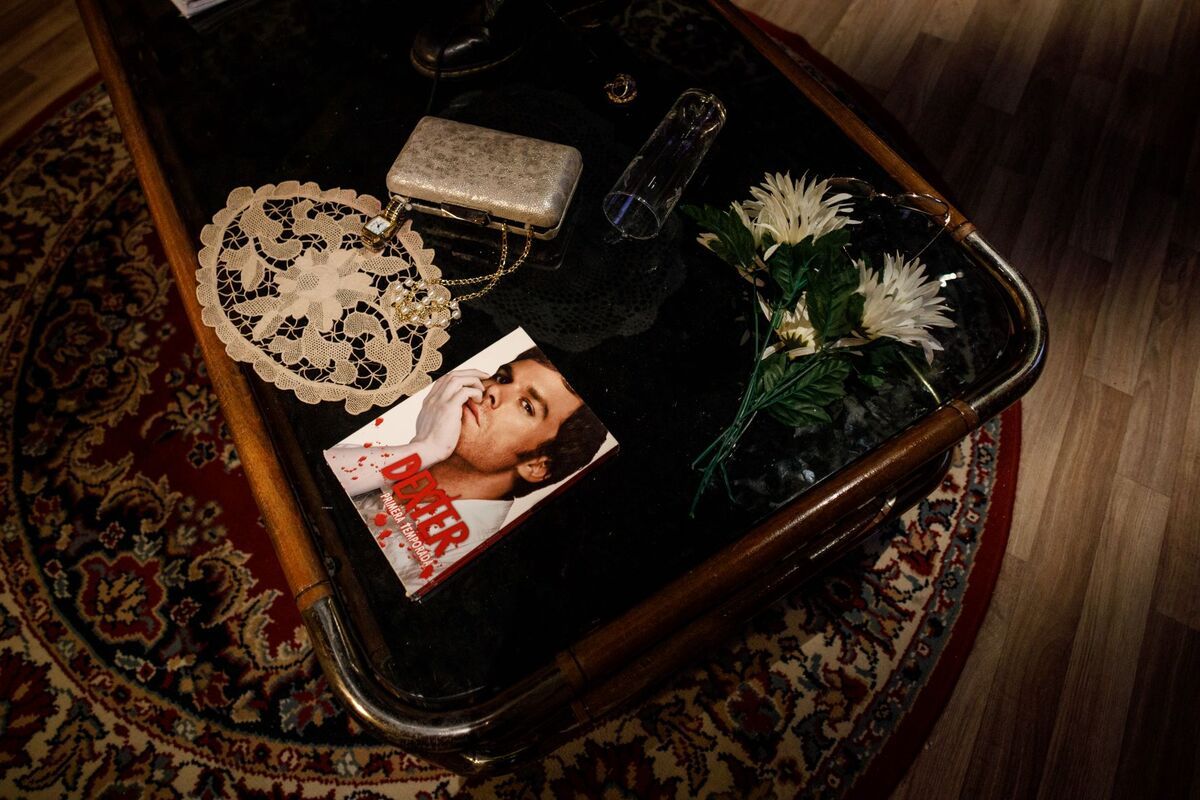
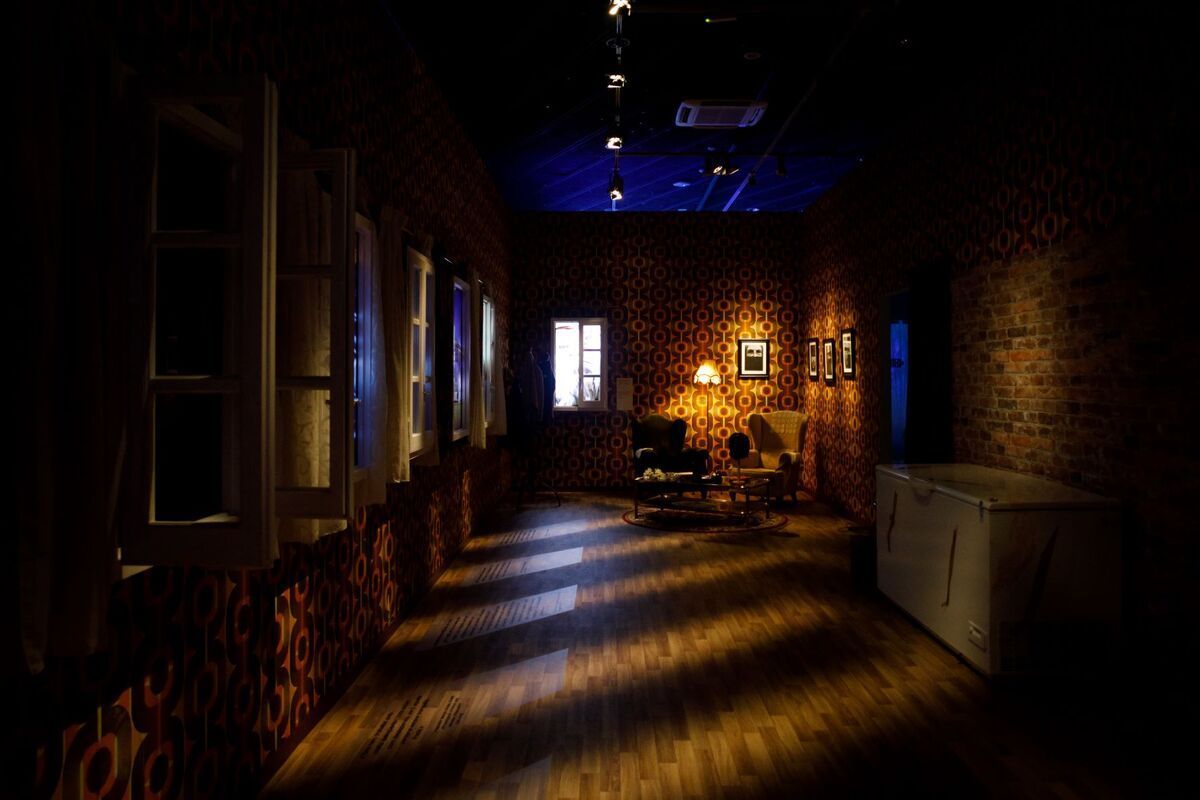
The setting of the first room of the exhibition, dedicated to criminals, connects with the aesthetic canon of Catalan horror initiated by the Hotel Krüeger of Tibidabo and refined by Jaume Balagueró with the REC saga. We find ourselves in a dilapidated apartment in the Eixample, let's say not very welcoming and furnished with symbolic elements of the program: a Dexter DVD, a freezer chest, a pearl necklace, or some dried flowers.
Having passed the most macabre room, in the next room the visitor appears projected on the wall as one of the suspects in a police lineup. The game is evident: Are murderers so different from us?
A few steps further, the most introspective corner places us at a digital sunset on the shore of a lake, where we must imagine that the souls of those who are no longer with us rest. On a wall we read that "the families of the victims do not have social support. They feel a great loneliness. We are a society that despises victims". The quote is from Carles Porta, who in another inscription vindicates the three "Rs" that govern his work and that of his team behind the cameras: Rigor, Respect, and Rhythm.

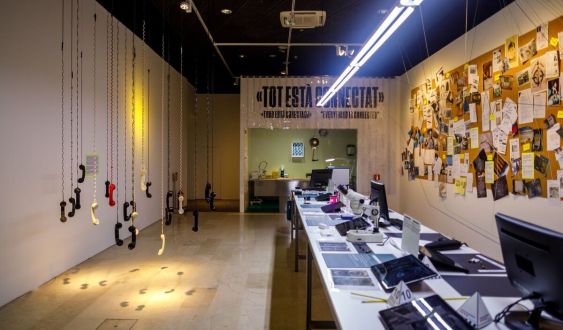
The main attraction of the exhibition is the large room that concludes the tour, where the visitor can put themselves in the shoes of forensic police, learning in detail about the technology that allows them to analyze the evidence found at the crime scene. The informative panels tell us about ballistics, dactyloscopy, composite sketches, and DNA analysis with a prose that is pure description, devoid of feelings.
On one of the walls, an immense mosaic of documents and photographs linked by causal relationship vectors confronts us with the 22 cases that Crims has brought to the screen. If we look closely, we can review the secret codes exchanged by Brito and Picastote, the anonymous letters received by Helena Jubany, the blurry images of the Putxet killer captured by an ATM camera, or fragments of the summary of the Guardia Urbana crime.
Coinciding with the premiere of the new season of Crims on TV3, the exhibition at Palau Robert offers us a good opportunity to look face to face at the true crime of our country and to confirm, once again, Carles Porta's ability to keep us hooked on his magnetic thriller.
Add The New Barcelona Post as your preferred Google source for free
Stay informed with the latest news.