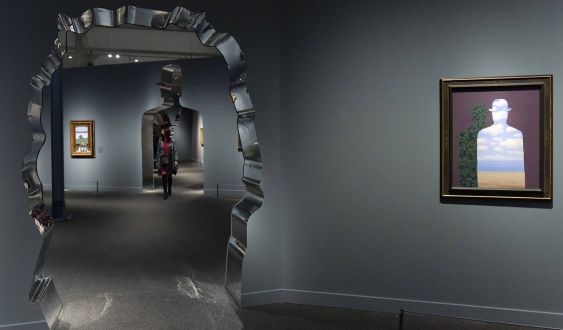
It had been a long time since René Magritte (1898-1967) and his enigmatic paradoxes had been seen in Barcelona. The Belgian artist had not starred in an exhibition in the city since 1998, when the Fundació Miró dedicated a large exhibition to him that served to make him known, being at that time a novelty for the local public. It is no coincidence that the Fundació Miró organized it, taking into account the friendship that united the two surrealist painters. They even danced tango together, says the president of the Magritte Foundation, Charly Herscovici.
CaixaForum takes over from the Fundació Miró more than two decades later with The Magritte Machine, a freer interpretation of the painter's trajectory, explains the exhibition's curator, Guillermo Solana. When his faceless faces and the pipes that are not a pipe have already traveled half the world, the La Caixa Foundation, together with the Museo Nacional Thyssen-Bornemisza, recovers this mysterious figure to delve into his recurring motifs and try to unveil a little the mysteries that surround him. A total of 69 paintings make up this retrospective, which was already presented in Madrid. The exhibition, which can be seen from this Friday until June 6, draws on works from some fifty institutions, galleries and private collectors in Europe, the United States, Canada and Japan.
The freedom with which The Magritte Machine has been conceived allows the collection not to follow a chronological order, points out the deputy general director of the La Caixa Foundation, Elisa Durán, but rather to explore the themes that obsessively and mechanically were repeated in the Belgian's work, precisely, with the intention of being able to possess a little more the enigmas he wanted to solve. "He is a methodical artist who returns again and again to a motif," adds Solana. No answer is given to the mysteries he drew, but it helps to glimpse the gears of his imagination, with variation, repetition and inversion as a way of leaving few loopholes to the unknown.
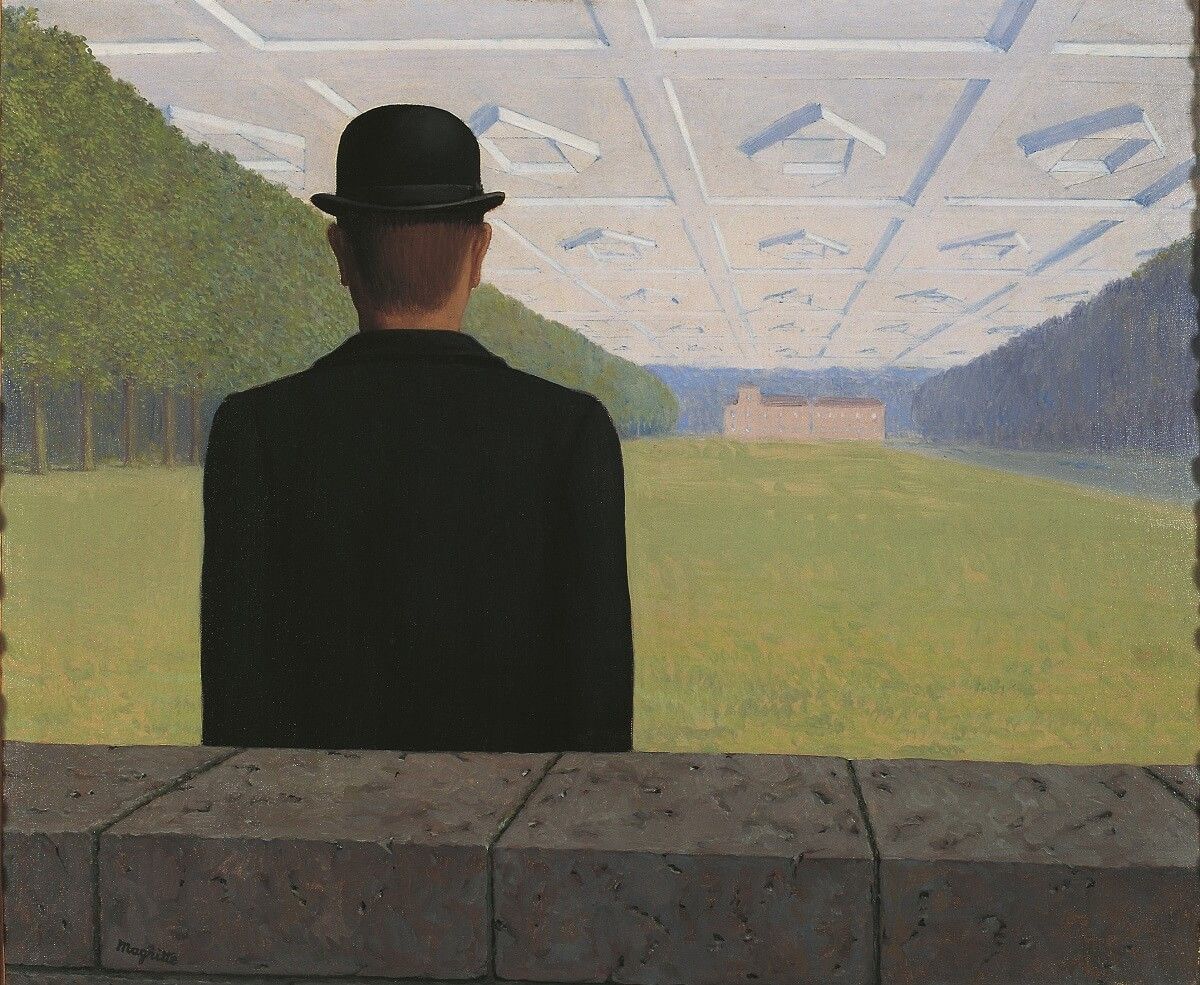
The exhibition begins with self-portraits, although one should not expect representations of what Magritte was like in the usual way. These paintings are an excuse to reflect on the creative process and the superpowers attributed to a painter, such as creating something out of nothing, always with a touch of humor.
From self-portraits, the focus shifts to words, a common resource in paintings of the era, permeating Cubist, Futurist, Dadaist, and, of course, Surrealist creations. The paintings incorporate words that combine with figurative images, with which they rarely agree. The words reject the images, which in turn do the same ---the famous Ceci n'est pas une pipe is not included in the Barcelona exhibition---. The feeling of strangeness provoked by these creations by Magritte, which had already begun with the self-portraits, intensifies. To reduce the bewilderment, the exhibition includes in this room a collection of home videos of the artist that also reveal him as a precursor of performances.
The Magritte Machine also addresses the influence that collage had on Magritte's work, even if it was not the protagonist of many of his paintings. As with the self-portraits, the collages are the least important, since what the surrealist painter wants is to try out cutting, essential for generating a large part of his images. This technique helps him to see different planes, as in Popular Panorama, in which the sea, the forest, and the city are revealed in levels, as if he had torn off successive layers of paper.
The freedom with which The Magritte Machine has been conceived allows the collection not to follow a chronological orderCropping allows you to invert concepts such as figure and ground, leaving only the outline and making the absence of the original object more evident, as inHigh society, in which two gentlemen in bowler hats have become a beach and a bush. This ends up evolving into mimicry, one of his obsessions, with birds that blend into the sky and boats that do so in the sea. Even Napoleon's funerary mask ends up camouflaging itself among the clouds and the blue sky.
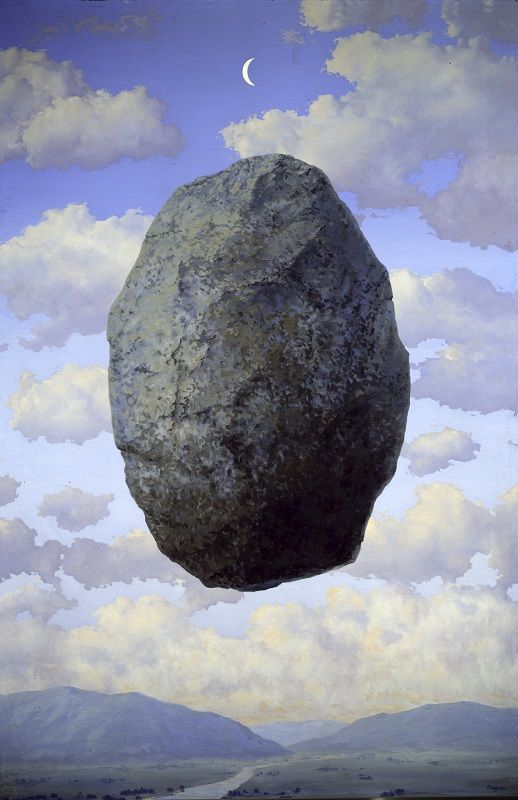
This theme could be related to depression, indicates Solana, present in the will to want to disappear and be invisible. Magritte accompanies it with the opposite reaction, megalomania, the desire to be visible and to make euphoria evident to everyone. The surrealist painter shows it with exaggeratedly large objects, turned into monsters, like an apple that fills an entire room in The Listening Room, or a female body that grows lengthwise, as if it were a telescope, in Delusions of Grandeur. Solana explains that this last painting draws from Lewis Carroll, whom Magritte admired, and Alice's Adventures in Wonderland, when the protagonist says she would like to grow in parts, like a telescope. Rocks also expand, but the artist makes them levitate in The Sense of Realities, revealing, through an unusual situation, their true meaning, gravity.
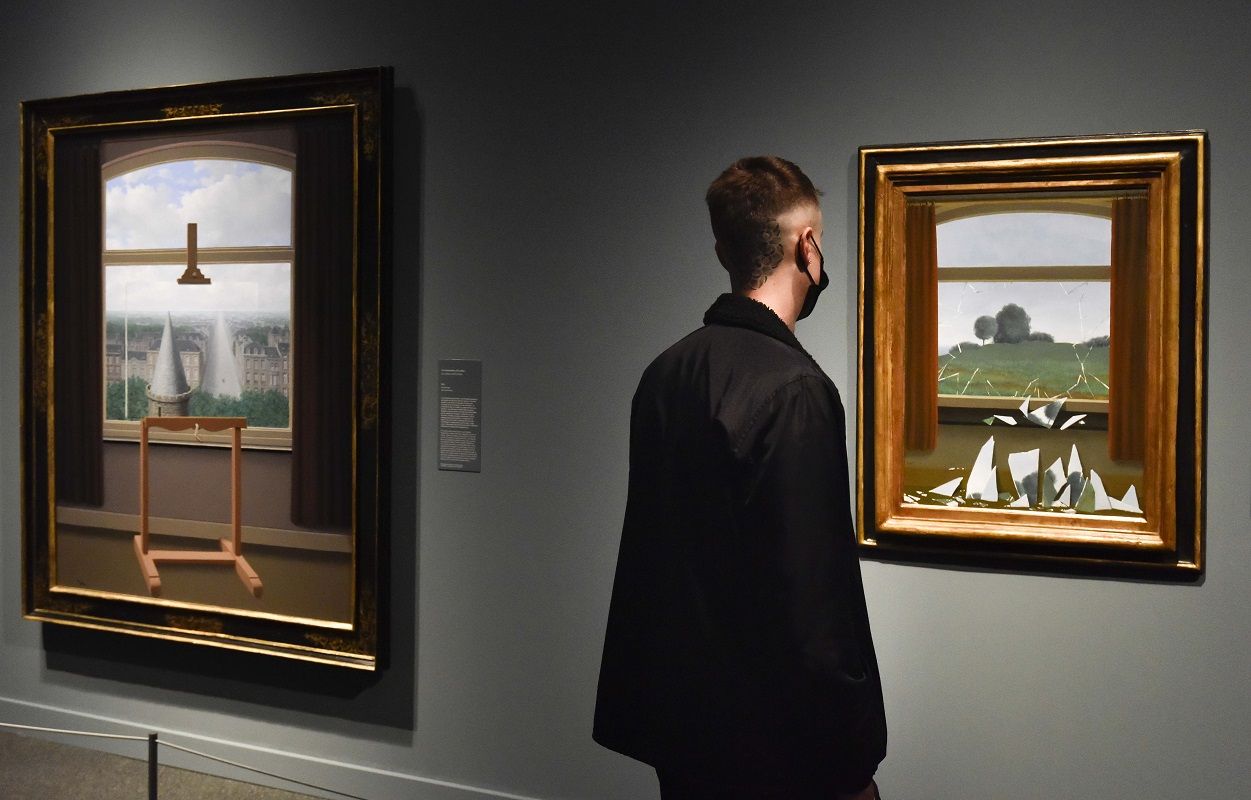
Another of the artist's recurring themes is the classic metaphor that says painting is like a window. Magritte takes this conception to the extreme, even ridiculing it, as in The Walks of Euclid or, very especially, in The Key to the Fields, in which the glass has broken and it has been seen that it was also painted, that it was also an invention. He again provokes strangeness, awakening suspicions about what is real and what is an invention, making us question if what we see is nothing more than a setup. "He takes us out of our comfort zone," Solana summarizes. Everything can be distorted and emptied of its conventional meaning.
Magritte's paradoxes do not end there, and the exhibition reviews his characteristic allergy to the human face, related to his fascination with the fictional character Fantômas. Light should reveal what is there, but in The Pleasure Principle, a spotlight leaves a body faceless. The artist also resorts to turning characters' backs, using cloths or multiple objects to deny a very human privilege, that of having a face. And from there he moves on to giving it to any object, playing with pareidolia, that is, recognizing human faces in landscapes or inanimate things, as in The Wise Tree or Elemental Cosmogony.
Add The New Barcelona Post as your preferred Google source for free
Stay informed with the latest news.
