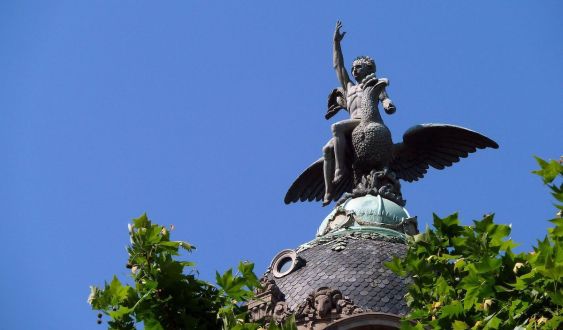
Someone once told me that the difference between New York and Barcelona is that in Barcelona people walk slower. It's not that they are exactly absent-minded: they have a direction, but they move more calmly. In fact, the verb badar doesn't have an exact translation into English, just as it doesn't have one into Spanish, and it's an ambiguous verb: badar can mean not paying attention to what's around you (or to almost anything), but it can also mean paying more attention than usual.
In Barcelona there are monuments, statues, buildings and heritage that go unnoticed not because they are discreet, and not because the city walks particularly fast, but because it bada incorrectly. It doesn't know how to badar well and, therefore, it is badando. Not everyone is (nor needs to be) Lluís Permanyer, but Barcelonans are especially cruel or distracted with detail: so much going straight to the point that we forget why we were going straight to the point. Who we are, in short. This way it's impossible for any city, any country, any Phoenix to rise from the ashes: "Barcelona is back," some say, and they can't specify where it's back from, where it went, or where it wants to go (if it wants to go anywhere).
Barcelona can only return to Barcelona, and that is a journey not suitable for all sensibilities. I have before me the building of La Unión y el Fénix, on Paseo de Gràcia, and it's as if it had never been there. Like an old piece of furniture at home, which we know exists but not its history or its reason for being. This way there's no way to return, or to leave, or to be reborn.

From below, while I wait for the traffic light to change on the "pacified" Consell de Cent, for the first time I observe the immobile choreography of the building. Mythological figures, allegories, classical bodies, between impudence (Americans don't have naked statues in the street, because no one Romanized them: in any case, they keep them under lock and key in museums) and noucentista hieraticism. In fact, a significant part comes from the hands of a sculptor as omnipresent (and at the same time elegantly discreet) as Frederic Marès, who, no matter how much he tries to be neoclassical, has the problem of having lived in the years of noucentisme. Noucentisme could never pretend to emulate Rome or Greece, because it is cold and static like few things. Its obsessive symbolism becomes almost inexpressive, not very sensual, of an alarming rigidity. And, even so, surely the voluptuous and sensual Barcelona of Modernism needed an answer.
Marès, who could model a chin with the same naturalness with which he accumulated infinite collections (for me his great work is his museum), participated in the symbolic construction of this building along with other lesser-known but equally decisive sculptors. This combination is what turns La Unión y el Fénix into a kind of choral opera: as in Plaza Catalunya, everyone sings a little, but no one takes all the spotlight. The figures, distributed across the facades, form a visual discourse on prosperity, work, constancy, industry, the navy, agriculture, the arts, all of them (virtues and trades) represented with a nobility that far exceeds the commercial mission of the property: an insurance company, after all. The "just in case." It's normal that they wanted to evoke concepts with a little more epic.

The Phoenix, symbol of the company, is the work of the French sculptor Charles René de Saint-Marceaux (multifaceted but tending towards Neo-Renaissance) and crowns the building with an almost Olympic pride, always about to rise. With stone feathers that look like the wings of a city condemned to not be able to take flight. Below, sculptural groups that evoke progress and protection, the light that combats misfortune, the serenity that overcomes chaos. A grandiloquent Barcelona, yes, but it is forgiven because it did not want to become outdated or trapped between fairies, flowers, and medieval knights. Barcelona did not want to stop being modern, European, monumental. It's a shame that insurance companies are the theme: the damned stability, so valuable when needed, but always annoying when it's time to move forward.
We have become accustomed to looking at modernism as if it were the only possible alphabet of urban beauty, but this building, between stretched noucentisme and disciplined classicism, opens up a less obvious and less Instagrammed city for us. Perhaps this facade does not deserve a kiss or a like, but it is enough to cross the traffic light, look up and suddenly discover a river god hiding a smile, a female figure holding a torch, a young man who could be Hermes if we put wings on his ankles. There can be beauty in what no one looks at, yes, but if we look a little more we will at least understand the gods who speak to us. They are always there, and they have something to say. And it is something important: in addition to being reborn, like a Phoenix, one must also know how to endure. Let's look a little more, then. "No val a badar".
Add The New Barcelona Post as your preferred Google source for free
Stay informed with the latest news.
