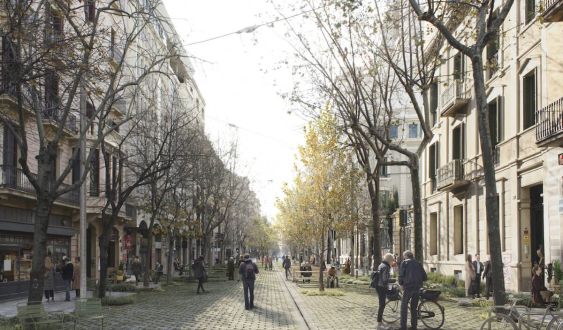
The future of the Cerdà urban plan is beginning to take shape. The Barcelona City Council has selected the teams of architects who will be responsible for designing the first streets and chamfers in the city center that will be transformed into green corridors and squares. The Eixample, which is to be entirely converted into a super-block, will begin its transformation in the streets of Consell de Cent, Rocafort, Comte Borrell, and Girona, and at the intersections of Consell de Cent with Rocafort, Comte Borrell, Enric Granados, and Girona, with construction expected to begin in June 2022.
The premises that will define this new city model are based on focusing on the pedestrian, who will be able to walk along these streets in straight and continuous paths, without cars or buses interrupting their journeys. Only private vehicles destined for those same streets will be allowed to circulate, and at a very low speed of 10km/h. The streets will be a single platform, from facade to facade, and the asphalt will disappear, to be replaced by recycled content and less hard pavements, such as cobblestones.
The second protagonist of this new Eixample will be greenery, which will invade the streets and chamfers transformed into squares. The aim is to build sustainable streets, with pavements made of recycled materials that harness rainwater and the incorporation of photovoltaic systems to supply the energy required for lighting.
Likewise, the Eixample super-block will not only guarantee that one can walk without cars but will also include areas for sitting and playing and will promote local commerce. It remains to be defined how loading and unloading will be guaranteed in these premises, considering that, without asphalt, the pavements that will be laid will not be able to withstand the passage of excessively heavy vehicles.
Defining the base model
The City Council called in early November two tenders to redefine the four streets and chamfers of the Eixample selected in this first phase of transformation, for an amount of 37.8 million euros. A total of 86 proposals have been submitted and the municipal government has selected eight. One of the chosen proposals, Caminar des del centre, by b67 Palomeras Arquitectos and Cierto Estudio, will be in charge of defining the base model from which the first four streets and chamfers and those that may come in the future will be designed, collaborating with the rest of the teams. For the Deputy Mayor for Urban Planning, Janet Sanz, the new code must maintain the feeling of repetition and order of the Cerdà grid, where no street is the same, but one identifies when one is in the Eixample.
Cierto Estudio and b67 Palomeras Arquitectos will also be in charge of transforming Consell de Cent street into a green axis, the longest of the four planned in this first transformation of the Eixample, which will go from Joan Miró Park to Passeig de Sant Joan. Their proposal is for pedestrians to occupy the center of the streets, where cars used to circulate, and circulate freely, and for the street to communicate with the elements that surround it, as if it were a carpet. "Buildings will come out to meet the street, shops, restaurants and the different activities that take place on the street," explains Marta Benedicto of Cierto Estudio. "We are convinced that the new model of public space is absolutely necessary. As a technical team we will work to empower the inhabitants," she adds.
For the Deputy Mayor for Urban Planning, Janet Sanz, the new code must maintain the feeling of repetition and order of the Cerdà grid, where no street is the same, but one identifies when one is in the EixampleOnce the base model is ready, the teams that have to convert Consell de Cent, Rocafort, Comte Borrell and Girona into green axes will begin to draft the executive projects.In addition to Cierto Estudio and b67 Palomeras Arquitectos with Consell de Cent; Esteyco-Caceres Arquitectura, Martí Franch and NablaBcn Studio will take care of Girona street; Gonzalez Cavia and Cabrera and Fabric Office, of Rocafort, and Ingeniería y Arquitectura, Agence Ter and Ana Coello de Llobet, of Comte Borrell.
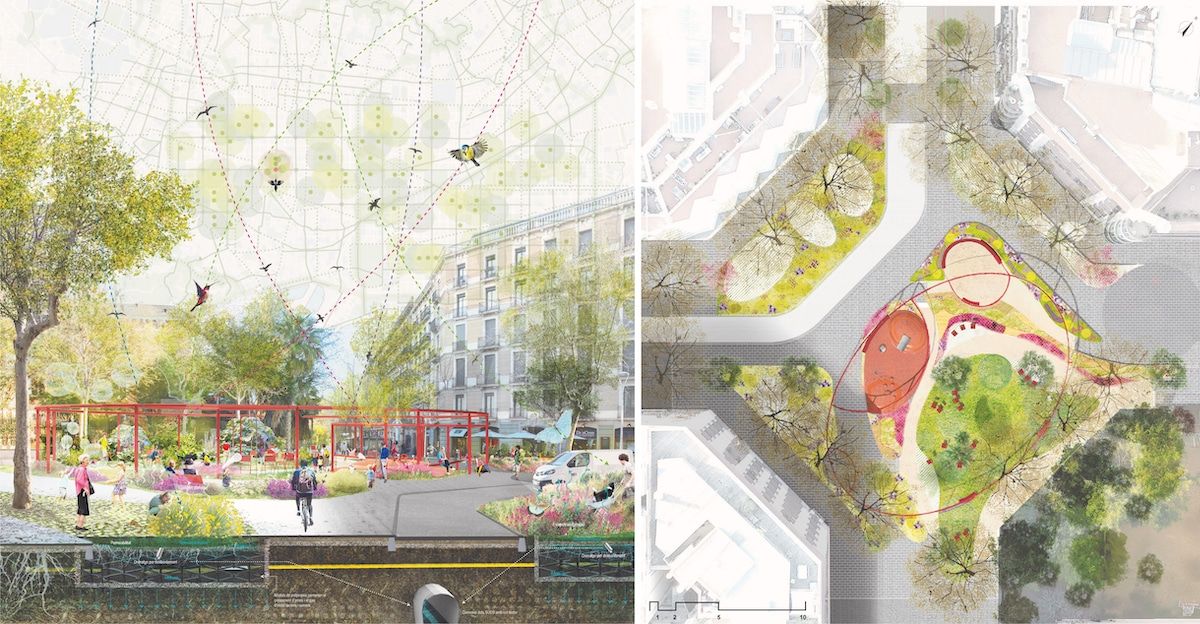
On the other hand, the winning teams will also begin to draft the corresponding executive projects to define the four squares, which will be quite similar to the proposals presented in the competition. All executive projects must be ready by February 2022, with the aim of starting works in June of next year and finishing them in the first quarter of 2023. Parallel to this, the participatory process of the project is being carried out.
Add The New Barcelona Post as your preferred Google source for free
Stay informed with the latest news.
