[dropcap letter="L"]
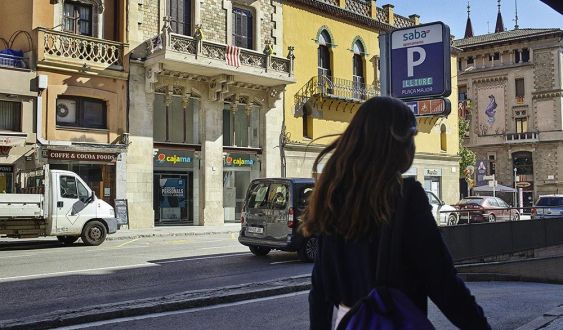
he entrance to Vic's Plaça Major via Jacint Verdaguer street is made hand in hand with the sweetness and beauty of some palaces. The announcement of pastry shops and chocolate shops, sponge cakes, muffins and coques from Perafita envelops the Mercadal, which is also the name given to this unquestionable epicenter of the capital of Osona. If any square in the country is strong, indisputable, it is this one. Jacint Verdaguer street leads directly from the train station to the Plaça Major, thus fulfilling a geographical logic appreciated by those arriving by train. Breakfast in one of the cafes that act as a hinge between Verdaguer and the Plaça Major, next to the Casino de Vic, one of the many emblematic buildings of this bombastic, bulging square, which invites you to linger over all the details. Once I have wiped my whiskers (the croissants and the muffin that accompanied the coffee were delicious) I delve into the exploration of the Plaça Major.
There is a hustle and bustle of vans unloading products for the establishments under the arcades. The sun seems to want to highlight some prominent palaces, some roofs with privileged views, ornamental elements, the numerous banners asking for the freedom of political prisoners and the estelades. I linger over the tiles under a balcony, the ornaments on the facades, the decorations on the windows, the arches of the arcades - all changing, depending on the building they shelter under; the arches give this idea of being the sum of different eras, efforts and aesthetic tastes...
In the nook formed by some wooden beams, swallows' nests can be seen. Who knows how many years they have found shelter there! Who knows how many couples have met in the square, who have danced or kissed.Immediately I feel the good coolness from under the porches. And I also enjoy the colors of the buildings, carefully restored, oranges, ochres, browns, reddish, whitish, as if someone capriciously had been finding variations in the palette. Casa Costa, Casa Tolosa, Casa Moixó, Casa Beuló, Casa Cortina, are the names of the most distinguished houses in the square. Said like that, in one go, they seem like a basketball lineup with a particular sonority, which resonates in time. Among them all, they combine styles and centuries, Gothic, Baroque, Renaissance and Modernist.
In the nook formed by some wooden beams, swallows' nests can be seen. Who knows how many years they have found shelter there! Who knows how many couples have met in the square, who have danced or kissed. A market place every Tuesday and Saturday, a place for major events (the Medieval Market, the Vic Live Music Market, the Vicantic antique fair...). The City Hall is based in the building in the royal part of Vic, built around 1358. Narrow, it looks like a minimal house that, were it not for the balcony, one would say has a touch of modesty, of not wanting to stand out more than necessary. But from afar one can see its clock tower, which dominates the square.
From the side street of the City Hall, for a moment, you have the impression that a big-head or a flamenco dancer or a child from the film Ventre blanc, the delicious fable that Jordi Lara dedicated to the ancient city of Vic and its popular culture, must emerge. A song of love to both. A tribute that invites you to contemplate the city and its expressions with a new gaze, with an enchantment for beauty and for what often goes more unnoticed.
Perhaps for having invoked the universe of the writer Jordi Lara and the dreamlike atmosphere of Ventre blanc, as I head towards the north side of the square, the figure of a man catches my attention: an old man in a long tunic, cloth espadrilles, and a cane, walking aimlessly. Where did he come from? A sporty couple passes by him, dressed in striking colors, with that infuriating tanned skin tone... And the man continues to tap the grit of the square with his cane. Then he meets a young girl, with her head covered, and they start talking animatedly, but I cannot understand them.
I continue down and see a tanker truck entering the square, starting to draw circles and soak it with water. The circles become smaller and smaller, the part of the square darkened by the water, larger and larger, and its movement has something of a harmonious dance. A child watches the tanker truck's dance, mesmerized. A couple of elderly ladies wait for their turn to pass so they don't get wet. And in this daily repetition and the kind of surprise that mirrors it, I seem to see a hint of joy, the joy that things happen, link together, and work.
I am now on the north side of the square, much more crowded with shops than the south, which has a slightly more dilapidated air. They say it has always been like this, no one knows why. They also say that years ago, as youngsters, when going out for a stroll, the side with the arcades was where people walked, to see someone or be seen. It was precisely in this L-shape on the north side, where most of the cafes are lined up. In this corner, in the shade, a big-headed figure reclined, with crossed legs, watches everything that happens with satisfaction. It is the sculpture of Merma or the Cap de Llupià, a grotesque big-headed figure that leads the giants and plays at chasing children. This bronze Merma seems to laugh. You would take his arm, invite him to dance in the square and go up together to one of the rooftops with views.
Add The New Barcelona Post as your preferred Google source for free
Stay informed with the latest news.