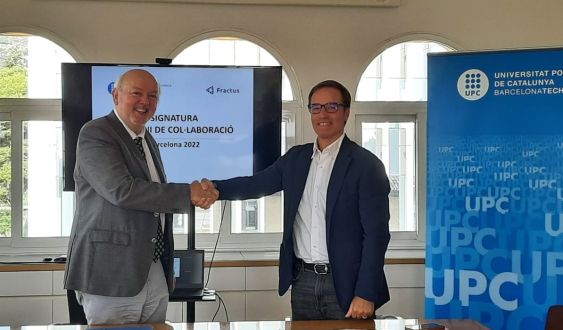
The promotion of deep tech technologies, in all their fields of application, will be one of the responsibilities of the new research and development center established by the Polytechnic University of Catalonia-BarcelonaTech (UPC) and the company Fractus, specialized in the development of fractal antennas. The center is born with a clear vocation to boost research in disruptive technological solutions based on scientific challenges (deep tech), which demonstrate great potential to enter the market and have a social impact.
In this way, the promoters want to contribute to the creation of startups and subsidiaries, spin-offs or spin-out companies from the UPC that have already focused on this area of research. The university has a long history in R&D&I in the deep tech sector, as well as a close relationship with more than 2,000 companies from various sectors, so it already has a critical mass in the field of research and innovation in disruptive technological solutions.
Over the next few months, the center's work plan for 2023 will be detailed. In general terms, a screening of all ongoing projects from the different UPC research groups linked to deep tech solutions will be carried out. Likewise, work will be done on the design of possible financing structures, whether considering the instruments available to the university itself, Fractus' contribution, or third-party capital, according to university sources told The New Barcelona Post.
On the other hand, the experience that Fractus, a company that has become international and was founded in 1999 as a UPC spin-off, can contribute stands out. Led by Rubén Bonet and by Professor Carles Puente from the Barcelona School of Telecommunications Engineering at UPC, Fractus has positioned itself as a pioneering company in the development of internal antenna technology for mobile phones, tablets, and other wireless devices in the field of the Internet of Things (IoT).
Specialized in new applications of fractal technology and other emerging technologies, the Catalan company has a portfolio of intellectual property rights of more than 30 inventions protected through more than 120 patents and patent applications in the United States, Europe, and Asia.
The activity of the hub ---which will be named Fractus-UPC Deep Tech Hub--- will focus on research, innovation, and knowledge transfer in areas such as mobility and logistics, materials, sustainability, urban planning, information and communication, biomedical engineering, and environmental and energy technologies. The initiative will also focus on the emerging areas of quantum computing, photonics, artificial intelligence, cybersecurity, robotics, electronics, and advanced materials.
Add The New Barcelona Post as your preferred Google source for free
Stay informed with the latest news.
