
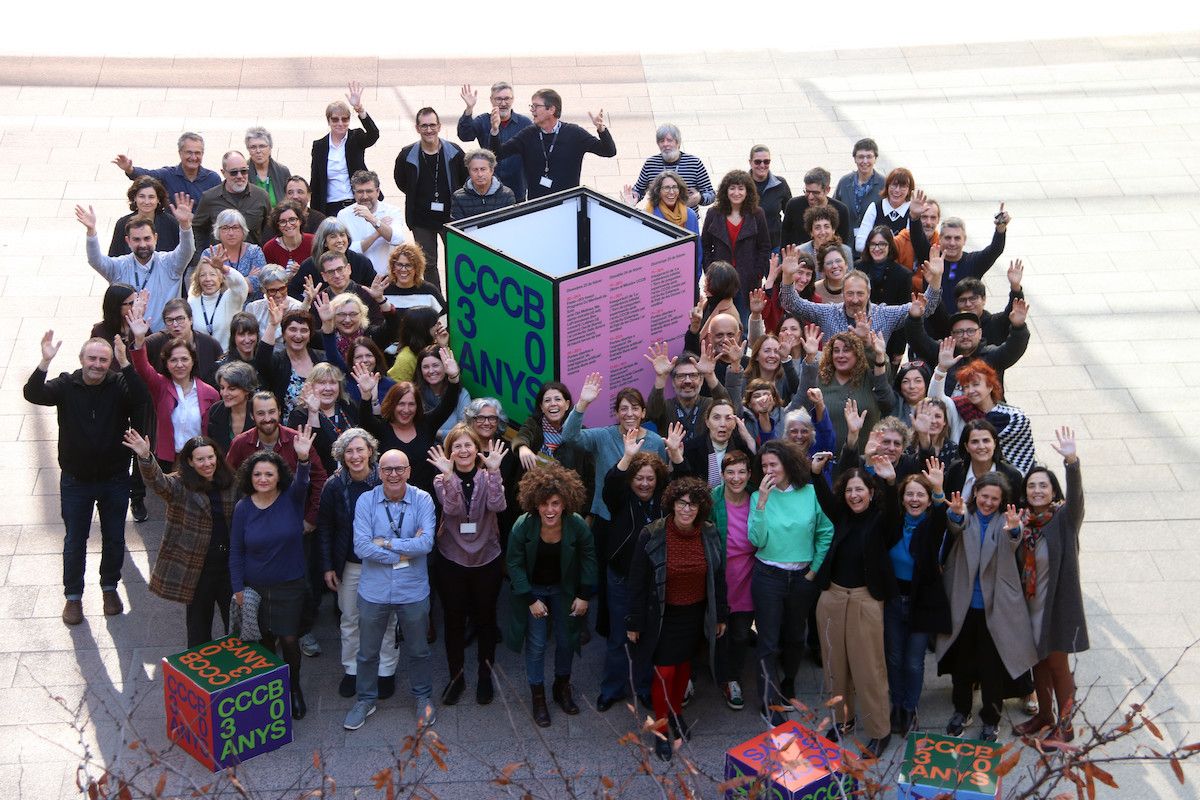
Time flies, but this Saturday marks 30 years since the birth of the Centre de Cultura Contemporània de Barcelona (CCCB). In a post-Olympic city that was opening up to the world, the CCCB began operating on February 24, 1994, in the old Casa de la Caritat, in the heart of the Raval, just one month after, very close by, flames consumed the Liceu. It was created as a center dedicated to the contemporary city, without its own collection, conceived as a meeting point for calm and critical reflection through exhibitions and debates. "The CCCB is part of the cultural and emotional memory of the entire city, of many generations, but, above all, of my generation, which grew up with it," says its director, Judit Carrera.
Three decades later, with an economic crisis and a pandemic in between, Carrera argues that it has consolidated itself as a space for critical debate about a world that has changed during this time, but not that much, with scourges that there is no way to leave behind. With its halls full after the pause due to covid, the CCCB emphasizes that it manages to attract a diverse and, especially, young audience, one of the profiles most resistant to visiting other cultural spaces in the city. But its attendees are also eminently local, with 70% residing in the Barcelona metropolitan area. In total, it has gathered more than 11 million visitors in these 30 years, with a program consisting of almost 200 exhibitions and 6,700 activities.
If in 1994 there was talk of the Rwandan genocide and the Balkan war, now there are the wars in Ukraine and Gaza. However, Carrera points out, in the mid-nineties, "there was a certain confidence in the future, with the fall of the Berlin Wall and the beginnings of the Internet". "Everything was more predictable and less uncertain, now the world is totally different, much more complex, political crises are multiplying, freedom of expression is in crisis and the far right has spread," explains the director of the CCCB, "these are times of uncertainty, dark and of distrust regarding the future."
For this reason, he defends that the CCCB model remains valid: "Through the different languages of culture, it remains faithful to its purpose of posing the most pertinent questions and testing the answers, and today, when everything insists on denying the future, trying to imagine other possible horizons." In this desire to open paths, the center celebrates its adulthood with a program of international residencies, with journalists Patrick Radden-Keefe and Eliane Brum as the first guests.
The initiative, financed by the private Mir-Puig foundation, was born with the aim of taking a step further in the cycles of conferences and critical thinking seminars it offered until now, with more than 350 participants each year, 30% international. With a budget of half a million euros, the residency program will serve to create unhurried and long-term workspaces, as well as to promote more sustainable mobility and deepen the link with the city's cultural agents. Over the next three years, three guests will spend a few months in Barcelona each year, not to develop their writing projects, but to work with the CCCB. In the case of the first two guests, Radden-Keefe will direct a series of conferences on George Orwell, while Brum will advise on the exhibition Amazonias. The ancestral future, scheduled for next November.
Weekend of celebration
To mark its 30th anniversary, the CCCB has scheduled a weekend full of activities. From this Friday to Sunday, there will be concerts, such as Hyper_O by musician Carles Viarnès and visual artist Alba G. Corral, a proposal that could be seen at last year's Sónar, but also conferences. The central event will be the confrontation between physicist and biologist Ricard Solé and philosopher Carolin Emcke, moderated by Carrera to talk about the times of bewilderment currently in force.
In addition, it will be possible to go up to the CCCB viewpoint, on the fifth floor, from where one can contemplate views of the city. This is an activity that had been lost with the pandemic and has now been recovered, not only for the anniversary, but also on certain Sundays of each month. There will also be open doors to the exhibition AI: Artificial Intelligence, co-produced with the Barcelona Supercomputing Center (BSC). On Friday, to the delight of the cultural center's team, it can be visited until 11 p.m. with prior reservation.
The CCCB celebrates 30 years with open doors to its viewpoint and the exhibition AI: Artificial IntelligenceRegarding AI, far from easy catastrophic discourses, the CCCB will take advantage of its thirtieth anniversary to play with this technology and benefit from all the legacy it has generated over decades. Based on the debates and conferences from its archive, with some 2,300 videos and audios, the programming collective Estampa has fed an AI that will compulsively write a conference every day based on an idea proposed by thinkers, writers, and filmmakers such as Marina Garcés, Juan Pablo Villalobos, Lucía Lijtmaer, and Clara Roquet.For one month, a screen in the Pati de les Dones will broadcast live the text of these infinite conferences, which will last eight hours.
As if that weren't enough, the cultural center has also prepared another experiment with AI. In this case, it is a tool that has drawn from the CCCB's archive and answers questions about the issues that have been discussed in debates and conferences, with a repository of more than 200,000 answers. Ah, this AI was asked what the CCCB has done well in these 30 years. And it said: "It has created a welcoming and inclusive space for dialogue and for diverse communities. It has been a helping hand in difficult times." Luckily, it didn't have to answer with biographical data; it doesn't have them very controlled yet.
Add The New Barcelona Post as your preferred Google source for free
Stay informed with the latest news.
