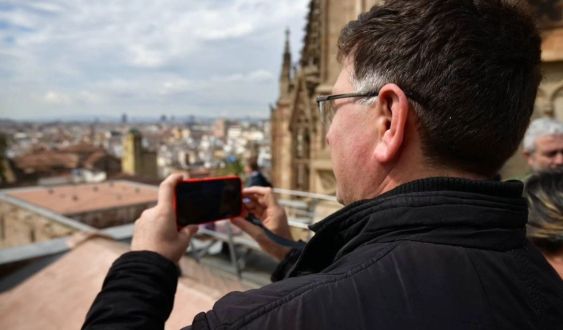
When the works on the current Barcelona Cathedral began in 1298, its workers never imagined that parishioners and visitors would end their visit on its terraces with a mobile phone in their hands and discovering the city thanks to artificial intelligence. Basically because back then, augmented or virtual realities were not thought of; only one reality was conceived, the earthly one, and, in any case, also the celestial one. Centuries later, in the midst of 2025, artificial intelligence has invaded all aspects of daily life, and the cathedral did not want to be left behind. The ecclesiastical building has launched La Talaia de Barcelona, an application that incorporates augmented reality to discover and learn the history of the emblematic points of the Catalan capital from the temple's terrace.
The name of this new application, in fact, is already a declaration of intent. "Atalaya" (watchtower) was the name given to watchtowers from which, thanks to their height and privileged location, the surroundings were observed. The terraces of the Barcelona Cathedral also offer this privileged situation since, after their restoration in summer ---which improved access and security---, they allow a complete tour of the temple and offer a 360-degree view of the Catalan capital. Now, through this application, one can delve into the history of about 45 emblematic places in the city, from monuments to religious buildings or even natural heritage.
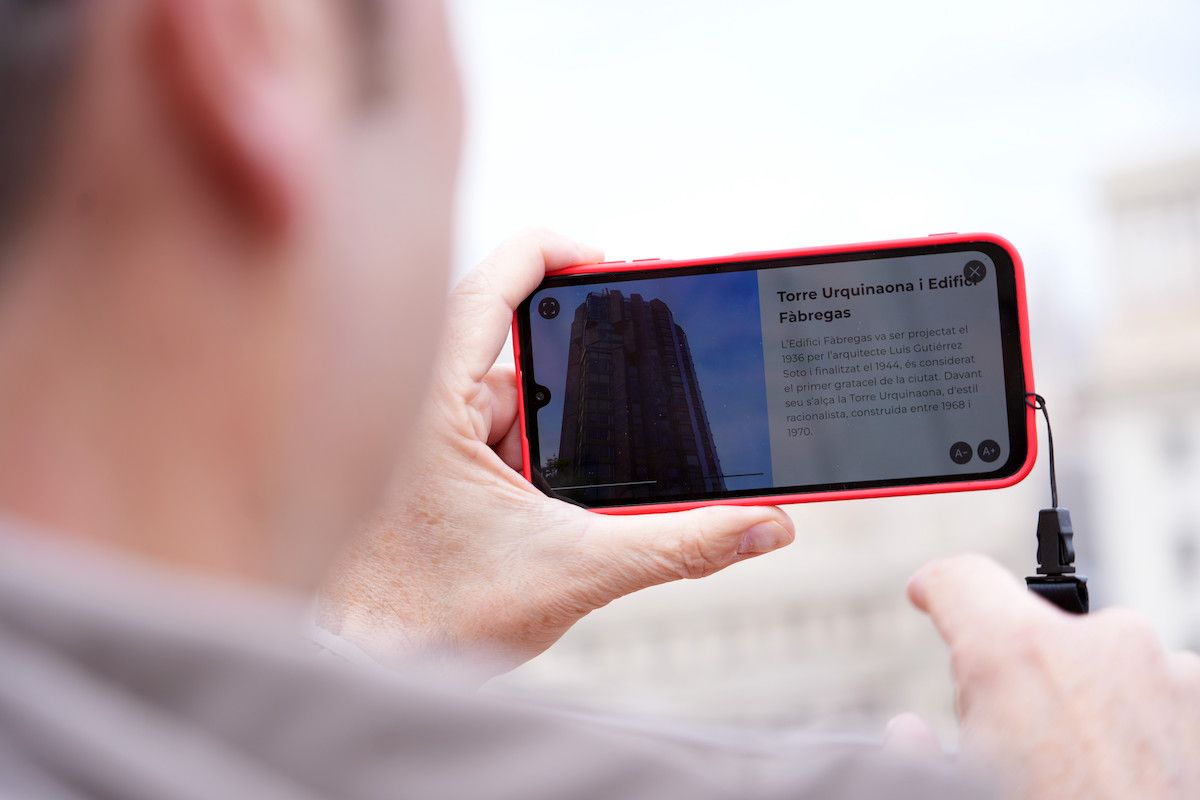
The idea is that the temple's terraces can become a privileged viewpoint in the heart of the city, incorporating technology. Thus, instead of finding a small telescope and a printed map pointing out the most prominent places in a city, it will only be necessary to have a mobile phone and focus on the different points one wants to explore. An intuitive and simple application in which, if you tap on the screen on the different points of interest, a drop-down appears with its name and description. In this way, through this new tool, more information can be obtained about the Sagrada Família, Camp Nou, or Santa Maria del Mar, but also about natural elements such as Montjuïc or the Garraf coasts. The user can also use the application to filter by type of building and only focus, for example, on religious or natural ones.
On days with good weather that allows for optimal visibility, from the temple one can even observe more distant points, such as the island of Mallorca. Santiago Bueno, dean of the Barcelona Cathedral, has emphasized that the temple's terraces offer privileged views, being the "only public point in the heart of the city that has such a wide viewpoint." This application has been developed by the company GMAV (Accessible Virtual Guides for Museums), specialized in creating mobile audio guides. The company works for museums and institutions such as the Museo Nacional del Prado or the Cathedral of Seville and, in Barcelona, for monuments such as the Recinte Modernista de Sant Pau, Camp Nou, or the Museu Nacional d'Art de Catalunya (MNAC).
For the cathedral, this is "one more step in the commitment to make the temple's heritage accessible," as Bueno highlighted, not only focused on tourists but also on city residents who want to rediscover Barcelona. In fact, since 2018, they have been working with GMAV to offer virtual guides. In 2023, they took another step with the implementation of virtual reality with 360-degree glasses, and now they reinforce it with this augmented reality tool on their terraces, which also uses GPS to locate the visitor's position and artificial intelligence so that the tool can recognize the buildings the visitor focuses on with their camera.
The application is available in seven languages ---Catalan, Spanish, English, French, Italian, German, and Korean--- and cannot be downloaded on any device, but can only be accessed through mobile phones provided by the temple once one accesses, by elevator, its terraces. The reason, as explained by GMAV director Jaime Solano, is that the application must be very well calibrated so that it can truly locate and recognize all buildings, making it difficult to adapt it to the wide variety of mobile devices on the market.
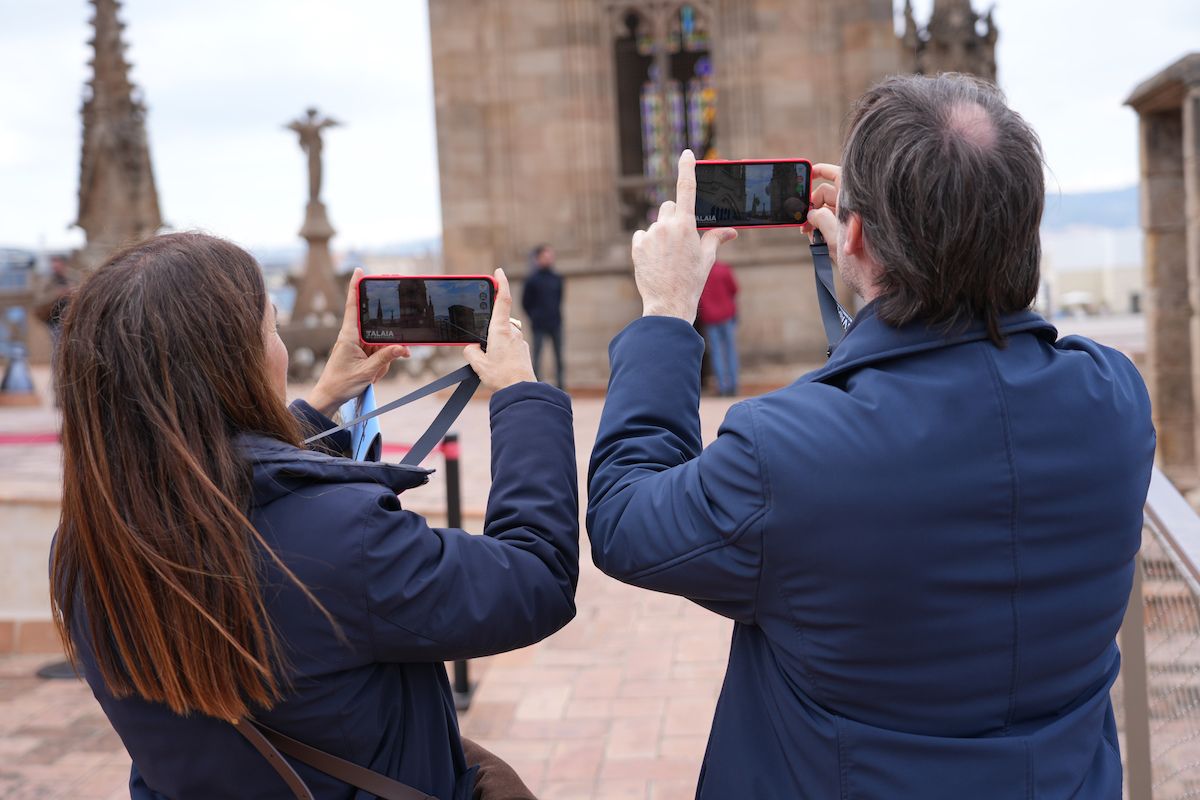
The objective, as defended by the canon administrator of Barcelona Cathedral, Josep M. Turull, is that all these technologies "do not eclipse or mask the heritage of the temple, but rather can be a complement to know and recognize it even more," and he added that these tools "should not be the end, but the means that help to enjoy this richness." This new service is included in the price of the general admission ticket, which costs 16 euros for adults and 8 euros for children under 12, and allows access to the choir, the chapter house, the rooftop and its new augmented reality tool, virtual reality with 360 glasses, the Diocesan Museum of Barcelona and, for a month now, also to the recently restored Church of Sant Sever.
A complete visit that allows one to learn about the different stages of the temple, since its history dates back to Roman times, and the different artistic movements that coexist within it, such as Romanesque, Gothic, or Baroque. A historical review that now concludes in the 21st century with the incorporation of artificial intelligence and augmented reality.
Add The New Barcelona Post as your preferred Google source for free
Stay informed with the latest news.
