The confluence, a term that refers to the flow of water in a river, is used here to point out a series of convergences between works from the museum itself and from the publicist's impressive collection. Thus, 25 confluences are paired in some thirty sculptural works where we find names such as Joan Miró, Henry Moore, Pablo Gargallo, Julio González, Eduardo Chillida, Josep Maria Subirachs, Manolo Valdés, Joan Brossa or Aurèlia Muñoz.
Located in the exceptional Francesc Marès Museum, in the middle of the Gothic Quarter, the exhibition Confluències. Escultura contemporània de la col·lecció Bassat also aims to pay tribute to the museum's sculptural trajectory, with a collection gathered over decades by Frederic Marès (1893-1991), a prominent sculptor and "collector of collections". This legacy communicates with the chosen works from the impressive contemporary art collection of Carmen and Lluís Bassat, which boasts more than 3,000 pieces gathered in what constitutes one of the most complete collections in all of Catalonia and Spain.
The Bassat couple began their collecting journey in 1973 when, almost by chance, they acquired their first works of art at the Galería Adrià in Barcelona. Since then, their passion for art has led them to become a national and international reference. Their collection, focused on contemporary art, includes numerous pieces of Catalan art from the second half of the 20th century, and can be visited occasionally at the Nave Gaudí in Mataró, as well as in different exhibitions around the world.
On the other hand, Frederic Marès was the most prominent art collector of the 20th century and, in 1946, he donated his collections to the Barcelona City Council. In 1948, the Frederic Marès Museum was inaugurated in the preserved part of the courtyard of the old Royal Palace of the Counts of Barcelona. Marès' collection is focused on Hispanic sculpture, from antiquity to the 19th century. Part of his own sculptural work is exhibited in his studio-library. The Marès collection was not focused solely on art pieces themselves, but on a whole series of objects that the artist treasured as a witness to the history and customs of the time. Thus, we find belongings, jewelry, watches, pipes, keys, reliquaries, pots and pharmacy utensils, etc.
The ultimate intention of the exhibition Confluències. Contemporary Sculpture from the Bassat Collection, which can be visited until May 21, is for the viewer to let themselves be carried away by the apparently casual suggestion of the pairing of works in impossible diptychs. One must be guided by the nervous system and not by reason when understanding the connections that shy away from context, culture, religion, society, economic factors, materials... that condition and define a piece of art.
The works, therefore, do not always dialogue. There are times when they contrast, oppose each other, or break coexistence, generating a conflict that extends through time and forms. While some works connect, others fight, compete for space, and we could say that others simply limit themselves to coexisting, discreetly, one next to the other. The visitor must not forget the most important thing, which is that these works exist.
The exhibition is the result of postmodernism, eclecticism, and the constant feedback loop between current art and culture in relation to previous art. This "new" way of looking is an unequivocal symptom of our times. The juxtaposition of two photographs, two screens, two pieces of art, is a constant revision of the past that seeks to impose itself on the present and permanently question the references and value of current contemporary art. There is a desire to reclaim the new through the old, as if it were a need for approval from the masters regarding their most advanced students.
The curator, art historian and critic Ricard Mas, assures that the exhibition "adds new readings of the museum" and highlights that "the idea came from the new director, Salvador García Arnillas, who, together with his team, found surprising parallels between the works." The work on the display pedestals, by Albert Vallverdú, makes them give the works a certain uniformity, presenting them correctly and with the appropriate intentionality, in disposition and form.
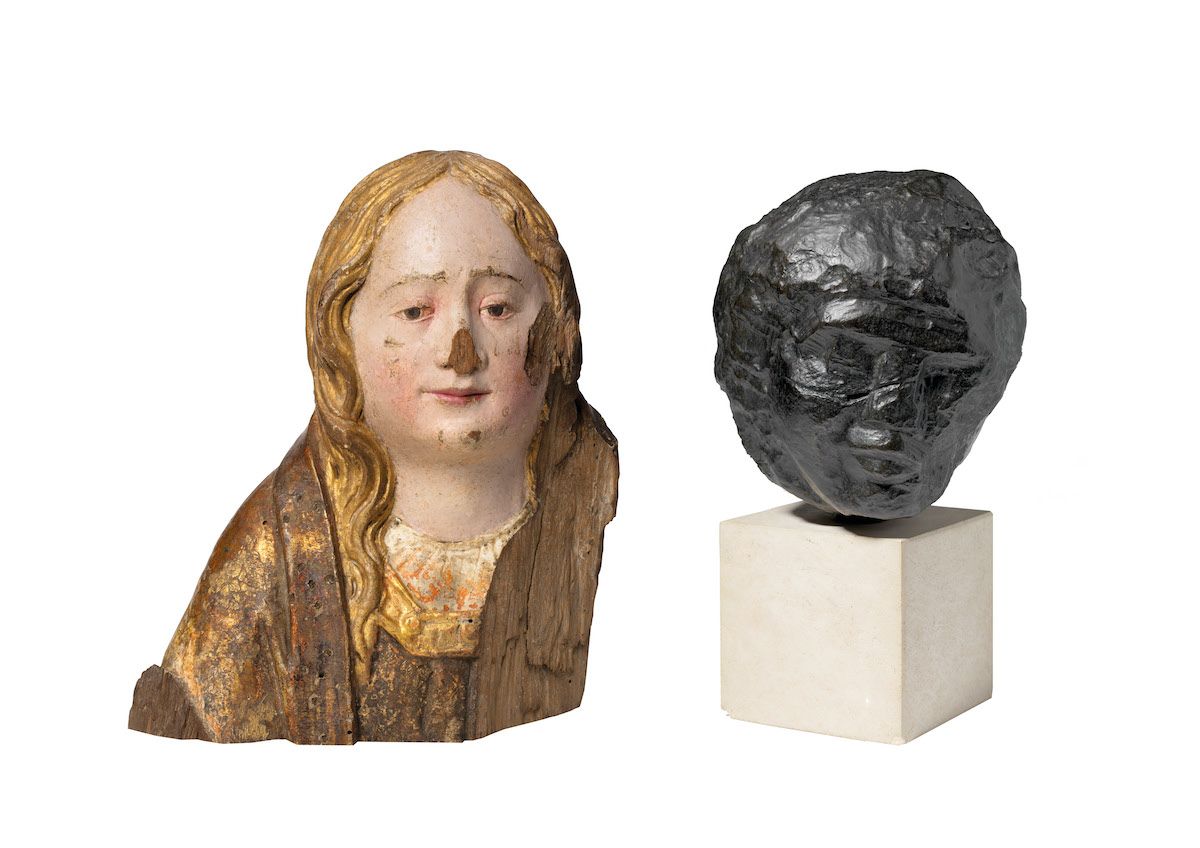
In the exhibition, the confluences of Saint John the Evangelist (1600), by Juan Montejo, with White Ovals (1981), by Aurèlia Muñoz, made of macramé and white linen, stand out, where the work of fabrics and their expressiveness is explored; the anonymous 16th-century reliquary busts, with Gerard Mas's bust Lady of the Wasps (2019), where there is a clear imitation of the aesthetics and forms predominant in the medieval era.
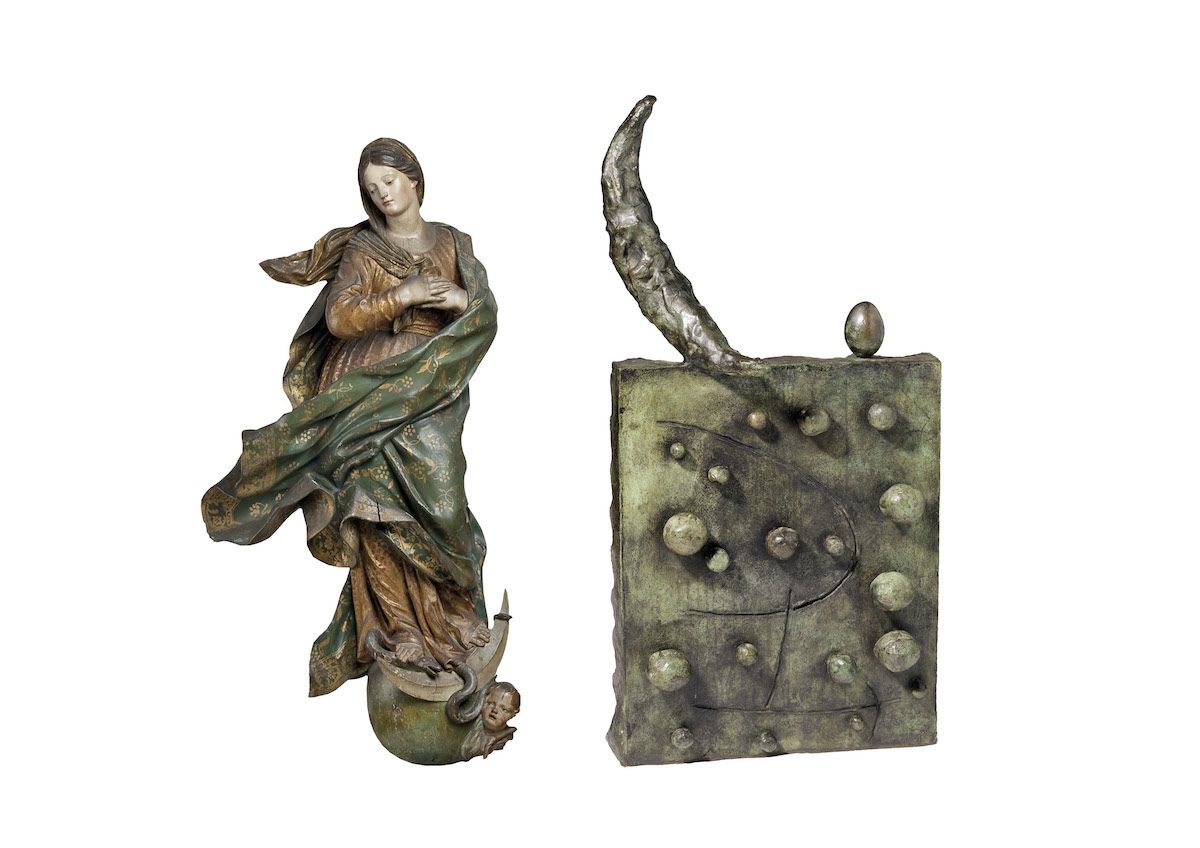
The curator, art historian and critic Ricard Mas, assures that the exhibition "adds new readings of the museum"The Immaculate Conception(1718-28), by Antoine Dupar, with the bronzeSilent Constellation(1970) by Joan Miró, where the common element is the egg, a symbol of fertility and birth. The reflection on the origin of everything, of the world, characterizes this pairing, with what is the great universal paradigm, with the evident difference in interpretations and eras.
The marble from the early 2nd century AD, with a sculpture of two female figures without heads or limbs, with Henry Moore's bronze, Reclining woman (1980); "a temporary loan from nature" which, with the passage of time, nature itself takes care of closing the cycle between nature and culture. Nature provides the stone and culture models it, until nature reasserts itself.
The bust of Emperor Augustus from the 1st century AD, with the two heads Oscuro y Claro (2016), by Samuel Salcedo, one in black graphite in tension, with air pressure inside the mouth, and the other in light wood, serene and exhaling. A dialogue that evokes the tension of power and the reaction to the magnanimous mandate.
The bust of a saint, from the Workshop of Alejo Vahía, from the 15th century, with Júlio González's Cabeza doble cabeza (1934-36), where the latter's work is shown as cryptic, in an indescribable gesture, unlike the female bust, which shows tears and feelings with total clarity.
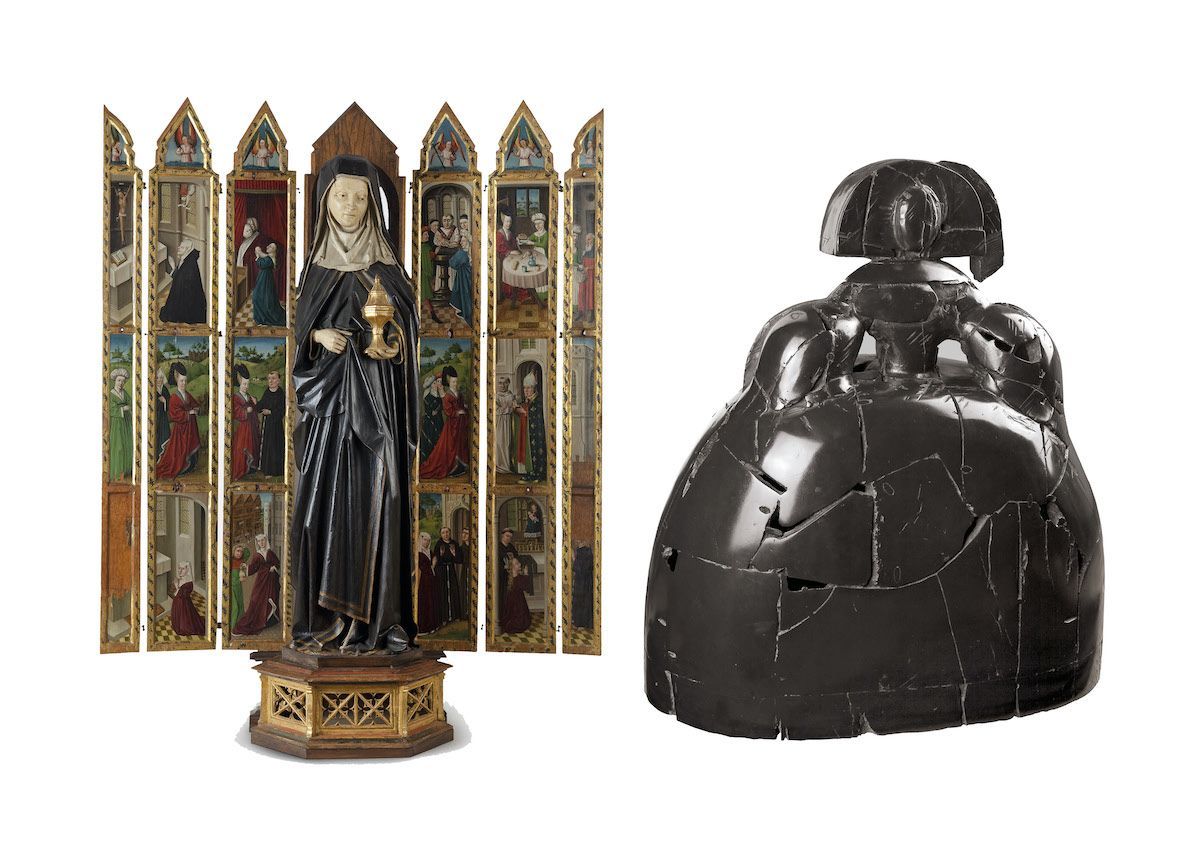
The polyptych of the life of Santa Clara (1500), a painting on panel and polychrome figure, with La Reina Marianna II, by Manolo Valdés (1999) in bronze, in which the visitor has to trace the biographical path to understand the parallelism; the saint secluded throughout her life voluntarily against the queen painted by Velázquez, a minor, and subjected to the strict rules of the court.
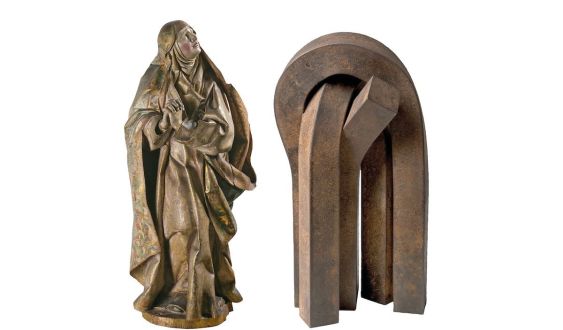
It is worth highlighting the formal, almost gestural, connections in appearance between pieces such as Chillida's Lotura XIV (1991) in iron, with the polychrome carving Virgen María de los Dolores (1618-20) by Sebastián Ducete and Esteban de Rueda; where the first seems to be the minimal expression of the other, as if the two pieces were looking at the same thing or synchronizing to do so.
The final conclusion approaches the idea that there is no concrete answer to the questions posed by the works in their context, but rather infinite paths to explore and infinite new interpretations. The exhibition will feature, on specific Saturdays by reservation, a family workshop that includes a guided tour of the exhibition and an activity for children aged 6 to 12 that will consist of making sculptures with modeling clay.
Add The New Barcelona Post as your preferred Google source for free
Stay informed with the latest news.