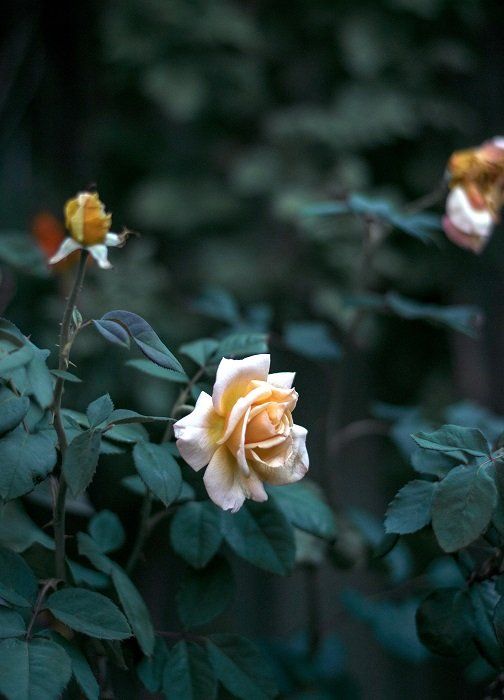
If in previous articles we talked about bulbs, orchids, and jasmines, the rose deserves a separate chapter. It can be considered the queen of flowers. It is the one with the most history and undoubtedly the one that has witnessed the most stories of love and heartbreak, from antiquity to romanticism; from the dawn of modern consciousness in Europe to the ambivalent conception of love that predominates today, lived with reasonable sentimentality, and which alternates between disenchantment and the need to believe in something eternal. It is understandable that it is the most present flower in lyric poetry. In verses attributed to Sappho, between the 7th and 6th centuries BC, it is considered the favorite of Zeus himself. In a Latin context, it will be the protagonist of the most famous invitation to seize the time of life, usually referred to as carpe diem. A well-known poem by Ausonius, already in the 4th century AD, opens with the warning Collige, virgo, rosas: "Gather the roses, maiden" (and continues: "take advantage of the fact that the flower is fresh and youth, and that your time is advancing"). An invitation that is often claimed in our time as a blank check, a supposed legitimizer of behaviors that do not precisely convey too much vital wisdom.
In any case, continuing chronologically and taking another leap, in the Roman de la Rose -one of the medieval best-sellers- the link of this flower with the most delicate and exemplary conduct was allegorically outlined: courtly love. A paradigm that, over the centuries, evolved to the extreme of passionate love, which different romanticisms formulate in poetic terms or by employing the confluence of the arts, as in the case of Wagner's Tristan. This radical form of death in life, or vital fusion that leads to the disappearance of the actors through erotic longing, can be identified sublimated in the figure of the rose, by several poets, from William Blake to Charles Baudelaire, who is considered the author of the saying: "L'amour est une rose, chaque pétale une illusion, chaque épine un réalité" [Love is a rose, each petal an illusion, each thorn a reality]. And it is that the fact that this flower of anthological perfection -most subtle in aroma and texture- is armed with its no less anthological thorns, capable of shedding the blood of the inadvertent or hasty lover, is a most significant coincidence. The inverse phenomenon occurs with the a priori dissuasive cacti, capable of surprising with generous blooms and striking shades.
We know, however, that one of the greatest aspirations of human beings is to control meaning and prune any roughness from discourse, as if feeling could grow in the absence of such adverse elements. Perhaps we can interpret Juan Ramón Jiménez's well-known interjection in this sense. We imagine him tired from the eager search for adjectives with which to convey a perfect expression, until he exclaimed "do not touch it anymore, for thus is the rose." Threatening edges, indeed, can counterpoint its immaculate reality: the aforementioned thorns, or that invisible worm ("invisible worm") that Blake evokes in a poem. Despite this, roses are admired for their beauty, and for the properties of their essential oils and their fruit (rosehip), used in different ways to maintain health and as a guarantee of a more lasting youth. Undoubtedly, the rose is also stripped by the passage of time, and its inevitable decay hints at the unfortunate truth that love wants to transcend. As with all flowers, it actualizes the atavistic promise of eternity, the perpetuation of life. A life that begins with the impulse of attraction and continues with care, awaiting the fruit.
Add The New Barcelona Post as your preferred Google source for free
Stay informed with the latest news.
