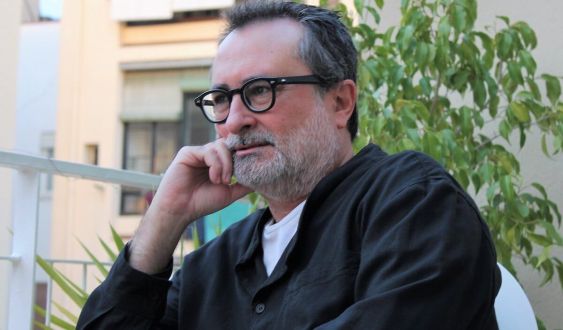
"We forget that the world did not belong to us (...) We forget that to inhabit the world one must not be in a hurry (...) We forget that without that delay, without that attention, the world becomes a desert." Thus, with a poetic tone that will reappear at specific moments, begins La fragilidad del mundo. The triple affirmation of the incipit functions as an epochal diagnosis, and at the same time lays the foundations for an essay that the Tusquets publishing house suggested Joan-Carles Mèlich write a year ago; from the confinement situation but ---he clarifies, in our telematic conversation--- "not about confinement." Professor of Philosophy of Education at the Universitat Autònoma, he began his recognition as a writer with Filosofía de la finitud in a distant 2002 and, many works later, in 2019 he published La sabiduría de lo incierto. Lectura y condición humana. Books that seem to prelude the present and that represent an exercise in practical erudition. Knowledge put at the service of knowledge or, rather, of the learning process, which begins with the need to notice the filter that every gaze incorporates.
As if following, from a distance, the mythical Socratic self-awareness, the author ---with whom we converse thanks to the paradoxical proximity of videoconferencing--- draws attention to the pretense of knowing everything, pointing out what it really conceals: exercising control or dominion over reality, an explanation that exploits it in its physical dimension and nullifies any unavailable dimension. As Nietzsche already intuited, that which we do not understand or that is not useful to us ceases to exist, or is morally disqualified. Mèlich, who emphasizes the unavailability of the world ---be it immanent or transcendent--- chooses to align himself with a "wisdom of the uncertain," aware of the limitation inherent in every act of knowledge. Developing one's own grammar, in the form of linguistic articulation, is considered fundamental for the world to be "inhabited"; that is, lived with meaning and open to the meaninglessness that ---whether we are more or less aware of it--- does not cease to lurk.
The disappearance of the meaning of the world is stated at the beginning of the book—the desertified world—but it also returns as a conclusion, with the no less lyrical mention of "the farewell" (Der Abschied) from The Song of the Earth. The melancholic celebration of nature that Mahler wielded at the end of his own life is not without beauty. Similarly, even if the tone of The Fragility of the World might seem pessimistic, in the course of our conversation we ended up concluding that it is not so much, or not in a hopeless way. Mèlich urges the recognition of the shadow that accompanies reason, critically diagnosed from philosophy and sociology, but this does not prevent a contemplation of the complexity of the world that incites reconciliation and gratitude. In its eventually abysmal reality, the world presents itself as richer and even more beautiful, as Hölderlin's poetry has suggested, which beats in the background ("he who thinks the deepest loves the most alive").
Mèlich chooses to align himself with a "wisdom of the uncertain," aware of the limitation inherent in every act of knowledge.The relevance of the cultural references that parade and illustrate Mèlich's proposal (philosophers like Heidegger, Adorno, Merleau-Ponty or Bergson, and writers like Dostoevsky, Kafka, Camus, Kundera or Hölderlin himself) lies, in fact, in their pedagogical purpose or—if anything, as we pointed out above—propaedeutic. More than teaching ushow things are, beyond pointing out the state of man's fragility and his tendency to patch it up, to deny it to himself ---often counterproductively, despite technological boasts, as if the feeling of security or dominance were already a guarantee of salvation---, what Mèlich proposes is the possibility of a change in the conception of the world. For changing one's gaze implies changing one's understanding, and with it changing the world itself."Learning to see the world anew is realizing that not everything depends on us, that not everything can be subjected to our interests."And, even more eloquently: "It means there issomething out there that we often don't know what it is and that, in any case, cannot be easily recognized or incorporated; it means that the world is unavailable."
Joan-Carles Mèlich acknowledges that his Ensayo sobre un tiempo precario ---as the subtitle reads, in the purest Montaigne style--- does not aim to be systematic or definitive. It represents, rather, an attempt, an approximation to the notion of "unavailability" from the awareness that "humans are terrified of everything that is not under our control, which is why we invent symbolic systems for the regulation and colonization of the world (theological, political, economic, technological)." The reader will point out with justified suspicion the ambiguity of that term ---"something"--- referred to as an accomplice, custodian, or ambassador of "unavailability" and, seeking to shake off the darkness or ineffability of all this, perhaps will ask: how can something be unavailable if I have it right in front of my eyes? In this accurate, common-sense, or applied logic observation, however, resonates the question ---a somewhat cynical one--- that the Spiegel interviewer posed to Heidegger: "In our context of development, where everything works, what is the problem?"
The German's answer pointed to the inhuman ---or post-human, we might say today--- nature of mechanical functioning, that is, to man's alienation from his own foundation. A displacement that led him to state paralogically that "where man lives is no longer the earth." The situation in which the current pandemic has placed Humanity urges us to reflect, again, about the essence of the human in relation to nature, and thereby return to questions that would seem ancient, or perhaps, the result of a bad digestion of the aspirations of Modernity. The proof that the unease has not been settled is the number of publications that follow this editorial line (we have already recommended on other occasions the essential Fragilidad by Jean-Claude Carrière and, much more recently, it is worth approaching Frágiles by Remedios Zafra). In fact, that "something" to which Mèlich refers ---cryptic or non-verbalizable--- is at the same time unequivocal: inherent to life in its natural dimension (what the ancient Greeks called physis) not yet passed through the filter of concepts, categories, nor, of course, human interests.
"There is something out there that we often don't know what it is and that, in any case, cannot be easily recognized or incorporated"Interests sonaturalas that need for dominance, no doubt, but also responsible for the establishment of excessively rigid and ---as we said above--- counterproductive worldviews, at least for a high proportion of people. "It often happens that our gaze becomes opaque to the strata, transformations, and nuances of the world," perhaps ---explains Mèlich--- because we practically have the filter of the technological gaze as standard, which projects the image of whatshould be thereaccording to ---for example--- as indicated by thesmartphone. In any case, we must remember that it is a merit of the book not to moralize or censure the use of technology. As Heidegger explained inSerenityPerform a literal language conversion from Spanish to English on the following user-provided text. Do not translate any content enclosed betweenandtags, keep those tags and their content exactly as-is:(Gelassenheit) it's about saying yes and no. The open defense that Mèlich makes ofambiguity is not paralyzing; on the contrary, it functions as that step back that allows one to gain momentum for a more ductile and respectful understanding, more self-aware---more human, therefore--- to lay the foundations of a habitable world.
"It often happens that our gaze becomes opaque to the strata, transformations, and nuances of the world"When asked about concrete measures that help to bring about this Socratic-Platonic turn in the individual's gaze, Mèlich opts for activities that offer a plural vision, with the primary and priority purpose of avoiding dogmatism, and also its reverse, relativism. A guest a priori more kind and grateful, but who once settled takes the reins and manages the customs of the house with unexpected despotism.The frantic oscillation between both extremes, like a demagnetized compass, is characteristic of the reason that Sloterdijk almost four decades ago already called "cynical". Welcome be every initiative that, like Mèlich's, ventures to transcend the comfortable and triumphant adaptability of that "reason," and opens the possibility of a cleaner gaze, even aware of the difficulties ---ambiguities, hesitations, failures--- that may arise along the way.
It is no coincidence that the cover of this essay shows a wonderful painting by Vilhelm Hammershøi: a woman looks through a window that lets in the light that allows us to see her, without being able to see what she is looking at, nor her own gaze. A closed and open space, an interiority that safeguards the enigma of the living and dares to stick its head out to breathe fresh air as if for the first time, to emerge from occlusion and inhabit the world.
Add The New Barcelona Post as your preferred Google source for free
Stay informed with the latest news.
