In this return after the holidays, I have come across two articles about the future of large cities and metropolitan areas, one of my favorite topics. Both feature two of the great specialists and consultants in the field: the American Richard Florida and the British Greg Clark. Their articles start from different subjects but end up converging on the sustainable future of cities from not only an environmental but also an economic and social point of view. In any case, both provide reflections that we must take very much into account.
Florida's article is titled Why downtown won't die. Published in Bloomberg.com, the urban planner analyzes the future of American urban centers, known as downtown, which differ from the European concept, usually associated with historic centers. In the United States, downtowns are urban cores, not always historic, where most economic activity takes place due to their concentration of commercial and office offerings. They are actually business districts whose life physically unfolds separately from residential neighborhoods.
According to Florida, there is a perception that the phenomenon of teleworking is putting these economic districts in crisis because one of its consequences will be the closure of many offices and activities that depend on them, such as restaurants and other types of businesses. However, this consultant believes that downtowns will overcome this crisis as they have been doing for decades, because, he points out, they are "the human creation with the greatest capacity for adaptation and resilience", despite the fact that New York City Mayor Eric Adams himself has stated that the end of business districts has arrived.
To contradict Adams and other specialists, Florida uses data collected in large American cities, which indicate that the loss of activity due to teleworking will be compensated by a change of use in downtowns. And, he points out, a phenomenon is occurring in which more and more people, especially young people, are moving their residence to these centers. According to Florida, American downtowns are going to become the closest thing to the 15-minute city, a concept popularized by the mayor of Paris, Anne Hidalgo, which promotes that, within a fifteen-minute walk or bike ride, city dwellers should be able to access most of their essential needs, including their workplace.
This 15-minute city model has recruited a good number of supporters, considering it the most sustainable and allowing for a considerable reduction in the vehicle fleet and the pollution they generate. Florida recalls that, in 1958, the also American urban planner Jane Jacobs —author of the historic book Death and Life of Great American Cities and who died in 2006— published the article Downtown is for people, in which she predicted that the future of urban centers lay in the diversity of uses and not in their specialization as economic districts.
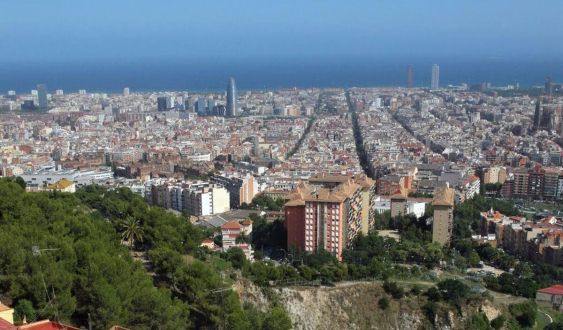
The article featuring Clark is an interview in La Vanguardia. In it, the British urban planner focuses on the future of metropolitan areas and specifically on Barcelona, for which he laments the lack of effort for a political consensus that allows it to grow. For this, he considers a great metropolitan pact essential because if each municipality acts on its own, as until now, it will not be achieved.
The future of urban centers lay in the diversity of uses and not in their specialization as economic districts, according to Jane JacobsClark also refers to the 15-minute city and its role in the future of cities. He believes that this model will only work if it is implemented within the framework of a metropolis, in which citizens have access to basic services (library, doctor, school, sports), but he points out thatthe 45-minute cities are those that offer universities and specialized doctors, airport, port and railway network. And he sentences: "15-minute cities are not an alternative to the metropolis. Without a metropolis, you have a 15-minute city for the rich and a 45-minute city for the poor, and there is no interaction."
Metropolitan areas and regions are the great economic engines, but often, as Clark points out, it is the lack of a joint supramunicipal strategy that prevents them from deploying their full potential. Likewise, the great challenge facing these urban giants is the fight against climate change through the decarbonization of economic activity. And that is where initiatives like the 15-minute city come into play. This is a model that can be applied with political will in cities with European morphology. It will be more difficult in the extensive city model that abounds in the United States, where a car is necessary even to go buy bread. But it is interesting that urban planners like Florida think about this model in the next transformation he predicts for downtowns.
The 15-minute city may be the future of large cities, but as in the case of metropolitan areas, it will only prosper with political will and consensus.
Add The New Barcelona Post as your preferred Google source for free
Stay informed with the latest news.
