
"I have always been interested in the cultural and social aspect of History. More than the characters themselves, I am interested in their relationships, their bonds, the networks they wove around them and which are what best define people and eras. Because that also allows you to escape from black and white, from polarization, and to know the shades of gray. If history teaches anything, it is that, to understand reality, a certain mental flexibility is necessary," reasons historian, researcher and writer Teresa Abelló at the bar, enjoying a late afternoon gin and tonic, to the rhythm of Chick Webb's Jubilee swing.
A professor at the UB and an absolute reference on the history of labor movements in Spain, Teresa Abelló assures that she learned to learn from a teacher named Dolors in the rural school of her native Vinaixa. That was the beginning, the first door of a mind that would never stop questioning itself and those around it.
"I studied History and my grandfather told me that I had chosen the wrong profession, because our family had no connection with the academic world. But, finally, it's what I've been doing and I'm satisfied, because I have also always tried to work on diverse topics, dealing with various fields transversally and going quite freely," she explains without losing her smile.
This approach based on transversality, on the ability to analyze the same subject, the same historical episode, the same area, applying different perspectives and simultaneously using methodologies, has accompanied her throughout her professional life. "My first job when I finished university was very nice. It was the beginning of democracy and the city councils were very active, because they found themselves with very degraded cities at all levels. It was then that I joined the team led by the architect Lluís Cantallop participating in the development of an urban plan to clean up the old town of Tarragona, the so-called Part Alta." For the next two years, the parishioner visited, door by door, all the residents of the neighborhood to document their lives and understand what they were like in that place.
Following in the footsteps of Josep Termes
After receiving a research scholarship in Holland —"which was a big change, because in that 1982 the differences between Amsterdam and Barcelona were enormous, at all levels"—, Teresa earned her doctorate with the pioneering thesis Les relacions internacionals de l'anarquisme espanyol (1881-1914), which would be published shortly after due to the enormous value of her research. "My thesis director was the historian Josep Termes i Ardèvol, with whom I am very happy to have worked. A great person. I believe there is no one who doesn't have great memories of him." Termes passed away in 2011, and three years later the parishioner would be co-editor of Josep Termes: catalanisme, obrerisme, civisme, a volume that paid homage to him through the contributions of several professional colleagues.
That book joins others such as El movimiento obrero en España, siglos XIX y XX, La CNT. Papers d'exili i clandestinitat or her recently published La Vaga de la Canadenca (Rosa dels Vents), an egregiously documented review of an episode of great historical significance, which led to Spain being one of the first countries to implement the eight-hour workday. And where, of course, there are plenty of citations from the admired and missed Termes.
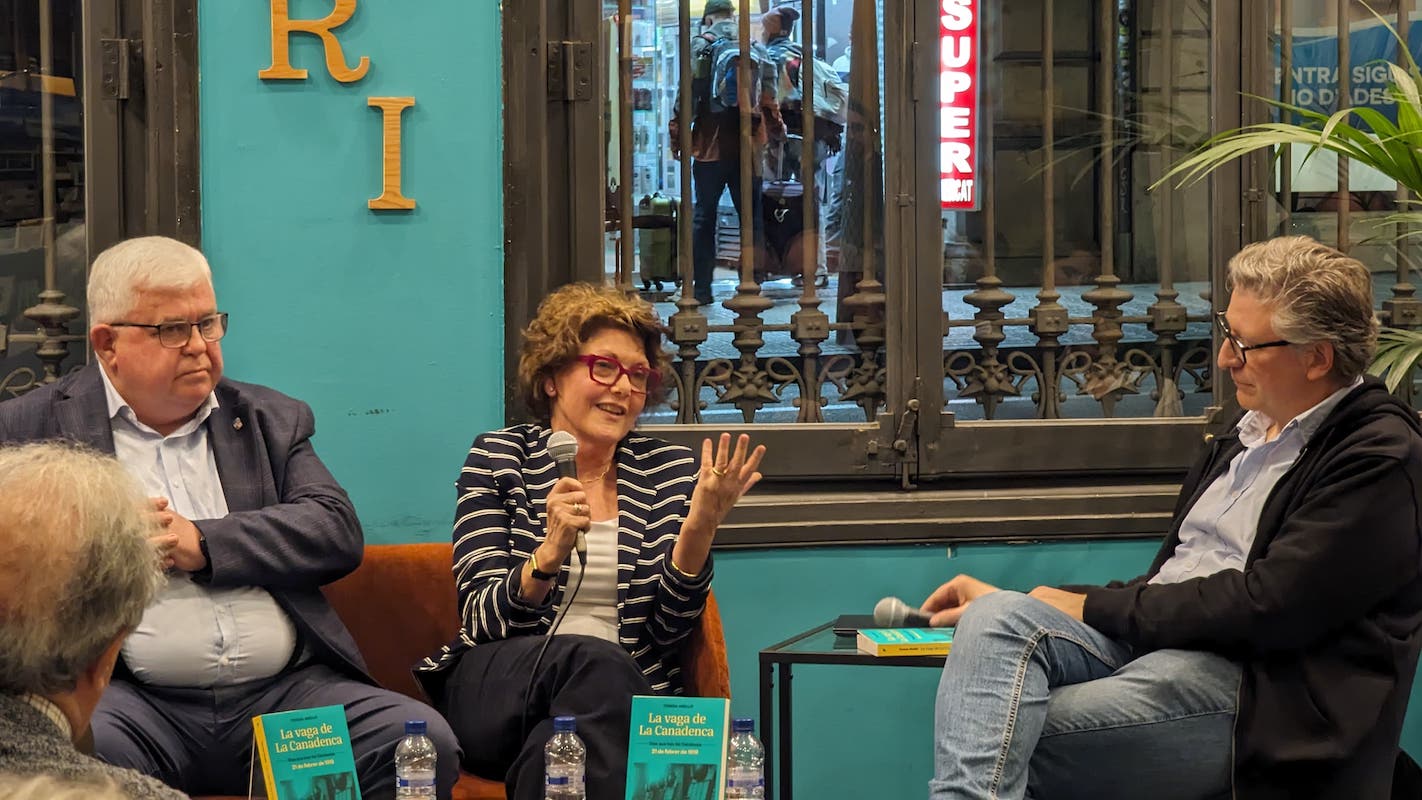
Friendly, manageable and, above all, anonymous
"I am not from Barcelona, in the sense that I was not born here, but I feel very much from Barcelona. I like living here because I am also very urban and, despite having grown up in a village, I don't idealize village life," declares the parishioner with her gin and tonic almost finished. "This is a friendly and manageable city that, moreover, allows you the anonymity typical of large cities, something I really like."
Perhaps, if she had to ask for something, she dares to suggest "that some things be done with more care, since I believe that some urban interventions have been done without care and there are aspects that could be improved, such as cleanliness or excessive permissiveness that tolerates uncivil attitudes that should not be allowed," she determines as she finishes her drink and the notes of Chick Webb's Blue minor resound in the air.
—What is not uncivil at all is our gastronomic offer, in case you want to have dinner. We have everything: menu, à la carte, sandwiches, combo plates… all exquisite!
—Combo plate definitely not, because I detest it!
—Then?
Teresa Abelló laughs loudly.
—Well, after a gin and tonic… let another gin and tonic come!--- she determines, animated by the atmosphere of the Bar.

Add The New Barcelona Post as your preferred Google source for free
Stay informed with the latest news.
