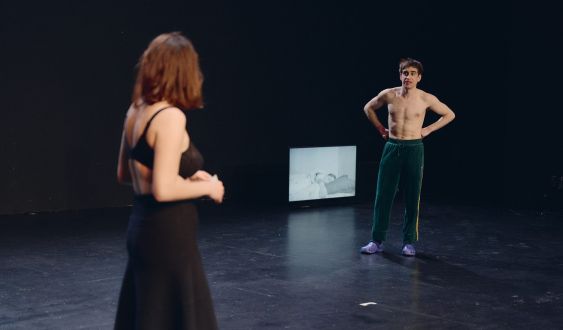
What happens when a set designer and an actor decide to bring their intimacy to the center of the stage? The answer is Tendrament, a play that lands at Sala Beckett to dismantle, piece by piece, the puzzle of coexistence, desire, and power structures in a couple.
Tendrament, naturalness is served
The show begins by breaking the fourth wall with utmost naturalness. The introduction of the performers (who play themselves) sets the rules of the game from the very first minute. It is brilliant and very amusing to see how Judit's presence is managed, as she is not a professional actress. Her interpretative "shortcomings" (forgetting the text, doubting if she is understood) give it a touch of truth that makes the audience immediately connect with the proposal.
The appearance of their son through a "baby monitor" type recording reminds us that, although we are in the theater, domestic reality and its obligations are always present.
The power struggle reflected in the table and chair
As the play progresses, the "how" we love each other becomes the engine of the action. We see situations with which any couple can feel identified: reproaches, disguised arguments, and the constant negotiation of one's own space.
A play that teaches us that tenderness is also based on listening to the invisible violences that appear while we try to build an "us."
The gender analysis proposed by Tendrament is perhaps its strongest point and, at the same time, the most bittersweet: Pau Vinyals, with his childlike, playful, and overflowing energy, occupies the scene with the same force as the "immense table" that occupies the stage. Faced with this, Judit Colomer often remains blurred, like a chair that has to make room for the magnitude of the other. It is a very powerful visual metaphor about how, even in the most conscious relationships, the man tends to talk only about himself, and ends up overshadowing the woman.
The culminating scene of this theme takes place when we see Judit literally carrying the weight of the table on her shoulders. In the end, she ends up almost crushed by its structure. It is the image of the wear and tear of the "woman-mother" who controls and sustains the world while the other plays.
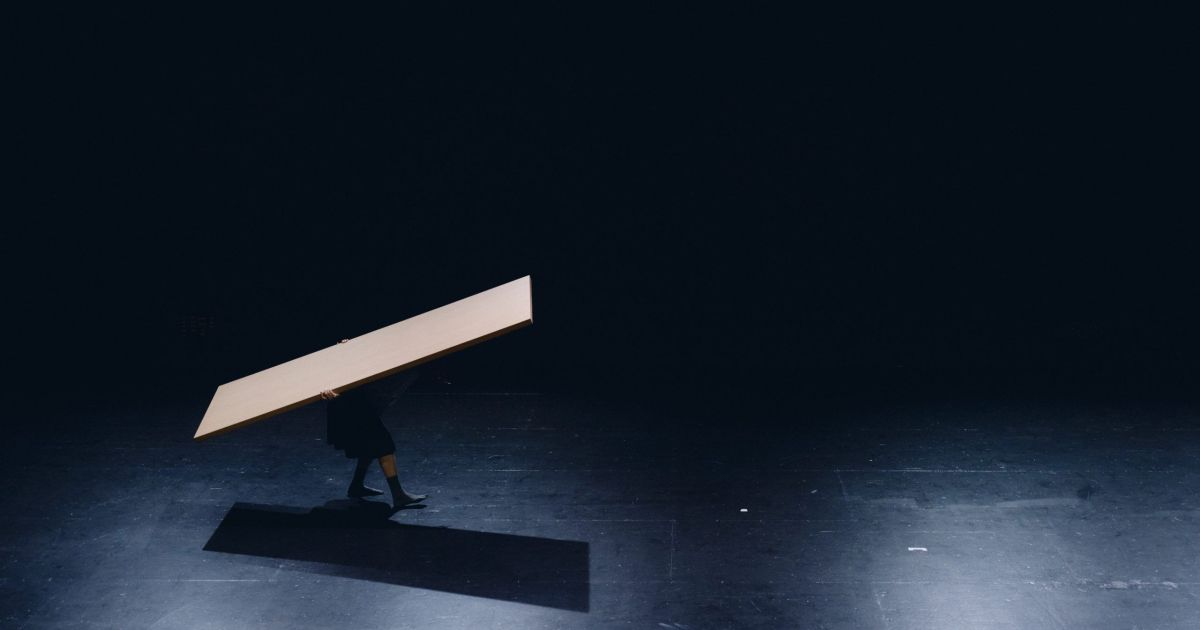
But, Tendrament encourages us to find a way to solve this imbalance. And we see that in Pau's final gesture, who also gets under the table to share this weight with her. They love each other, they rethink each other, and they try to yield space.
A too familiar mirror
If we had to put a "but" to this piece, it would be precisely that the image projected of man-woman is not innovative. We find ourselves before the usual archetypes: the man as an eternal and free child, and the woman as the figure of control and burden. It is such a widespread reality that, at times, it would have been interesting to see another perspective of these very marked roles.
Even so, Tendrament is an original, metaphorical, and everyday proposal. A work that teaches us that tenderness is also based on listening to the invisible violences that appear while we try to build an "us."
Add The New Barcelona Post as your preferred Google source for free
Stay informed with the latest news.