On the occasion of the tenth anniversary of the death of the Barcelona artist, we highlight his work and cultural legacy, which was born in Catalonia but reached the most recognized artistic centers on the international scene. The MoMa in New York, the Institute of Contemporary Arts in London, and the Musée d'Art moderne in Paris are some of the many centers where he has exhibited.
This year marksten years since the disappearance of the painter, sculptor, and art theorist Antoni Tàpies (1923-2012), the maximum exponent of abstract informalism and one of the most international Catalan artists of the second half of the 20th century. To delve into Tàpies' work ten years after his deathit is essential to know its historical moment and contextualize abstract informalism, a pictorial movement that, broadly speaking, emerged in Europe after World War II, as a result of the unease in which society was submerged after this catastrophe. As a consequence, artists lost interest in representing the reality around them, the lack of hope generated great disillusionment, and art took the path of formal experimentation and abstraction, which served artists to externalize the feelings of anguish and frustration that troubled their daily lives. In the case of Catalonia, this disillusionment was further exacerbated by the repression experienced after the Civil War.The abstract informalism that is breathed in Europe filters through some artists who feel identifiedand import this aesthetic current here. These artists belong mainly to the Dau al Set group (which we will define later) and Antoni Tàpies is the main representative. Tàpies was born into a family of the intellectual bourgeoisie of Barcelona. The connection of his environment with the political life of the city before the Civil War stands out, mainly marked by the figure of his father, a lawyer and legal advisor to the Generalitat. Unfortunately, his primary education (during which he drew self-taught) was interrupted by serious health problems in 1940, when he was forced to undergo a long convalescence in different sanatoriums in Puigcerdà or La Garriga. It is during this period that the young artist develops his inner gaze and his interest in philosophy is born. He draws from authors such asNietzsche, Ibsen, Stendhal or Proust and also discover the music ofWagner or Brahmsand he feels very attracted to German Romanticism. The illness, added to the fall of the Republic and the disappearance of the society Tàpies had known during his childhood, would deeply mark his work and character. During his youth, he began studying Law, which he would not finish because he felt a much deeper vocation for the world of art, to which he wanted to devote himself completely with the hope that it would give meaning to his life, which had become unbearable for him. During this stage, he came into contact with some personalities with whom he would have great affinity throughout his life and who would also influence his career: the poetsJ.V.Foix and Joan Brossa, the gallerist Joan Prats or the artist Joan Miró, of whom he was a great admirer. Also corresponding to this stage is the birth of the magazineDau al set, which deserves special attention and which arises as the fruit of a series of very fruitful friendships between characters closely linked to Tàpies' life:Joan Brossa, Arnau Puig, Joan-Josep Tharrats, Joan Ponç or Modest Cuixart. The magazine (which appears clandestinely because it is written in Catalan) represents a breath of fresh air and almost miraculous modernity in a Barcelona in the midst of post-war. It aimed to recover the Catalan artistic avant-garde forcibly interrupted by the Civil War. Such was its impact that the MoMa museum in New York considered this publication as one of the first avant-garde magazines published during the 20th century, highlighting its content and surrealist spirit, the aesthetic that combines texts with visual poems, pictorial works and much more.
Dau al set represents a breath of fresh air and almost miraculous modernity in a Barcelona in the midst of post-war
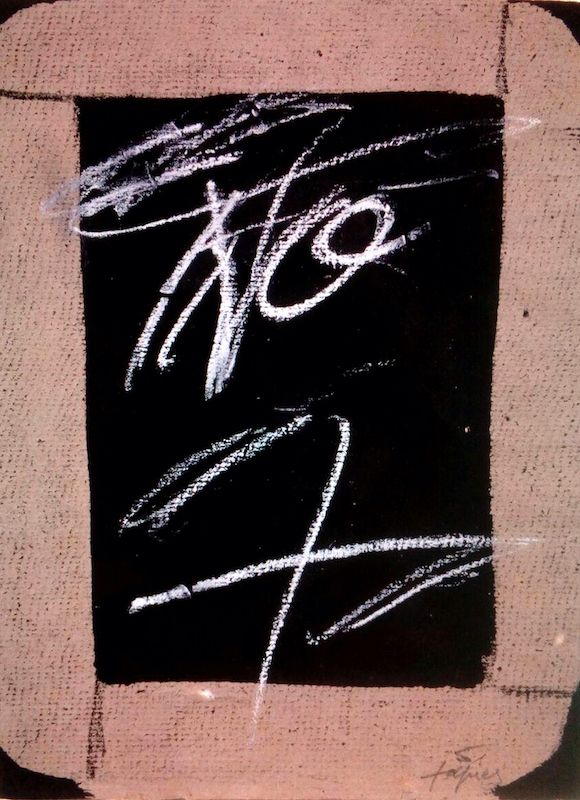
In this first stage, we find a young artist who travels through the already explored paths of figurative art and immediately the need arises in him to go further, to investigate with materials as an active entity of the work of art and to apply these materials in an unconventional way, generating new realities through the collageand of the superposition, which are constant in his work. Thus, we find in his work thick pastes, excess of matter and an innovative conception of the work of art, not understood as something that represents reality, but as an object of power that brings value in itself with its presence,connecting with the purest primitivism of ancestral societies by which she felt attracted and which were so distant from her own. During this stage, the artist also delves into the study of surrealism and dadaism. Artists likeDuchamp or Dalíwill strongly influence his work which, little by little, will lose material density and will also incorporate other elements such as ropes, ceramics, and scrap metal. He is also attracted to artists such asIves Tanguy, Max Ernst or Paul Klee,of whom he is interested in his great variety of techniques and his communion with nature.
Tàpies proposed an innovative conception of the work of art, not understood as something that represents reality, but as an object of power that brings value in itself with its presence
Tàpies has another objective: to create a space in Barcelona to promote contemporary creation
And it is because of Teresa Barba that the couple's dreams culminate, since culminating the foundation we find the sculpture Cloud and Chair(1990), which, as explained, is the material representation of a dream Teresa had, where she flew among clouds above the sky in a chair. Teresa shared her dream with Tàpies and he materialized it by crowning the Foundation's building and thus raising its height, as it is located between two substantially taller buildings. I finish these lines leaving the Tàpies Foundation, where I like to go from time to time to rediscover Tàpies after Tàpies, to corroborate that he is an artist who continues to live through his work since, ten years after his death, he continues to do something that was very characteristic of his art and his person: generating synergies with the work of other artists to mutually enrich each other, in this case with emerging artists who often fill its walls and coexist with the master's work, establishing new dialogues and forms of connection that allow us to rediscover new nuances of his work. Detail of the sculptureCloud and Chair(1990), culminating the Tàpies Foundation.
Add The New Barcelona Post as your preferred Google source for free
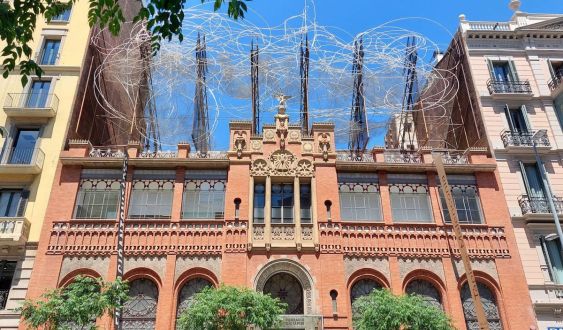
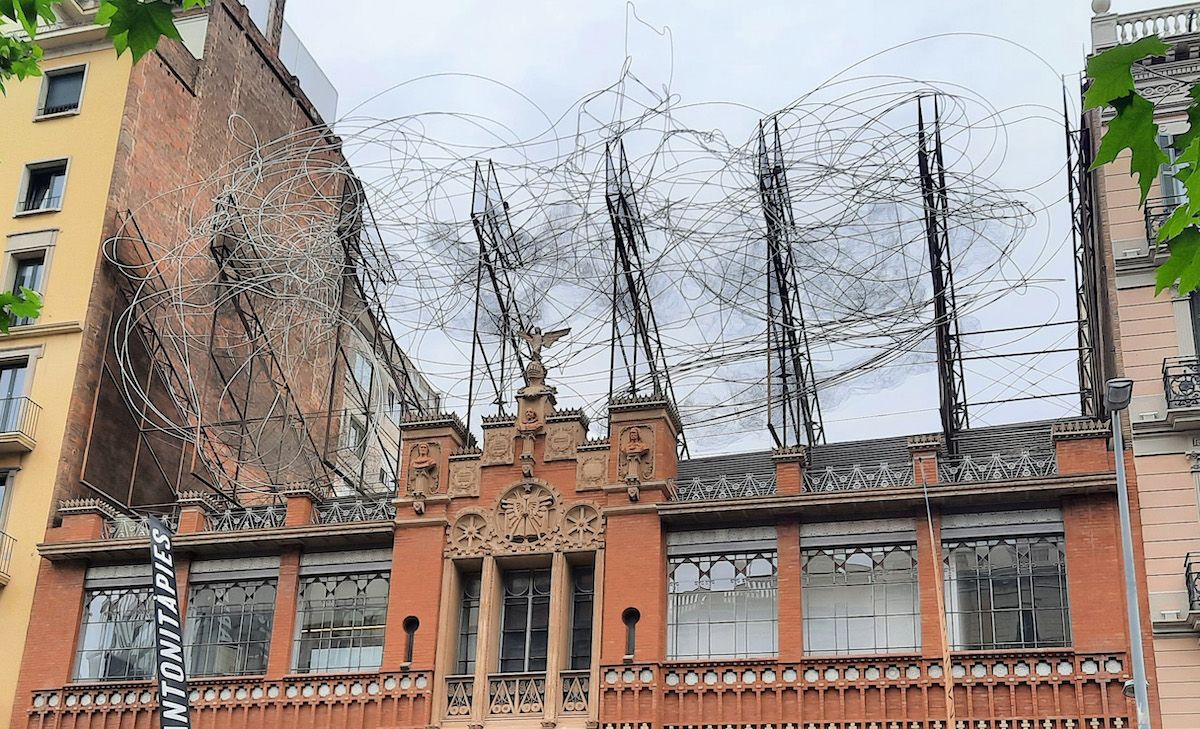 Detail of the sculptureCloud and Chair(1990), culminating the Tàpies Foundation.