
The Catalan economy is in a good moment and is taking steps towards a more productive model, despite the pending challenges to be resolved. These are the conclusions of the Annual Report on the Catalan Economy 2025, which serves not only to understand the evolution of Catalonia's economy —especially in an uncertain international context—, but also to analyze the challenges and opportunities it faces, and how to address them.
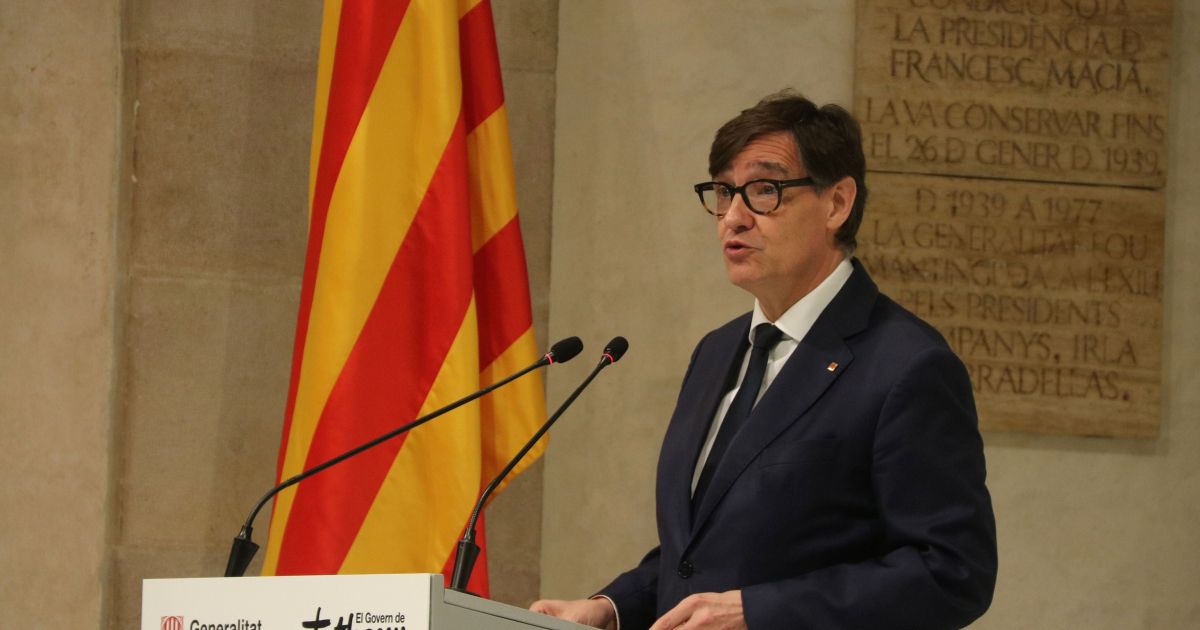
Because in this approach to challenges and opportunities is where, often, the difference can be made. "We must look at opportunities and not just risks; pessimists, step aside," proclaims the President of the Generalitat, Salvador Illa, as a maxim. But, just as pessimism must be set aside, "there is also no room for complacency."
"Misunderstood optimism closes its eyes to challenges, and that is dangerous," and even more so in a context of international uncertainty. And, as the general director of Economic Analysis and Foresight, David Lizoain, highlights, "the Catalan economy is in a good moment, but it could be otherwise; the good situation occurs despite the external context, and thanks to internal demand."
Thus, despite a 2025 marked by tariffs and international conflicts —and a 2026 that follows the same trend—, the Catalan economy grew by 2.7% in 2025, "almost double the eurozone average" (1.4%). The average GDP per capita is also above the European average, and the unemployment rate is the lowest in recent decades.
All this occurs at a time when the Catalan economy perceives underlying signals towards a transition —still incipient— towards a "better productive model," with jobs in value-added sectors. But these signals are not without challenges, such as those cited by the dean of Law and Political Science studies at the UOC and member of the Advisory Council for Productivity and Economic Leadership of Catalonia, Ignasi Beltran de Heredia: "The challenges we have ahead are of great complexity."
"Some we have known for a long time, such as population aging or young people's access to the labor market, and others have emerged in recent years, such as climate change and AI," highlights the also professor of labor law and social security, who cites another challenge: that of equality between women and men in the labor market. The doctor in Economics and member of the same council, Jennifer Ruiz-Valenzuela, has emphasized the importance of women participating in the labor market with equal conditions and opportunities, and has stressed that "the problem is not so much inequality between men and women, but what happens when children arrive."

All these challenges and the way they are addressed condition the competitiveness and productivity of Catalonia and, therefore, its economy, and its capacity to redistribute it. Faced with these challenges in favor of productivity, the Minister of Economy, Alícia Romero, proposes a recipe with three ingredients: talent, innovation, and increasing the size of companies.

"Talent is the most important element for a company to function and for productivity to increase," she emphasized. Innovation also plays a crucial role, which is why the Government has articulated a new strategy to promote it with more aid and, above all, with a more coordinated and connected system that improves the transfer of knowledge to the market. "To be more productive, it is essential that we are more innovative." And here the third ingredient is also relevant: business size. This is because 90% of Catalan companies have fewer than ten workers, when a larger size facilitates progress in areas such as innovation, export, and internationalization.
They are three elements capable of multiplying productivity and competitiveness, and of raising the level of the Catalan economy and its GDP. However, as Lizoain has highlighted, "the entire economy cannot be reduced to GDP, nor can the entire country be reduced to the economy; the correct functioning of the economy is a necessary, but not sufficient, condition to respond to the challenges we have ahead." And it is that the good situation of the economy must translate into a "shared prosperity", into a model of wealth redistribution that Illa has valued, also through the Catalan budgets. "Ensuring that the prosperity generated by Catalonia is shared is both a moral imperative and something necessary for the functioning of the economy," highlighted the president, who went further: "Catalonia's shared prosperity model will not be for sale for a few tenths of GDP."
Add The New Barcelona Post as your preferred Google source for free
Stay informed with the latest news.