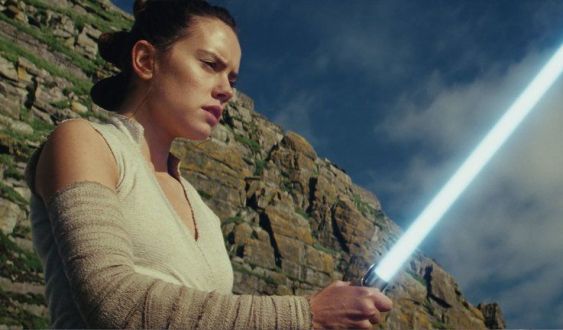
The products derived from that distant world fulfill a ritual function, making their owner a participant in a narrative proper to the mythIt is tempting to believe that the success of the sagaStar Warsit is due to the deployment of an aggressive marketing device. But the question can also be understood in reverse: the deployment occurs according to the interest aroused by the complexity of the issues put on the gaming table by fiction, and which go far beyond what is usually narrated in action movies, in which "good guys" and "bad guys" face each other without truce or ambiguities. It is undeniable that the proliferation of never-before-seen or imagined creatures, as well as special effects, powerfully capture the viewer's attention, while the wise use of the soundtrack, by John Williams, endows the plot with a deeper and more credible dimension, through theleitmotiv, that is, by assigning recurring themes that characterize characters and allow amplifying the meaning of the situations presented. And, yet, the audiovisual grandiloquence functions as a support for a proposal that in itself wants to be transcendent and whose progress is narrated with an epic tone, as aepicfoundational of values, located beyond the viewer's context ("a long time ago, in a galaxy far, far away").
SPIRITUALITY THAT PERPETUATES IN TRILOGIES ""Humanity begins the moment it stops being instinctively selfish," affirmed Akira Kurosawa, having observed not without astonishment the capacity for sacrifice of which human beings are capable. Georges Lucas's knowledge and appreciation for the Japanese director's cinema is evident, and in fact he himself has pondered the influence of films such as Rashomon, Seven Samurai or, above all, The Hidden Fortress.
It's hard not to understand, in light of these, the Jedi aesthetic and discipline. Katanas become lightsabers and kimonos are the attire that characterizes those governed by a Buddhist-like morality, a philosophy of life that primarily renounces the satisfaction of particular interests.
The absence of theoretical doctrines in the Buddhismit is accompanied by a practical disposition, a form of empathy that is no less demanding than study. And yet, the proposal of alternative spirituality that it offersStar Warsproves to be extremely successful in commercial terms. It is well known how fiction -series and films, in our era- performs in the popular imagination the function of a mirror in which to look at oneself for self-acceptance and acceptance by others, and in which axiological questions, related to values, are debated (it has a role comparable to that of the novel, which Paul Ricoeur studied inTime and Narrativeor in Oneself as Another). The saga of the Jedi knights functions in the worldview of different generations of viewers as a foundational myth, a religious narrative that captivates from the beginning, with the original trilogy, through the split and identification of father and son, which becomes a figureChristicdue to the crisis he experiences upon knowing and suffering for the truth. The Freudian reading points to the constitutive ambivalence of that family relationship oflove-hate, present in the origin myths of different civilizations, including Christian (and whose psychoanalytic version, already in the 20th century, is the confession of that dream of a Freud patient: "Father, don't you see I'm burning?").The saga of the Jedi knights functions in the worldview of different generations of viewers as a foundational mythThe son redeems the father who has plunged him into the incomprehension of exaggerated suffering, he saves him; he promotes the turning of his gaze in Return of the Jedi perpetuating the emotional intensity of The Empire Strikes Back, one of the best sequels in the history of cinema. The second trilogy, on the other hand, is a full-blown anticlimax, which seems to be being amended by the third trilogy in recent years. In the figure of Kylo Ren -son of Han Solo and Leia- but also in that of the elderly Luke, whom Yoda still calls "young Skywalker" inThe Last Jedi, we rediscover the correspondence of good and evil, understood as two sides -not mutually exclusive- of the same coin. The "dark side" emerges in Kylo Ren, as it had in his grandfather Darth Vader, but also doubt, the hesitationThe parallels are not coincidental, quite the opposite. Luke is tempted to extinguish it, to deny it out of fear, which only spurs its reality.THE FORCE, COSMIC PRINCIPLE Thus, what truly captivates about the saga Star Wars, since its initial trilogy, is the psychology of the characters and the network of sentimental and family relationships that is progressively revealed, in relation to a principle with mystical connotations, such as the "the force". The term (force) well it can point to a physical aspect, to a power, because those who recognize it in themselves with a superior intensity are also skilled in combat, capable of making masses levitate with (the power of) the mind. There, precisely, lies the other aspect; the one that presents force as a spiritual principle, albeit incomprehensible or inconceivable in an entirely rational sense. The definition of the force is solemnly stated in the first film of the saga -chronologically speaking- by one of the most charismatic Jedi, Obi-Wan Kenobi: "The Force is what gives the Jedi his power. It is an energy fieldcreated by all living beings. It surrounds us and permeates us. It is what holds the galaxy together."Practically identical -we might think at first- is the definition Rey offers Luke Skywalker inThe Last Jedi, being questioned by him: "it's a power the Jedi have, that allows them to control people and... make things float." Luke's answer couldn't be more blunt:"Impressive. Every word in that sentence is incorrect". Not because the Jedi are not powerful, in the sense indicated, but because the assertion is based on a belief, abounds in myth, and is not aware that -as Luke specifies- the Force is not a power exclusively possessed by the Jedi; even if the Force gives them power, once they feel it within them, recognized as "balance and energy" -Rey will say, with good judgment. But this apprehension is not intellectual, nor can it be taken for granted, under penalty of debasing the one who believes himself powerful.
The demystification process of typically "Jedi" notions, in the latest installment of the saga, represents an essential part of the disciplineThe destruction of the temple or the burning of sacred books point to the need to transcend legend, and protect the disciple against imprudent deification. The demystification process of typically "Jedi" notions, in the latest installment of the saga, represents an essential part of the discipline that seeks to be restored. A step further is taken in the criticism of the dichotomous and Manichaean vision, which understands good as inherent to the Force and evil to its dark side. (It will continue...
El presidente de la República, Gabriel Boric, se refirió este lunes a la polémica por los indultos otorgados a 13 personas, entre ellos el exfrentista Jorge Mateluna y 12 condenados en el marco del estallido social.
Desde el Palacio de La Moneda, el Mandatario sostuvo que “lamento que se haya generado esta controversia. Aquí hubo un procedimiento, se actuó en base a las facultades que me entrega la Constitución y la ley”.
“Tengo la más profunda convicción de que fue una decisión bien pensada, una decisión en donde se sopesó el mérito de cada uno de los casos y, por lo tanto, yo actúo en conciencia y de acuerdo a lo que creo es lo mejor para la patria”, añadió.
En esta línea, Boric dijo que “más allá de las recriminaciones que sin duda van a seguir existiendo, yo invito a que construyamos puentes y que, de una vez por todas, cerremos este capítulo”.
“Aquí no hay letra chica, aquí no hay intencionalidad de generar polémicas artificiales, sino que es el uso de una facultad presidencial que está establecida en la Constitución y la ley”, complementó.
Finalmente, el Presidente Boric aseveró que “no me arrepiento de haber actuado en el marco de las facultades que la Constitución y la ley me otorgan. Y, por lo tanto, creo que es importante que cerremos este capítulo”.
Add The New Barcelona Post as your preferred Google source for free
Stay informed with the latest news.
