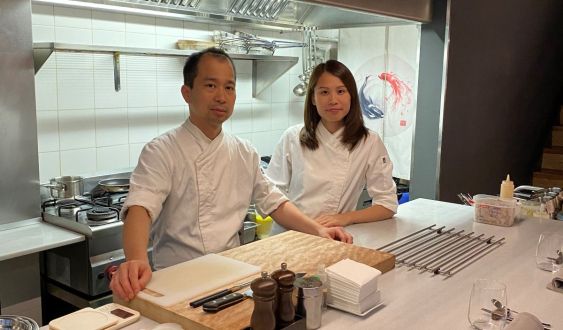
Dining at a bar predisposes, from the outset, to happiness. If we dine alone, what happens in front of us will provide exactly the company we want. If we go as a couple, positioning ourselves in profile activates an obliquity of glances and conversations that forces us to pay more attention to the dish. And if there are more than three of us, it's probably a better idea to take a table.
Although Soluna has tables, the finesse of this restaurant is enjoyed in high definition from the viewpoint of its marble bar. Spacious, comfortable, and well-lit, the bar is the decisive space at Soluna.
Once seated, we look straight ahead and our gaze stops at two people working with the meticulousness of a watchmaker. They are Teppei Nii, the chef, and Petra Hiebler, his kitchen assistant. With their heads practically submerged in the plate, the two silent figures integrate elements and polish plating. The precision of their gestures anticipates that everything will go well.
Approaching from behind, Diana Chen, Teppei's colleague and in charge of the dining room, explains that we can choose two tasting menus: Soluna and Festival.
The Soluna menu (€54) consists of seven dishes and a dessert, with the option of adding a Japanese wagyu A5 beef dish for an additional €18.
The Festival version already includes the famous meat among its 10 courses and costs €85.
We ordered the short one, but we would have liked to come back the next day to try the long one and return two days later to settle into a corner of the bar and observe, until we fell asleep, the movements of Teppei and Petra. Soluna is a mental spa, and its cuisine, a hydromassage bathtub.
Chef Teppei Nii officiated for eight years at Koy Shunka, the Barcelona temple of master Hideki Matsuhisa. During that period, specifically in 2013, the restaurant obtained a star, with the added merit of being the first awarded to a Japanese restaurant in Spain. Four years and thousands of niguiris later, Teppei Nii left Koy Shunka to begin shaping his personal project.
At the end of 2019, Teppei and Diana inaugurated Soluna. Located on Casanova Street in Barcelona, between Córcega and París, the restaurant's name is a fusion of "Sol" (Sun) and "Luna" (Moon), the translation of Hinata and Mitsuki, the names of their two children.
Soluna's Japanese cuisine has a marked Mediterranean accent that is not forced, but rather consistent with the chef's career, who, before his time at Koy Shunka, had worked in the kitchen of Keisuke Matsushima, a Japanese étoilé restaurant in Nice.
The strawberry mille-feuille that closes the Soluna tasting menu speaks of that period and refers to the academic devotion of French chefs to desserts.
On the other hand, the tomato, the queen scallop, the white asparagus, or the red shrimp demonstrate Teppei's interest in working with local produce, passing it through the filter of Japanese preparations and sensibility.
The beginning of the menu, calm, plays the keys of subtlety (cured bonito with tomato, queen scallop in ponzu sauce, and white asparagus with razor clam) and prepares us for the tsunami to come.
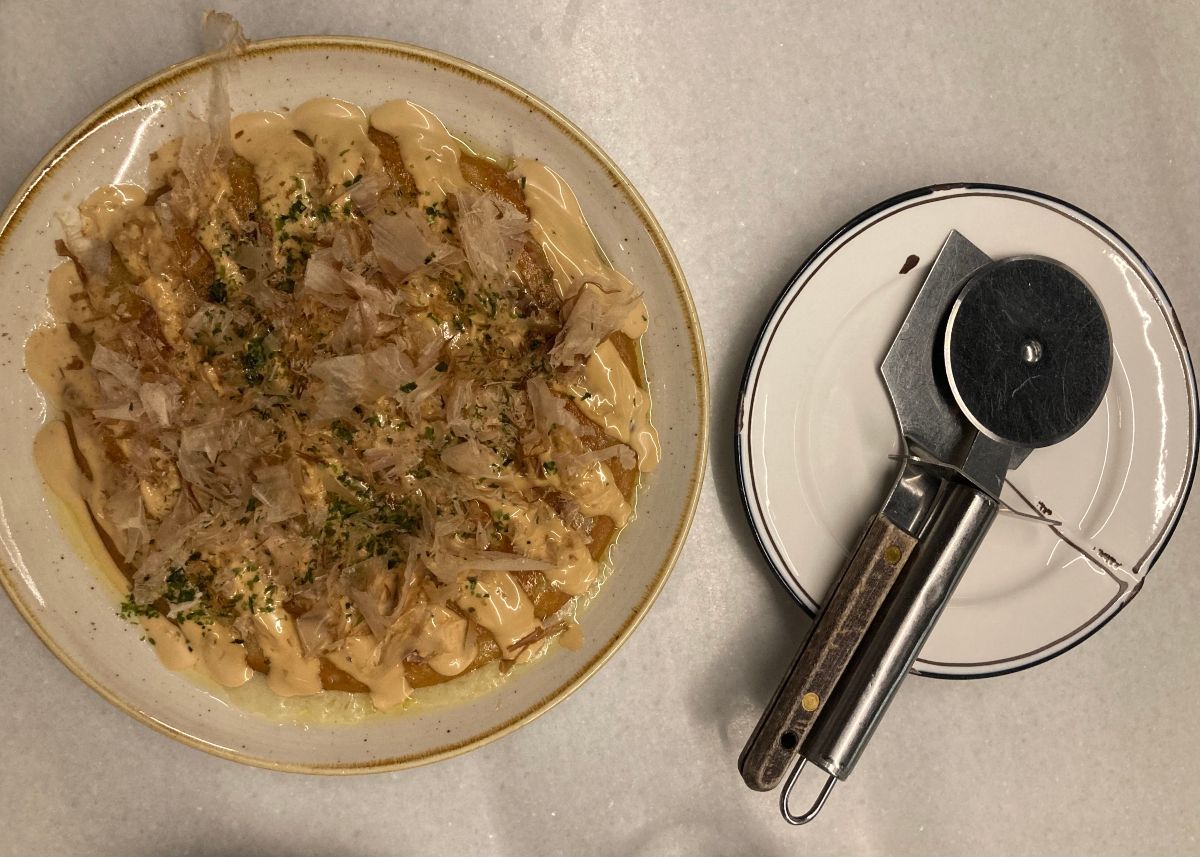
The Japanese kokotxas pizza, which has become an emblem of the house, is a madness that we devour with maximum joy.
A native of Osaka, Teppei Nii has created a memorable version of the traditional okonomiyaki cooked in the streets of his city, using here the gelatinous texture of cod cheeks to sign a triumphant recipe.
A dough made from flour, water, and olive oil gently wraps the kokotxas. The false pizza, halfway between an omelet and a crêpe – but without egg – is painted with a mayonnaise and soy sauce. The whole is a feast, and the dried bonito flakes (katsuoboshi) that crown the dish seem to dance with happiness.
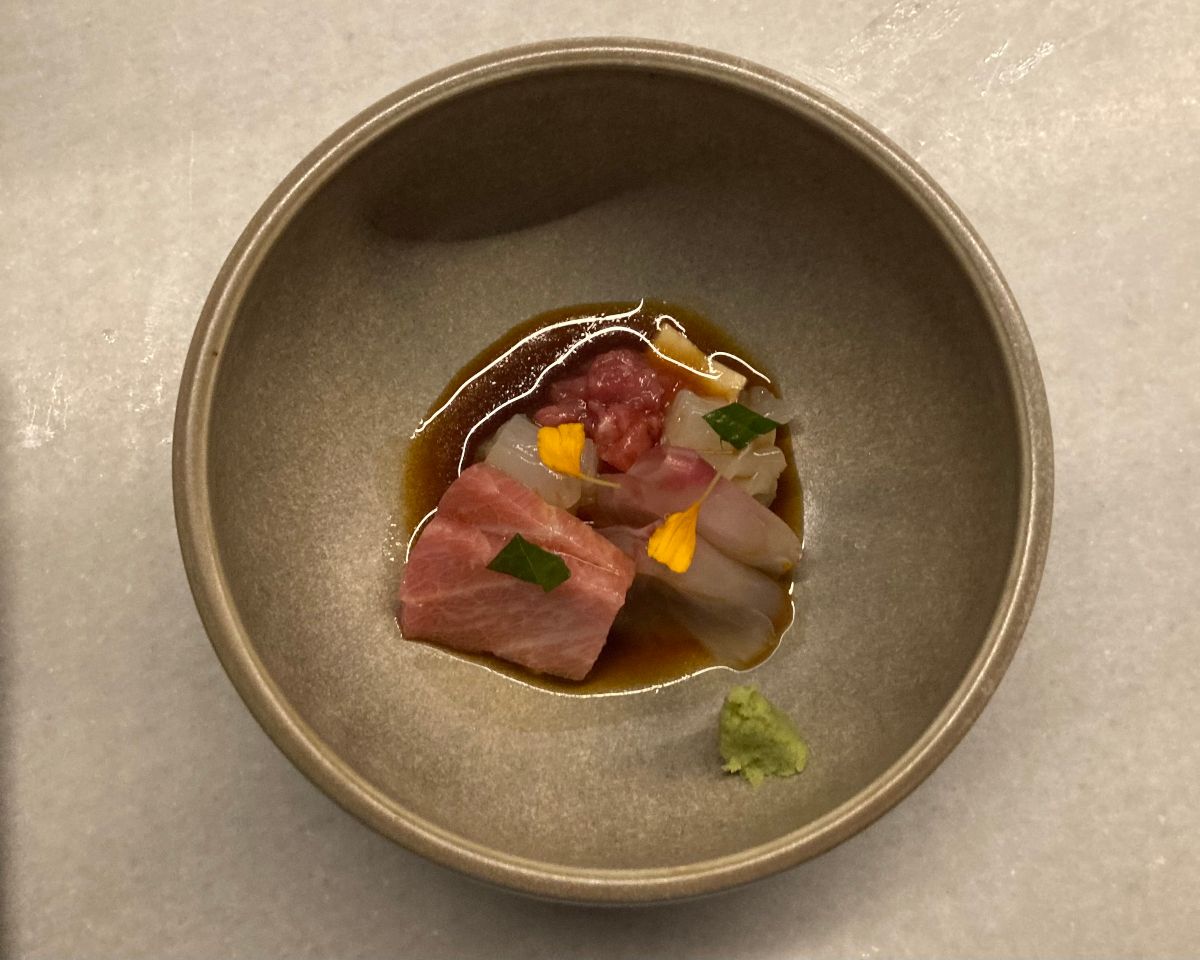
Still recovering from the impact, a bowl containing an assortment of sashimi lands, as if fallen from the sky, in which the toro cuts, glistening with marbled fat, capture all eyes. In a matter of seconds, the tuna belly disappears under our tongue. The squid meat forces us to chew, but the incisions the chef has drawn make the task easier for us. Hamachi and red tuna tartare complete the raw fish club meeting. Knives also cook, and Teppei's are very sharp.
The sum of stimuli is such that the excellent shrimp tartare temaki with scallop and Ebro Delta eel chirashi sushi that arrive next do not receive the attention they deserve, because our brain has transformed into a kokotxa and, suddenly, ideas seem like jelly.
A bar. A kokotxas pizza. Perhaps life wasn't so complicated.
Add The New Barcelona Post as your preferred Google source for free
Stay informed with the latest news.