
A few minutes past eight in the evening, the Palau de la Música maintains the utmost possible silence (which, in the case of the repulsive rudeness of Barcelona's music lovers, implies some mobile phones still to be turned off, the usual burst of last-minute coughs, and a candy wrapper that emulates the creak-creak of a worm-eaten staircase) and the pianist returns to his stage. Today we attend a concert for mythomaniacs, so the protagonist's fans are already excited just seeing him emerge from the darkness with the unmistakable face of a chubby-cheeked penguin who walks towards the instrument like a sleepwalker, with his Napoleonic right hand but in reverse, touching his back. As is also customary in the house, the man gives a brief greeting with a cadaverous mask-like face that will not change throughout the night, after which he quickly leans towards the instrument and - when the consumptives have not yet finished their recitation - attacks Beethoven.
Barcelonans, due to our horrifying civic narcissism, believe that many artists in the world have a special relationship with our city. We usually say it like that, lengthening the cadence of the word special in a particularly grotesque way. The clearest example of this delusion, and also the most abominable, is that of Bruce Springsteen, whom we consider a half-friend ---we call him "the Bruce", as if he were our niece's clarinet teacher--- simply because he visits us very often and gives us some awful tabarra of his in Catalan. This also happens in the case at hand, that of the brilliant pianist Grigory Sokolov, who visits the Palau de la Música almost annually in recitals of maximum artistic ambition, but who is above all known for what his faithful call "the third part of the concert"; namely, when the Russian begins a series of encores that can last, as this past Thursday, up to six curtain calls.
In fact, a good pianist friend always reminds me that the third act in question constitutes the best of these anthological routines. I must agree with him, perhaps because Sokolov is already seventy-five years old and is not as perfect as before in the execution of great "program" works. This was the case at the Palau, in a very uneven concert where Ludwig van's Sonata No. 4 in E-flat major, Op. 7 was very blurred by a surprising extra dose of wrong notes. But well, it doesn't matter if Sokolov wasn't having his best day, because the fireworks started to improve with the Six Bagatelles, Op. 126. Lifelong Russian pianism, with the pain of music embedded in the liver but without any emotional spasm, and with a very singular way of approaching the keyboard, percussing it as if it were still a hammer instrument, where each note should be differentiated from the rest, even though the Beethovenian fabric unites them like a trencadís of hysterical babble.
Despite the anxiety for encores, I was eagerly awaiting Schubert's D960, this delicious and absurd kilometer-long marathon, one of my favorite sonatas. I was surprised that the pianist attacked it quite fast, in a Molto moderato that I don't know if it ended up approaching twenty minutes in duration (Sviatoslav Richter, our Lord God, chewed it up to 24.33!), but with the trick of threatening-sounding mortuary basses fired as very few artists on the planet can play them, and an Andante sostenuto, who knows if the most beautiful farewell ballad ever written for any instrument, also somewhat rushed. I have heard Sokolov play the same piece many times, enjoying the silences that Schubert gives us much more; but he doesn't care, because to play this monstrosity you have to have balls like a bull and it requires being in front of a demented musician. The audience, who came applauded from home, forgets these amendments and already gives him an ovation.
From this moment on, of course, the liturgical feast of the encores begins. Here, the grand conception of long works is no longer appropriate, and technique is not what the audience demands, because the only thing they long for is the same infinite durability of the concert. The pianist repeats the usual ritual; two bows (now also addressing the spectators at the Palau organ) with a look of absolute indifference… and we're back to it. The Barcelonans are torn between their devotion ---the frenzy to hear the umpteenth interpretation of the third mazurka of opus 30 and the twentieth prelude of opus 28--- or rushing to the vicinity of the Palau to grab a bite at one of the dreadful establishments surrounding it. This is one of the best scenes of these concerts, where one watches in horror as fellow citizens ---applauding while standing and walking--- don't know whether to listen to a new piece or satisfy their craving for croquettes.
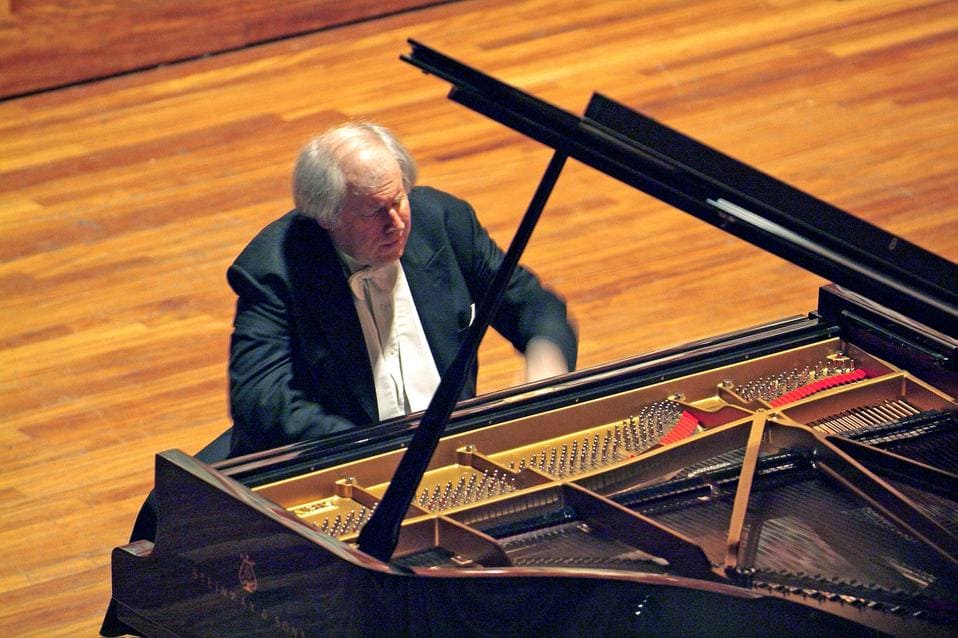
But all this completely slides off the pianist, because he has lived since childhood dedicated to art, according to the ancient Russian ethic of anti-personalism, and all he wants is to knock out another round of six encores with the same grimace he had two and a half hours ago... and get out of this place. We, the Barcelonans, absurdly repeat phrases like the preceding one, and most of us start our way to the aforementioned and dreadful restaurants of vomit-inducing tapas with that idea in mind, according to which we have just attended the concert of a true artist and a man who lives music without concessions. We are quite ridiculous, especially considering that we have attended a concert overflowing with illiterates who applauded between movements. But it doesn't matter, because the Barcelonans only wanted to witness another Sokolov marathon and the benign managers of the Palau have given it to us, for they know how complacent we are.
People flee the Sant Pere neighborhood half-ecstatic and famished. We are different kinds of people, we know the secrets of the city, and the folks at Casa Mari i Rufo await us on Freixures street, even if it's already night (meaning, when you can no longer have dinner in Barcelona!?) to drench our bellies with one of the best monkfish in the West and a clam for which we would sell Chopin's spirit. Until next year Grigory, we are already waiting for you.
Add The New Barcelona Post as your preferred Google source for free
Stay informed with the latest news.