
"The only truancy I committed in my student days was at fourteen to go, with a friend, to the presentation of a book by Camilo José Cela. That afternoon, the writer was presenting a luxurious volume completely out of my budget, but I went with my pocket copy of Viaje a la Alcarria for him to sign it for me. When he saw my friend and me, he exclaimed, with that voice so his own and audible: 'Two real readers, and not all those bitches in mink coats!'". The journalist and writer Sergi Doria cannot suppress a smile, before concluding: "That day I began to realize how interesting the literary world is."
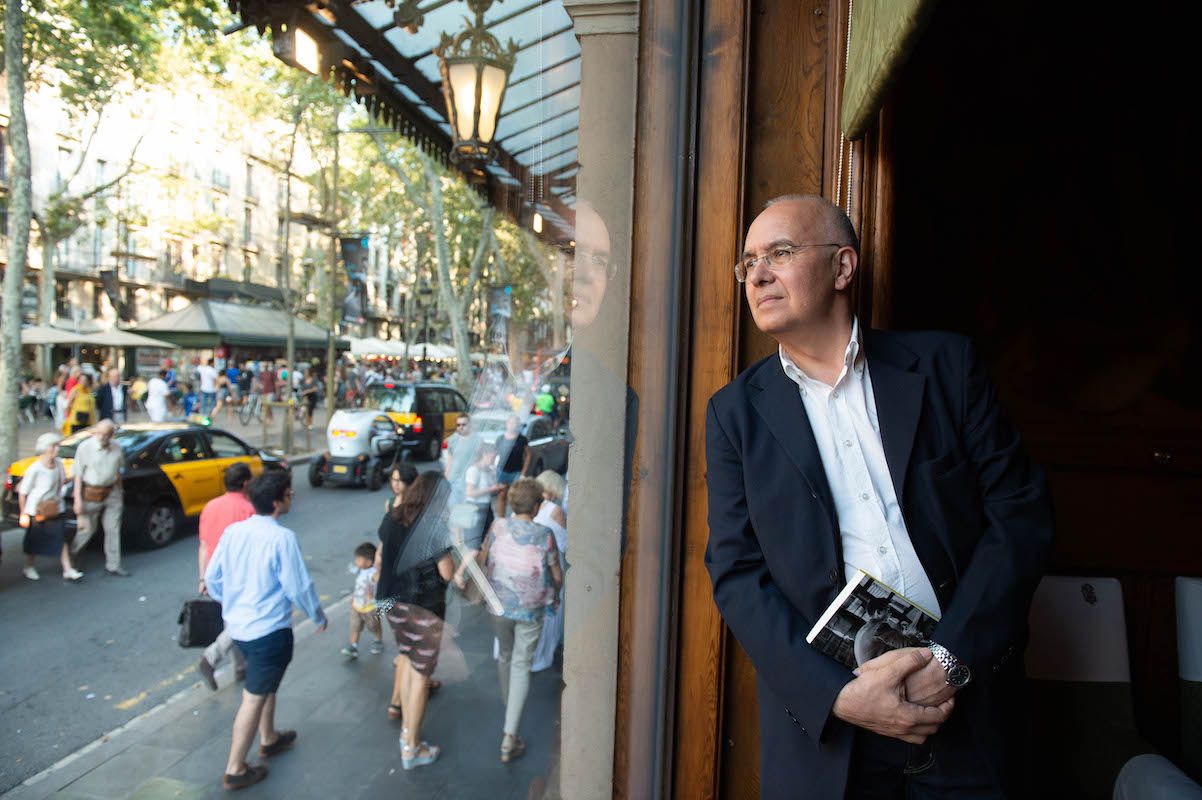
Leaning against the bar, the author of essays and novels such as No digas que me conoces, Passejades per la Barcelona literària (this one, with Sergio Vila-Sanjuán), Ignacio Agustí, el árbol y la ceniza; La verdad no termina nunca or Antes de que nos olviden, sips a mid-morning vermouth to the rhythm of Gardel's Volver.
"I am a son of Poble Sec and Sant Antoni, of the mixed and bilingual Barcelona of El Salchichón bar on Calle de la Cera and El Abrevadero on Calle Vila i Vilà, of the theaters and cabarets of Paralelo; of Sisa, of Peret, of Gato Pérez and of Serrat". Precisely, about the latter, he keeps one of the sweetest memories of his childhood. "The day my father came to pick me up from school and told me he was taking me somewhere. I thought it was the doctor and what was my surprise when I saw it was the Tívoli and that we entered through the artists' door to meet in person, in the dressing room, Joan Manuel Serrat, who was performing there that day. I was twelve years old and I felt like the king of the universe!".
Another moment he remembers with special affection is his friendship with Carlos Ruiz Zafón. "I was the first journalist to interview him after La sombra del viento, when he was not yet known, and from there a splendid friendship was born from which my book La Barcelona de Carlos Ruiz Zafón would also emerge. Meeting him reaffirmed my relationship with literary Barcelona". An idyll that grows in the form of articles for newspapers and magazines such as ABC, Revista de Libros or Turia; anthologies, essays and, of course, narrative.
Olympic secrets
Proud "to have written three novels about Barcelona without blushing before any critic", Sergi Doria announces that he is already working on the fourth, "which delves into the causalities of the Olympic anniversary 31 years ago". A date that has a special significance for being associated with a secret that was kept for years.
"In 1992 there was some concern regarding the lighting of the Olympic Cauldron by the archer Antonio Rebollo. Everyone wondered what would happen if he failed. My father told me then not to worry, that the cauldron would light up anyway. The reason is that he and a technician were in charge of lighting the flame from within, regardless of the trajectory of the arrow shot by Rebollo. At that time I worked at El Periódico, but, of course, I couldn't say anything." He sips a few drops of vermouth, and finishes: "I felt like I owned a great secret!"
--- And you were, no kidding!
Abuser of its prominent men
The Barcelona of writer Sergi Dòria is made of letters, voices, memories, secrets, and sounds, some already extinct, like the passage of the cleaning cart over the cobblestones of the streets of Poble Sec or the murmur of street sharpeners. It is the Barcelona of buildings, corners, and the Montjuïc of his childhood, untamed, "an abandoned and decadent paradise, a jungle for us, city children; a wild world where we could be happy." It is the city of reconstructed buildings, stone by stone, when Via Laietana was opened, and of corners "like the Patio de las Letras of the Universitat de Barcelona, that beautiful garden where Carmen Laforet conceived Nada." It is the city of lights and bars "like the Delicias del Carmel, where at any moment I expect to see Marsé's Pijoaparte," which is born on that Mount Táber that today houses "the beautiful headquarters of the Centre Excursionista de Catalunya…".
--- And it is also a city that mistreats its talent! ---he exclaims suddenly.
Sergi Dòria's Barcelona is that of buildings, corners, and the Montjuïc of his childhood, untamed, "an abandoned and decadent paradise, a jungle for us, city children; a wild world where we could be happy"--- What do you mean?
Sergi Dòria takes another sip before arguing. "As a child, I realized this when I saw that, as a token of recognition for his contribution, Narcís Monturiol, pioneer of submarine navigation, only has a small niche in the Poblenou cemetery. But he is not the only one. Mayor Rius i Taulet, the man who organized the 1888 Universal Exhibition with all that it entailed in terms of city transformation, had to endure insults in his day and oblivion once dead. But the most painful case is that of Ildefons Cerdà, one of Barcelona's great hygienists and the one who created the Eixample, one of the most brilliant and applauded urban plans in the world. He was mistreated by the nationalist Catalan bourgeoisie because his plan had been approved by the Ministry of Public Works against the radial model that they proposed."
And Sergi Doria lets a few seconds pass, which he uses to finish his vermouth, before concluding:
--- And I believe that is something that has not yet been forgiven, hence they have named one of the worst squares in the city after him. The one that always floods when it rains!
Add The New Barcelona Post as your preferred Google source for free
Stay informed with the latest news.
