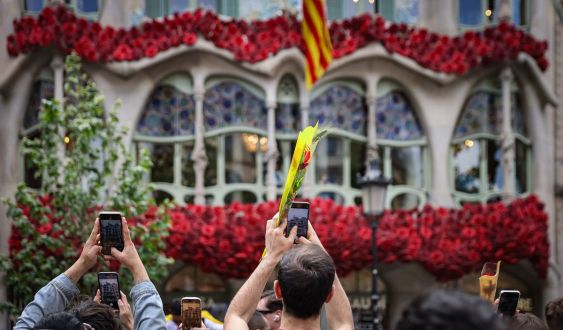
Barcelona changes the route, but not the tradition. This April 23, the city loses one of its most common images of the Diada: La Rambla transformed into a river of people and stalls for a day. The promenade, immersed in a long process of urban transformation, is left out of this year's celebration, altering the usual map of the festival. Thus, streets like Portal de l'Àngel or Via Laietana assume part of the prominence of a day that is not concentrated in a single point, but extends through neighborhoods, cities and towns. Because, despite the change of scenery, the Diada keeps its most recognizable image intact: books and roses will once again fill the streets in a gesture that transcends shopping and speaks of shared affection and culture.
A gesture that dates back centuries and finds its roots in an ancient tradition linked to the figure of Sant Jordi, a Roman soldier who, according to Christian tradition, was martyred on April 23, 303 AD. Over the centuries, his story became enveloped in legends until he became one of the most popular saints of the Middle Ages and, since 1456, patron saint of Catalonia. The best-known legend tells how the knight Sant Jordi saved a princess from a dragon that terrorized the kingdom. At the moment of victory, a red rose bloomed from the beast's blood, which the knight offered to the princess as a symbol of love and triumph.
It was this legend that ended up shaping the popular festival, whose origins are in the 15th century, when the gesture of giving flowers as an expression of affection and celebration became popular. The tradition of the book arrived much later, in the 20th century, when publishers and writers promoted a day to encourage reading in Catalonia. Initially celebrated in October, the initiative gained strength and was finally moved to April 23, a date that coincides with the death of great universal figures such as Miguel de Cervantes and William Shakespeare. Over time, both traditions merged to give rise to the Diada as it is known today: books and roses sharing prominence in a collective celebration of culture and affection.
Without La Rambla: the new map of Sant Jordi
After centuries of tradition, the Diada de Sant Jordi arrives this year with an important change: the relocation of the stalls in Ciutat Vella, traditionally located on La Rambla, to a new axis that runs through Portal de l'Àngel, Plaça Nova, Plaça de la Catedral, and Via Laietana. "Although La Rambla and Sant Jordi are inseparable, with the works in full swing we are forced to move the celebration," explained Raquel Gil, Deputy Mayor for Social Rights, Economic Promotion, Work, Feminisms, and Democratic Memory.
Despite the change of scenery, the city is preparing for another record-breaking Sant Jordi, with nearly 6,000 stalls—2% more than last year—between books and roses, of which 425 will be professional (364 for books and 61 for roses). In total, the stalls will add up to almost four kilometers of sales points distributed across the city's ten districts.

Beyond the new Ciutat Vella axis, the great hub of the Diada will continue to be the literary superilla of Eixample, already consolidated as one of the central spaces of Sant Jordi. Passeig de Gràcia, between Diagonal and Gran Via, and Rambla de Catalunya will once again be filled with stalls and readers, becoming a great river of books and roses. In the adjacent streets—Consell de Cent, Diputació, Mallorca, or Provença—the celebration will extend continuously, with each section occupied by books, author signings, flowers, and pedestrians.
Throughout the day, traffic will be restricted in the superilla area and the city will slow down, if only for one day, inviting people to walk, look, and stop. To guarantee these closures and reinforce security, the Guàrdia Urbana will deploy a special operation with more than 430 personnel—227 agents and 207 auxiliaries—as part of an operation in which up to 702 people will work throughout the week. "The Sant Jordi operation ends when preparations for the next one begin," joked Intendant Diego Calero during the presentation.

The device will cover the entire city, as Sant Jordi is not concentrated in a single spot. The Diada also extends to other neighborhoods, with stalls in places like Rambla del Poblenou, Plaça d'Eivissa, Carrer Gran de Gràcia, or Plaça d'Orfila. A dispersion that reinforces the idea that Sant Jordi has long surpassed the notion of a single center and even a single city, becoming a celebration that is intensely lived throughout the territory.
When the book takes over the street
Despite the novelties —also in the publishing sector, which these days is finalizing preparations to have the big titles of the day ready—, there is an image that is repeated every year: the exchange of books and the encounter between readers and writers. Because if there is one day when the city is experienced through books, it is this April 23rd. The data reflects this: last year, nearly two million copies and up to 75,000 different titles were sold throughout Catalonia, with a balanced distribution between Catalan (52.3%) and Spanish (47.7%). Such is the diversity of readings that the list of best-selling books —one of the great references of the day— barely represents 5% of total sales.
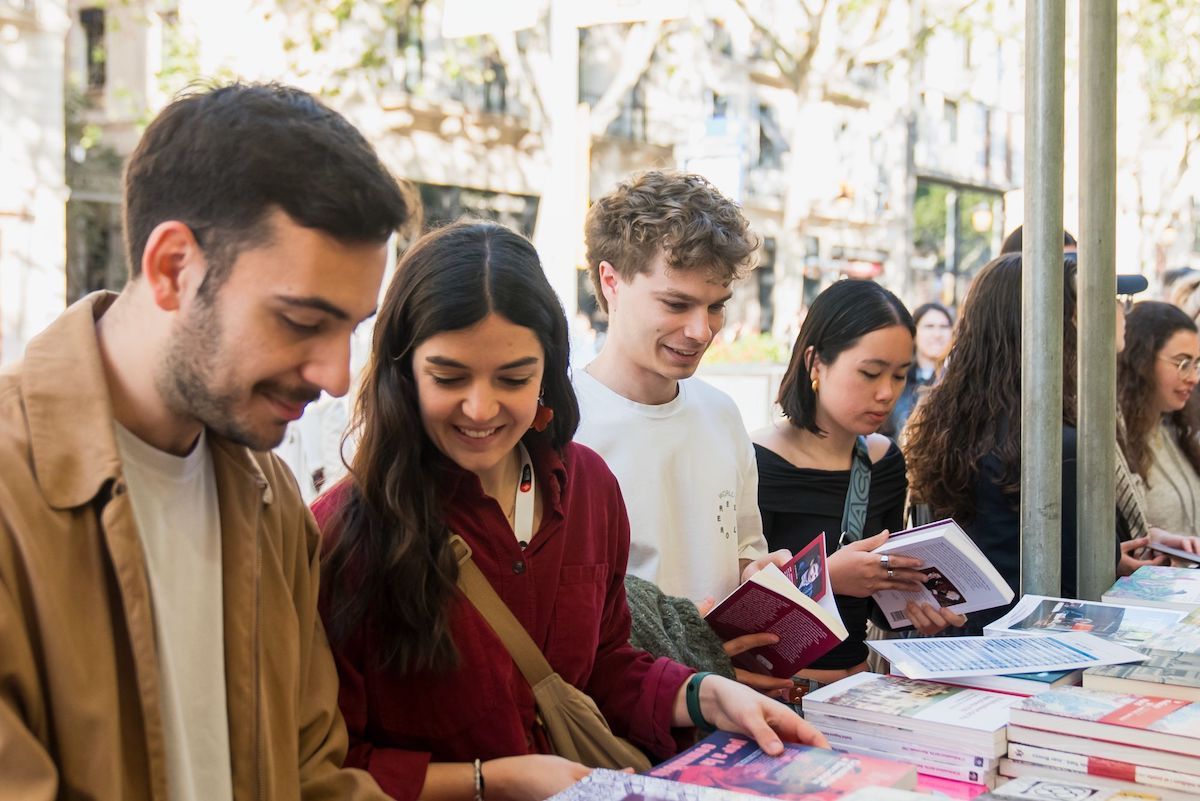
"We have been preparing Sant Jordi for two and a half months. The effort is very high, but it is a very inclusive and easy-to-understand festival, based on a very simple idea: to love and feel loved," said Èric del Arco, president of the Gremi de Llibreters de Catalunya, summarizing the spirit of the day and its most human dimension: direct contact with readers. Last year, this reality translated into 26.1 million euros in turnover —2.8% more than the previous year—, which represents around 20% of the annual turnover of Catalan bookstores.
The epicenter for the sector, however, is not the figures but the encounters. Book signings become one of the most anticipated moments for both readers and writers, with 257 signing points spread throughout the city, many of them in the literary super-block. Authors like Eduardo Mendoza, Albert Espinosa, Eva Baltasar, Regina Rodríguez, David Uclés, Javier Castillo, Alice Kellen, or Joël Dicker are part of this scene repeated every year: readers queuing to briefly converse with their writers, exchange a few words, and take home a dedication that turns the book into a unique object.
Seven million roses
If books are the cultural engine of Sant Jordi, roses are its emotional symbol. They accompany the Diada in every corner of the city, with a discreet but constant presence. The sector expects to maintain sales of around seven million roses throughout Catalonia, a figure similar to last year's and which confirms the intact strength of this simple and powerful gesture.

Those seven million roses will generate a turnover of about 25 million euros, according to sector estimates, with a price that will be slightly higher, around 5 or 5.5 euros per flower. However, the distribution of this volume is not homogeneous: "Just under 10 million falls to the professional sector," warned Joan Guillén, president of the Consell de Gremis and the Gremi de Floristes, in relation to the part of the business that remains outside regulated channels, while the rest moves in an underground economy.
"We have a serious problem, and that is intrusion," insisted Guillén, who warns of the uncontrolled growth in rose sales and the proliferation of unregulated stalls. According to the Gremi de Floristes, the current licensing system generates saturation, unfair competition, and a direct impact on the professional sector. For this reason, they demand a drastic reduction in licenses—to a maximum of 2,500 points of sale—and a stricter organization of space, with stalls limited to the professional sector and non-profit entities, such as students or social groups.
Also to combat intrusion, part of the Guardia Urbana's operation will focus on this area. In fact, last year 2,700 illegal roses were already confiscated, and fines of up to 180 euros were imposed.
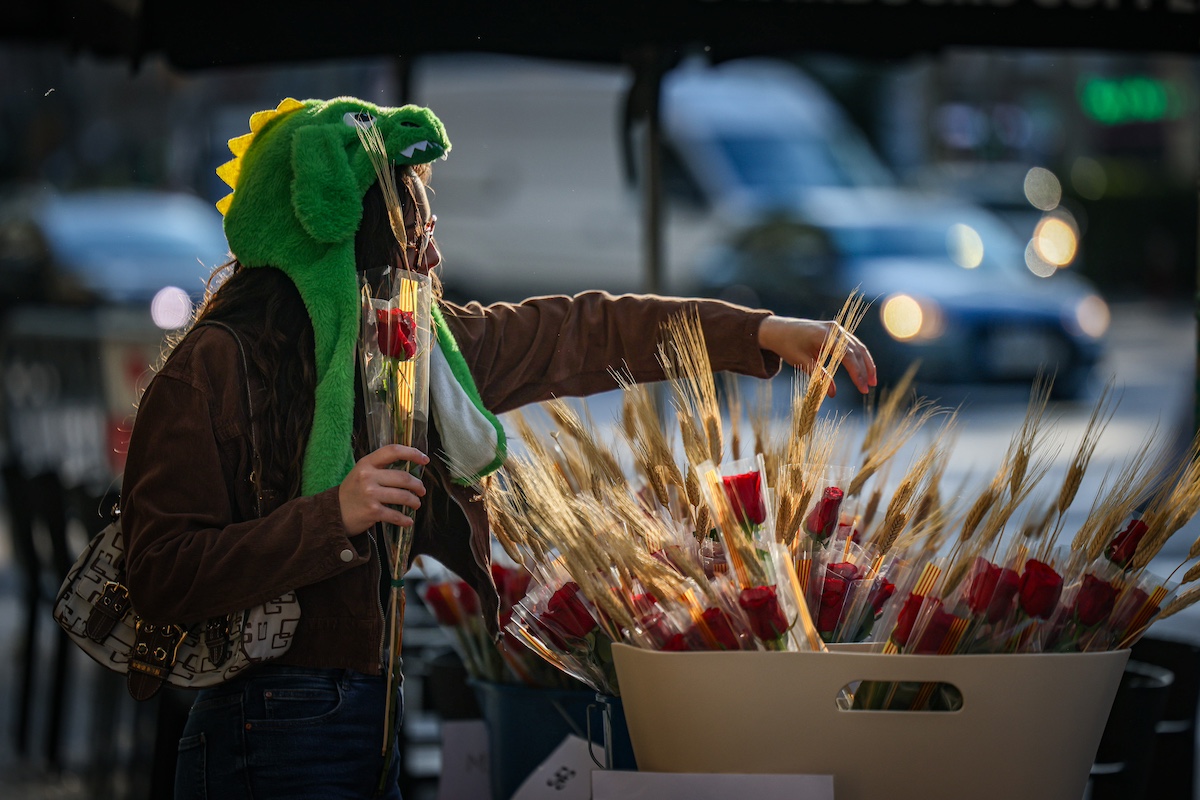
"The situation is a prelude to what may happen in ten years. If we don't change anything, we could end up losing the sector," laments Guillén, who recalls that local flower production—especially in Maresme—is practically non-existent today and does not even reach 1% of rose sales. Currently, most roses come from Colombia (80%), followed by Ecuador (15%) and the Netherlands (5%).
Sant Jordi, a collective celebration: music, heritage, and art
Sant Jordi has long ceased to be just a day for buying books and roses. The city transforms into a large cultural stage with dozens of free proposals spread across streets, squares, and facilities. The celebration officially kicks off on the eve with the reading proclamation, which this 2026 will be given by the writer Ali Smith in the Saló de Cent.
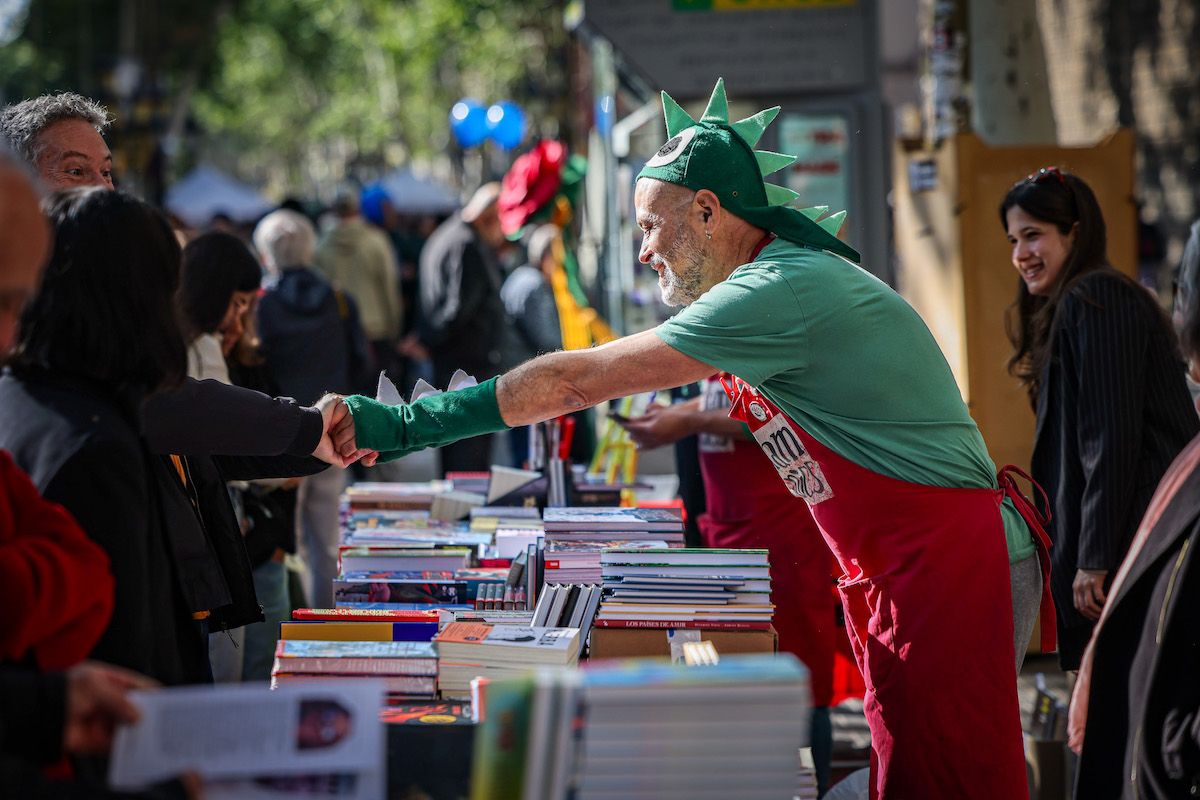
Beyond this institutional act, the entire city is adorned with art with proposals such as TVBoy's live mural, the traditional flowers of Casa Batlló, or installations like the car covered with more than a thousand perfumed roses or the large origami dragon in the Raima stationery store. Music also plays a prominent role, with the Old Estrella Damm Factory as one of the epicenters, featuring about twenty concerts by artists such as Els Amics de les Arts, Maria Jaume, Buhos, or LilDami.
But Sant Jordi is also synonymous with culture and heritage. For this reason, emblematic buildings such as the Barcelona City Council, the Generalitat, or the Biblioteca de Catalunya will open their doors for free, on a day that invites rediscovering the city from within. This offer is joined by spaces such as the Ateneu Barcelonès, the Museu d'Arqueologia de Catalunya, or the Mies van der Rohe pavilion, as well as the Recinte Modernista de Sant Pau, which this year, coinciding with its 625th anniversary, will be filled with book stalls and author signings. The ensemble is completed with a traditional gesture: people named Jordi or Jordina will be able to access spaces such as the Sagrada Família or the Mirador de Colom for free.
Add The New Barcelona Post as your preferred Google source for free
Stay informed with the latest news.