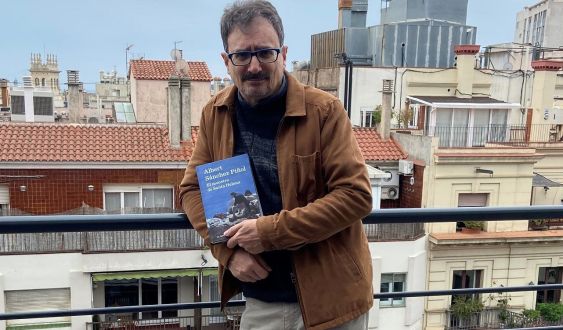
When Albert Sánchez Piñol began to think about The Monster of Saint Helena (published in Spanish by Alfaguara and in Catalan by La Campana), he imagined he would write a short story, with Love, Culture, and Power confronting each other on a remote island for an outcome. But then, the Bigcripi appeared, a marine monster, wet, enormous, and hungry. "More terrible than Moby Dick and Spielberg's shark," warns the Barcelona-based writer. And, of course, with such a fearsome being, the story grows and "you can no longer reduce it to ten pages." This is when the new novel by the author of Victus and Cold Skin emerged. "I had a blast," confesses Sánchez Piñol, who had not anticipated that this plot would be among the stories he would write throughout his life. "It's a gift from providence," he maintains.
Although that Bigcripi recalls the amphibians that inhabited Cold Skin, also set on a remote and unsettling island, Sánchez Piñol rejects any other similarity. "They are different themes," he insists. In The Monster of Saint Helena, he is talking about the counter-revolution that could have returned to power a banished, imprisoned, and brutalized Napoleon Bonaparte, when something unimaginable, and very fearsome, disrupts the established order and the response involves abstaining from ideals and "choosing between death or tyranny."
Despite the fact that all the characters appearing in the novel existed, as attested by the images preceding the narration, and Napoleon's confinement in Saint Helena also happened, Sánchez Piñol emphasizes that "he did not want to write a historical novel," even less so considering that the figure of the French military man stars in countless biographies and essays every year.
Although that Bigcripi recalls the amphibians that inhabited Cold Skin, also set on a remote and unsettling island, Sánchez Piñol rejects any other similarityIt begins by seeming like a historical novel, reinforcing that sensation with the choice of a diary as a way to narrate what happens, but very soon the trap is discovered. Napoleon's bad manners, especially at the table; the follies of the companions who have gone to the end of the world with him or the admiration his figure arouses among the inhabitants of the island are true details. So are the multitude of rats in Saint Helena, almost protagonists of the book.Thus, a completely faithful environment is built, until the Bigcripi arrives and transforms everything, returning the author to that more fantastic environment in which he moves with ease.
But before the Bigcripi emerges from the maritime depths, Sánchez Piñol has to bring Love, Culture, and Power together in the same room. To do this, he resorts to a trigger as old as tests of love. The Marquise de Custine, Delphine Sabran, wants to know if her latest lover, the acclaimed writer François-René de Chateaubriand, truly loves her. She thinks the best way to find out is to go to Saint Helena. She will present herself before the man who has been the most powerful and will see if, when she is about to lose him, Chateaubriand will fight for her or not.
The resolution is not just about the appearance of that monster, as there are other monsters on the island, some of whom reveal their true character before the Bigcripi arrives and others who demonstrate it when they have to fight it. "Monstrosity is contagious," says the author, making "no character emerge unscathed." The characters are archetypes, and Sánchez Piñol emphasizes that "he does not express himself through them; they are the ones who express themselves through me." "I was just passing through here...", he defends.
"Monstrosity is contagious," says the author, making "no character emerge unscathed"The Monster of Santa Elena she positions herself with the Love, Sensitivity or Beauty represented by the Marquise de Custine, she being the narrator of the entire story."It had to be her who explained it," assures the author, as he is also the character who, with the grievance, becomes the most lucid and ends up being conclusive.
But Sánchez Piñol also doesn't want to preach about who should win, whether it's the marquise, the literati, or the ancient emperor. "Books are made to be read and enjoyed," he states. Therefore, in the face of current contexts that might bring his Bigcripi to mind, such as Russia's attack on Ukraine, the writer doesn't know what role each of these archetypes should play. He only wants to "tell stories, not offer solutions." "The Bigcripi has many forms. The least remarkable would be that of the novel," he concludes.
Add The New Barcelona Post as your preferred Google source for free
Stay informed with the latest news.
