[dropcap letter="D"]
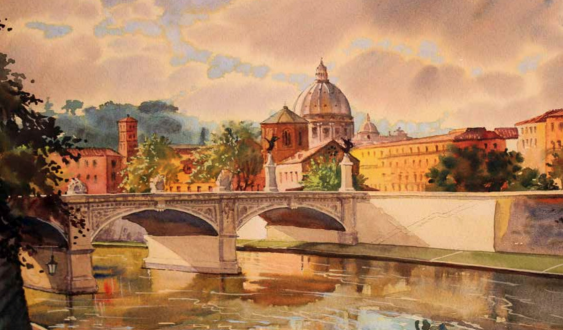
From my apartment in the heights of the heights of Mount Janiculum—the eighth Roman hill, it should justly be called—I contemplate a unique view of the city: domes and bell towers of magnificent churches, towers of superb palaces, sturdy imperial walls, and gardens with pointed cypresses. Also, at my feet, the rooftops of the nearby Trastevere neighborhood and, beyond, tracing the background of this lively Roman altarpiece, the distant curve of the mountain ranges that descend from the north and form, to the east, an irregular bluish line. I have the impression that all of Rome is before me, although the view of the Vatican escapes me, hidden among groves to the west. Today is an autumn weekend, close to sunset, and the flocks of starlings, retreating to sleep in the groves of the Tiber, form dense mobile clouds, in a regular and frenzied dance whose rhythms only they know.
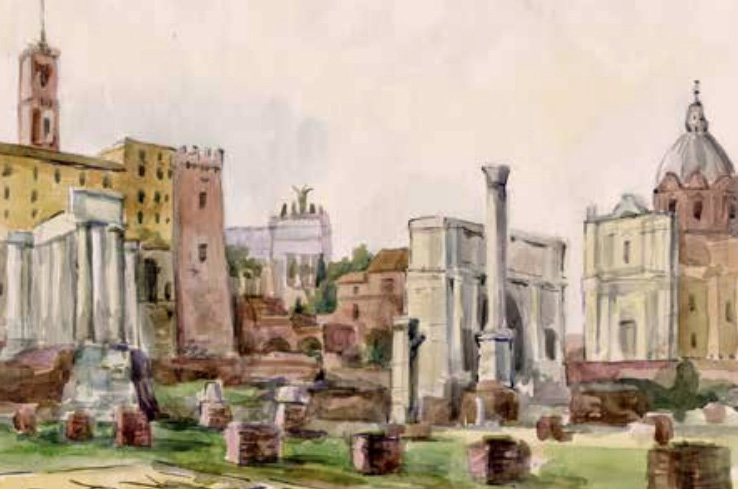
It is the best time to go down to the ancient city, to what remains of that imposing imperial capital whose palaces were razed by barbarians and finished off, taking the old stones to build their mansions, by the great Renaissance lords. Silence dominates the temples of the gods and the hills where the emperors built their residences: the Palatine, the Capitoline. If there is a full moon, that silence becomes even more alive, as if the gods of yesterday suddenly whispered to us that they are still there. Ancient Rome murmurs at night on the Via dei Fori Imperiali, it wants to tell us about its history of wars and art in the forums of Augustus and Trajan, in the Arch of Constantine and in the Antonine and Trajan's Columns. But the architectural king of the millennia-old imperial city is, without a doubt, the Colosseum, a stadium erected not to honor the gods, but to entertain the people. Time has left traces of its passage—and also the invaders of the city—and today it looks like a chipped denture in its upper part. But despite the damage, it is as imposing as the Acropolis of Athens.
The ancient circus, inaugurated by Emperor Titus in the year 80 AD, as I said, was intended to entertain the people. But what a way the ancient Romans had to entertain themselves! The Colosseum was a theater that, at times, even turned the arena into a swimming pool to stage naval battles. What happened is that the battles were real, and men stabbed each other fiercely and died by the hundreds. Among the proposed games were death matches between gladiators and fights with hungry tigers, lions, and bears. Also, as is known, the sacrifice of Christians, under the jaws of wild animals: it is estimated that, in the years the spectacles lasted, some seventy thousand followers of Christ perished in the sands of the Colosseum. It's hard to believe, on full moon nights, that such a serene and noble place, on the last esplanade of the ancient forums, was the scene of so much barbarism. The burlesque poet Gioachino Belli ironized about it in a sonnet: "In the past, so much mourning, so much havoc, and now so much peace! Oh, human ways! How the world is!, how everything changes!".
But old Rome is incomplete if you don't peek into the Pantheon of Agrippa, somewhat removed from the forums, where I cross almost daily during my Roman walks and where I always enter, even if only for a few minutes. It is the best-preserved temple of all Antiquity, and this is due to a Byzantine emperor, Flavius Phocas. He gifted it to Pope Boniface IV, who decided to maintain it as it was, only changing the statues of pagan gods for saints and virgins on the altars. Its dome is impressive, the largest in the city until the Vatican's was built. Experts say that, in its center, the large hole that dominates it today was built so that the gods could enter to communicate with men. But I have the opposite feeling: that I can escape through the opening and chat with the gods of yesterday. Those deities were extremely sinful and were closer to man precisely because of that. And perhaps that was the reason why, by simply passing through a hole, you were already in their chambers.
In the Pantheon there is something more: a marble sarcophagus, the tomb of the great Raphael. And it is, not only because his remains rest there, but because of the beautiful epitaph carved in memory of the painter. I translate from Latin the verses, due to the cardinal-poet Pietro Bembo: "Here lies Raphael. When he lived, Nature feared being conquered by him. When he died, she feared dying with him." It is probable that there is no other text in the world that honors an artist more in his sepulcher. Rome is a strange city in its relationship with art, a relationship that does not resemble that of any other city in the world. In Florence, in New York, in Paris or in Madrid, to enjoy the creations they treasure you must go to museums. Rome, on the other hand, as Byron said, "is an open-air museum." Here you can find a bicycle workshop in the ruins of an ancient palace or a bank office with a colonnade from an imperial forum or a monolith from Pharaonic Egypt in a square. And art, often, comes to meet you unexpectedly: for example, in the dark altar of a humble church that jealously guards the painting of a genius and does not cede it to any museum.
Stendhal, who wrote a magnificent book about his Roman walks, said that "what is truly great should have no affectation." And that may be one of the keys to understanding this city's relationship with art that I referred to earlier: nothing is affected, but natural. And that attempt to approach nature has dominated the work of Roman artists for centuries. For this reason, the task of finding them is sometimes arduous. It is curious that, in their country, the three great figures of the Italian Renaissance are treated by their first names and we all know who they are: Leonardo —da Vinci—, Raphael —Sanzio— and Michelangelo —Buonarroti—. That is: they are called like a relative or a close neighbor. And it is also curious that, with the exception of the first —there is hardly any of his work in Rome—, the other two must be sought throughout the city in numerous and different places. To "see" Raphael and Michelangelo, it is necessary to dedicate at least one day to each, with good shoes for walking on the unbearable Roman cobblestones, on the famous sanpietrini.
We are looking for Raphael, the prodigy and spoiled child of the Renaissance, the genius born with all the precocity of great artists. Leaving aside his works in other places in Italy and the world —such as the magnificent Portrait of a Cardinal in Madrid's Prado Museum or the cartoons in London's Royal Albert Hall—, there is an almost secret Raphael route in today's Rome. When I descend from the Janiculum to the city, I have two alternatives: either Via Garibaldi or the steep gardens that lead to Viale di Trastevere. I choose the first and, upon reaching the foot of the hill, in a small square, I turn left under an arch and arrive at Villa Farnesina, which was once the residence of a very wealthy papal treasurer. There are several frescoes from the genius's workshop in the palace and, above all, the Galatea stands out, directly from the painter's palette. And in another room, a beautifully decorated ceiling with mythological motifs, largely authored by him. Nudes abound in these works: Renaissance artists never held back when it came to painting a male sex or a woman's breast. However, prudishly, they always concealed the female sex.
One must continue sniffing upstream, in the groves woven over the Tiber by plane trees and chestnuts, until reaching the Vatican. And there, inside the great complex, seat of the popes, fulfill the ritual of the long queue to visit the museums. It is worth it because, after a long walk through galleries full of imposing paintings and frescoes, there are Raphael's so-called stanze who, with his assistants, created one of the masterpieces of the Renaissance: the frescoes of four rooms, of which Raphael himself was the author of two, while in the others he directed his assistants and students. In the Stanza di Eliodoro, the fresco of The Liberation of Saint Peter reigns without a doubt. But it is in the Stanza della Segnatura, where what, in my opinion, is the artist's supreme work: The School of Athens, is located. How to explain the greatness of this painting? Only one answer comes to mind every time I contemplate it: naturalness. Raphael creates in this fresco an imaginary space in time and space to exalt human wisdom, represented by ancient Greece and recovered by Renaissance Rome. Plato and Aristotle are the main figures, entering the great arcade, serene, solemn, before the gaze of Socrates. And everywhere wise men appear: Euclid, Homer, Zoroaster. And the most curious thing, as if it were a joke, is that Raphael puts the faces of some of his contemporaries on the leading figures of the past. For Plato's face, he chose Leonardo; for Euclid's, Bramante, and for Heraclitus', Michelangelo, his great rival! Raphael was a generous artist who knew how to recognize the talent of his adversaries. And The School of Athens reflects the faith of a good man in hope, while other contemporaries of his represented desolation, like Caravaggio, and often Michelangelo himself, the volcanic artist par excellence in the history of humanity, in addition to a splendid painter, sublime architect—Raphael also designed buildings—and a magnificent sculptor. Perhaps only Leonardo would equal him in greatness. And in Rome, one can follow the traces of his best works. The first of all, of course, the sublime dome of the Vatican, with classical lines, influenced by that of the Pantheon, and which is the largest in Christendom. If the power of the popes—formerly political and today spiritual—has been one of the most superb in human history, its best representation is St. Peter's Basilica, for its esplanade, the imposing facade of its temple, and the grandiose dome. And Michelangelo was one of the most renowned authors of such a magnificent work. Inside, there are also two of the best examples of his versatility: the Pietà, a marble sculpture representing the Virgin weeping over the corpse of her son, a man too young to die; and the lavish Sistine Chapel, where it is not clear whether it is God who takes the role of man or whether it is man who suddenly becomes God to administer the law of the Last Judgment. We go up the stairs that lead to San Pietro in Vincoli and admire the Moses that the artist chiseled for the tomb of Pope Julius II. What vigor the guardian of the Tables of the Law has! I see him, however, somewhat frightened by the weight of so much responsibility. Michelangelo does not end there. There is the design of the beautiful Campidoglio square, with its solemn staircase and the two beautiful buildings that house two sculpture museums, in one of which is the beautiful equestrian statue of Marcus Aurelius, a work of classical antiquity. And there is the facade of the severe Farnese palace, which today is the seat of the French embassy. And the marble Christ holding the cross in front of the main altar of Santa Maria Sopra Minerva.
Rome is even more than Michelangelo. Every day, I must continue sniffing around this open-air museum in the street to admire, for example, the legacy of the Baroque. The somber Caravaggio is present in at least three Roman churches and in the museums of Villa Borghese and the Barberini palace. To admire Bernini's talents as a sculptor and architect, one must visit a good number of squares and a few palaces and villas. As for our Velázquez, to pay homage to him it is necessary to approach the Doria Pamphili gallery and tremble before the perverse gaze of Pope Innocent X. Almost two days are needed to visit the settings where the great Borromini drew the plans for his religious and civil buildings or designed their facades and interiors: the palaces of Sapienza and Falconieri, the Oratorio dei Filippini, Santa Agnese di Agone, San Juan de Letrán and that small jewel that is the "perspective" of the Spada palace. This gallery flanked by columns with a small courtyard and a statue at the back, more than an architectural work, is a game of reason, a deception of the sizes of the pieces, a presumably real vision of something that is unreal. Like art itself. From above, in the Gianicolo, I look at Rome again at sunset. There is much to discover. Rome is eternal because it never ends.
Add The New Barcelona Post as your preferred Google source for free
Stay informed with the latest news.