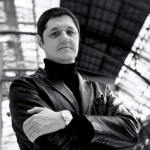
"When Gato Pérez arrived, for me it was a real revolution. That Argentine guy had another way of understanding rumba, the popular music of Barcelona, of its streets. In a way, he made our generation aware of the heritage we had, because Gato was part of the process of universalization of rumba, following in the footsteps of Peret and joining a great musical movement that, like all of them, is essentially something choral."
"A phenomenon in which everyone goes, or we go, contributing something, leaving our trace, making it advance without ceasing to be connected with our sonic ancestors." Batidinha by Jobim plays and, leaning at the bar, a half-eaten plate of Iberian ham and a freshly poured glass of merlot, musician and activist Rogeli Herrero enjoys an aperitif, "in my opinion, along with lunch, the most important meal of the day."
Raised in the Hostafrancs neighborhood, where he was a child of the streets, in his youth he quickly became involved in music, omnipresent in his family life thanks to a father who had been an orchestra singer —he was born "anointed by Antonio Machín"— and a home record player from which coplas, rumbas, and boleros tirelessly emerged. A heritage he documents in El Gran Peret: de rumba por la vida (Larousse), his recently published debut book that traces an emotional and illustrated sentimental memory of the figure of Pedro Pubill Calaf, Peret, great architect of that rumba that has accompanied his life: as a musician, as a Barcelonian, as a devotee of a thousand and one rhythms.
The creation of Los Manolos was a bombshell: "We were an anomaly, because of the music we made, because of the looks we sported""As a kid, I joined several bands. I played a lot and many styles. Instead of going to the disco, we spent the weekend holed up in the rehearsal room." It was the era of the first Zeleste on Platería street, of that Layetana wave with which he ended up connecting "more with the Latin and dance part, than with the progressive." It was then that he joined his first serious band, an orchestra called Copacabarna, which he later alternated with militating in the band of pop Sagrada Familia. "The 80s had arrived and the city's music was cooling down. It was the time when design Barcelona was imposed, and it's not that we rejected it, but we felt the need to reclaim the other city, that of the neighborhoods, that of rumba." From a series of jam sessions among friends where that sonorous flavor was given free rein, Los Manolos would be born at the end of the decade.
Because life, after all, is ups and downs
It was a bombshell. "We were an anomaly, because of the music we made, because of the looks we sported. We played in a lot of places and we were very lucky." This came from Seju Monzón, brother of El Gran Wyoming, "who hired us one weekend to play at El Café del Mercado in Madrid. And that's where things took off, because shortly after, people from Ariola came to see us to sign us. But don't think we said yes right away," he recalls. After rejecting the multinational's first offer, it was their rehearsal room mates, Los Negativos, who urged them to accept, "to take that leap."
For the regular, the success of Los Manolos, whose All my loving kept playing throughout the first half of the 90s, was "a window that allowed us to look out onto broader panoramas of what life is. I learned to value what I had more." But after the sweetness of that sudden success, came the bitterness of the inevitable downfall. "In the end, life is that, ups and downs, and you have to know how to manage them, relativize, be aware that nothing lasts forever and always know where you are, respecting others and making yourself respected."

And there is that feeling of Rogeli of never having stopped growing, musically, personally, during a life linked to music, to teaching, "lived alongside my wife and children and my friends, which is the best thing in the world." And, above all, never ceasing to feel part "of that great collective experience of rumba, faithful to my origins, but dialoguing and following what the younger ones do, something also possible thanks to having a musician son and that makes it much easier for me to connect with his generation. They are the new voices of that great choral movement that never ends and is always evolving, transforming." A discourse in which he continues to take part, as he confesses that, "after the journey that writing Peret's book has meant for me," he is writing new songs. He continues to be part of the great rumba choir.
The city that was losing its flavor
The musician's Barcelona is "that open city, that allowed itself to be contaminated by the cultures that visited it, festive and dialoguing." The Barcelona of Zeleste on Platería street, "with Claudio behind the bar, with Sisa, with Carles Flavià, with Rubianes. A city that, right now, I miss," confesses the regular who laments "the loss of flavor of so many things that defined Barcelona's personality, its character which in the end is that of the people who inhabit it, because I believe a lot in geographical origin as a conditioning factor."
Through the cracks of a brief silence, which the regular takes advantage of to account for the ham and wine, the notes of Bill Evans' trio's Come rain or come shine slip in. Over the piano's phrasing, supported by the rhythmic base of Eddie Gómez and Marty Morell, he resumes speaking: "Luckily, the sea is there. And one thing I do sometimes, when things go wrong, is go to the beach to look at it. To look at the sea and let its immensity remind me of the smallness of my problems."
—What doesn't lose flavor, fixes problems, and isn't going to move from here is our gastronomic offer, in case you want to extend the aperitif with some more tapas…
Rogeli Herrero looks around him. The music. The people. The good vibe of a Barcelona bar at vermouth time that turns into a meal with conversation.
—Why not?--- he replies then, with a wide smile plastered on his face.
Add The New Barcelona Post as your preferred Google source for free
Stay informed with the latest news.