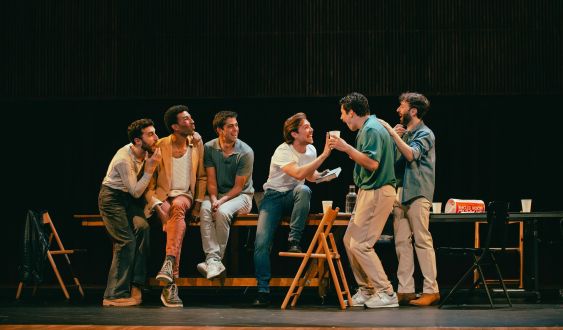
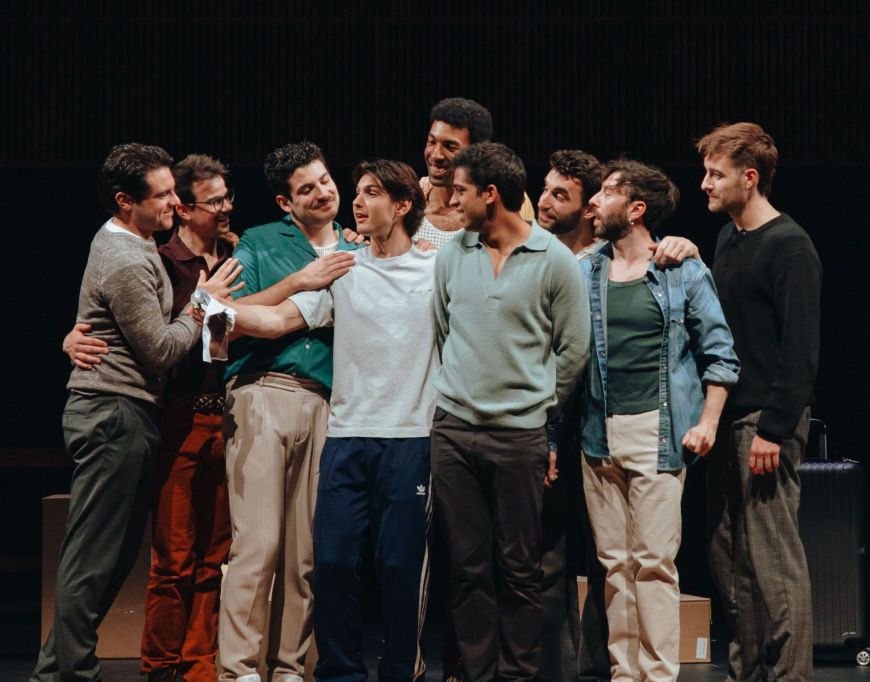
The premiere of L'herència was monumental, like the work itself: from four in the afternoon until eleven at night, the Fabià Pugiserver Hall in Montjuïc remained packed and in a sepulchral silence to listen to the voices, reflections, and confessions of this group of gay friends in New York in 2016.
We are facing a work by Matthew López that defends the chains that unite us, the responsibility we have towards them, and also the privileges achieved thanks to being part of a whole. An inheritance reflected from the different points of view of these characters who, like a fan of our society, do not know what to do with these chains: embrace them, reject them, or ignore them.
A whole theatrical experience
It must be said that the theatrical and artistic experience offered by L'herència is incomparable. Doing a theater marathon all Saturday afternoon, in the company of the actors, technicians, and expectant audience, is quite an feat: during the more than six hours of the show, a parallel universe is created in the Lliure hall. We say goodbye to our reality to delve into a story of love, friendship, community, struggle, memory, and literature, a lot of literature, accompanying these actors who do not lower their energy or enthusiasm at any time. Being a witness to this encounter of love for theater and humanity is an unforgettable experience.
Being a witness to this encounter of love for theater and humanity is an unforgettable experience.
L'herència begins in a rehearsal room. A group of writers are trying to write a story and the writer Morgan (played by Carles Martínez) is present there. They want to update their masterpiece Howards End and move it to a more current era, specifically 2026, when Obama is still president of the United States, but Donald Trump's candidacy is on the table.
The first hours of the proposal move in this metatheatricality: from dramaturgical writing to acting interpretation, the writers themselves put themselves in the shoes of the characters and interpret their stories, giving them life to see if they work well on stage. This choice gives a very fresh touch to the proposal, as well as touches of humor, rectifications on the narrative evolution, and a very original point that also allows showing how dramatic creation is and how a text is adapted.
The plot begins by recounting the love story between Toby (Carlos Cuevas) and Eric (Albert Salazar), a couple of seven years with very different personalities. On one hand, we have Toby, an ambitious, extroverted writer, but with a very well-constructed mask he created years ago to protect himself from the world; on the other hand, we find Eric, a simple, kind boy who loves and wants to be loved, and who lives somewhat in the shadow of his partner.
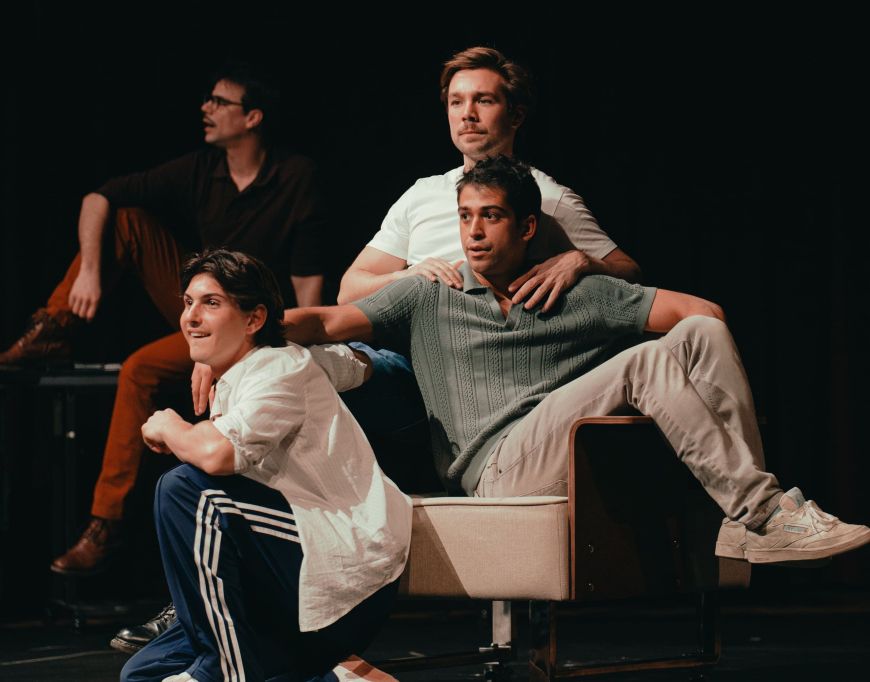
They have a large group of friends with whom they celebrate brunches, but above all, with whom they share a struggle: the struggle of the gay community. Because, as they rightly say in the play, gay people had no role models: they were hidden from society and, therefore, they had to invent their own role models. And to do so, they did it collectively, in those secret and sheltered spaces where they met and began, without knowing it, to create a legacy, a cultural heritage. Today, even though the community has more visibility, its strength remains essential: it is a refuge, it is a place where one can be oneself, it is a space for understanding, support, and help.
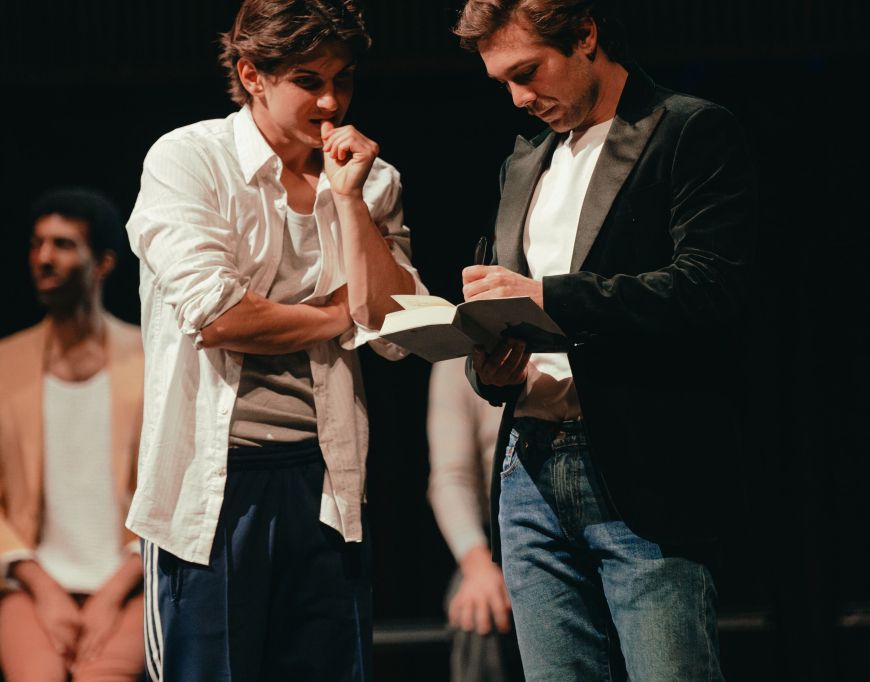
Everything seems to be going well when, suddenly, Adam (played by Marc Soler) enters the scene, a young man with great artistic sensibility and a drama student. The relationship with Eric and Toby begins to become intimate, profound, a relationship of friendship, admiration, and a great literary connection. But his presence will end up being decisive for the couple and for the group of friends.
An intergenerational story
Can we forget our heritage? Can we refuse to see where we come from to only focus on where we are going? These questions are present in the play all the time. And the way to show it is with the presence of an older gay couple: Walter (Carles Martínez) and Henry (Abel Folk). They live upstairs and their love story was neither as simple nor as natural as the one Toby and Eric can currently enjoy.
Walter and Henry's New York was a much more closed city. Although there were spaces for the gay community, it was very frowned upon in society. Many gay men married and started families, but at night they would go to these spaces to truly be themselves. But if they were not already stigmatized enough for their sexual orientation, the appearance of the HIV disease was decisive.
Fear and survival are what first appear in situations like these, so the couple rushes to isolate themselves in a country house, three hours from the city and with a large cherry tree at the door. But as the days go by and the situation becomes sadder and more unjust, looking the other way becomes more difficult and social responsibility begins to appear. What can we do when we see the world falling apart? Run away or try to fix it. And these two attitudes are made clear on stage by Walter and Henry.
What can we do when we see the world falling apart? Run away or try to fix it.
From microhistory we move to macrohistory and we see how, thanks to the collective's struggle, society began to wake up and, little by little, pharmaceutical companies and large medical companies began to research to fight against the virus. It was late and many ghosts hang from the back of this social injustice endorsed by a false morality. But, in the end, it was achieved and today, groups of friends like Toby and Eric's can enjoy a specific treatment and another preventive one. And we cannot turn our backs on this: inherited privileges, the benefits that others achieved and that we enjoy today. You cannot live turning your back on the past because the past is where the present is found and where the future is forged.
One of the most emotional, intense and magical moments of L'herència happens when, precisely, all those ghosts that live with us and that we cannot ignore are remembered. An immense, shocking scene that manages to take the breath away from the entire audience.

L'herència is also a love song to literature
Apart from the plot that tells us the evolution of the characters, L'herència is, above all, a tribute to literature. It shows at all times the great power that stories have to make visible, push and show other facets of life that, traditionally, have been hidden by tradition and Christian morality. The strength of letters, poetry, characters and words is present in most of the characters and functions as a common thread for much of the work.
Because E. M. Forster wrote his novels about homosexual relationships without daring to publish them during his lifetime. Even so, his legacy, his social inheritance, was very strong, impactful, and essential for many individuals, but also for American society of the time.
The importance of the collective: the inheritances of L'herència
This proposal shows the struggle between inheritance and oblivion. There are people who take responsibility for historical, social, collective, and personal inheritance; people who look to the past, face it, confront it, and prepare for the future. But there are also people who prefer to ignore this inheritance, turn the page, focus on the future, and save themselves in the present. A survival strategy, but cowardly; a technique to face life and not sink, but false. Because we are who we are thanks to those who came before us. And also because we are who we are, we have duties, obligations, a commitment to the collective: to help it advance, progress, move forward.
And also because we are who we are, we have duties, obligations, a commitment to the collective.
In the play, there are two characters who most show the facet of moving forward without looking back: Toby and Henry. Two people who do not want to stir up the past, who focus on living the present and concentrating on the future. But it is not out of selfishness: it is for survival. The play ends by defending that history has made us heirs of privileges, of improvements, but we also have the duty to be responsible with this inheritance and to know what we want to leave to future generations. Today we can enjoy what was fought for yesterday.
The theme of inheritance is shown in many ways: the physical inheritance of the house, as a material object that is received, but also the symbolic inheritance of this house, the refuge that cares, that provides, but that also must be cared for, must be provided for. The shared responsibility between receiving and giving. But it also speaks of the inheritance of the darkest things, of stigma, of mistreatment; the theme of HIV is repeated in both generations and, although it is treated in a different way, it remains present, stigmatizing, hurting, marking.
And, of course, individual responsibility also appears: we are heirs of our ancestors and that makes us responsible. Responsible for our lives, yes, but also for our environment, for our collective, for our society and for the future that, even if it is not ours, begins with us.
Shared responsibility between receiving and giving.
A collective work enjoyed in the collectivity of the theater
And there is no better way to receive this message than among hundreds of people who gather for a few hours inside a room. Theater as a channel of communication, of transmission of ideas, responsibilities and hope. Because, as E. M. Forster said, "Only connect", connect with others, with history, with society, with literature, with other generations. Connect, connect and connect to be more tolerant, to be more empathetic; in short, to be a better person.
Add The New Barcelona Post as your preferred Google source for free
Stay informed with the latest news.