
When masks became an essential item to control the pandemic, countries like Spain realized that their industry was not prepared to manufacture them. Despite not being a very complicated product, dependence on Asia further complicated a serious and unforeseen situation in which every second counted. "For Europe, the pandemic served as a wake-up call," said the director of economic analysis at the Barcelona Chamber, Carme Poveda, in one of the round tables that took place this Wednesday at the first congress organized by the Eurecat technology center, held at the Sant Pau Modernist Complex.
Poveda is convinced that COVID opened an opportunity to strengthen local production with the aim of guaranteeing the capacity to produce certain key products in the face of future crises. "Not everything in Europe, but strategic things, yes," she remarked. Companies are already doing this, increasing stocks and diversifying, and bringing suppliers closer.
In this sense, the multinational electrical material company Simón began doing so before the pandemic to reduce its ecological footprint, which allowed them to better face the lack of material experienced in 2020. "Time proved us right," said its Operations Director, Alberto Pérez, "reindustrialization is a duty more than an opportunity, it is absolutely necessary." And it not only involves producing more locally, but also betting on proximity to each type of client, that is, "being close and knowing them to set manufacturing policies." In Simon's case, with a presence in 16 countries, each plant adapts to its market, as seen in the fact that 97% of the production made in China is consumed locally.
This need arises from "a major error" committed by the West, relocating factories to reduce costs. It meant short-term savings, but it has ended up causing an economic stagnation and the impoverishment of societies that lost the plants, where there has also been an increase in inequality and tension, waiting for the retirement of the baby boom generation to also be affected. "We are at a critical moment. We can only do one thing, recover industry, with more stable and better-paid jobs. Are we on time? We are on time," said Guillermo Dorronsoro, consultant at Zabala Innovation Consulting. However, he stressed, Europe must get its act together given the determination already shown by the United States and China to lead the industry of the future: "Here we are good at regulating the matter, but we incentivize with less flair."
To encourage investment, the Director of Operations at Jolt Green Hydrogen Solutions, Arturo Vilavella, also asks institutions to strengthen those sectors considered strategic to allow their companies to commit to the territory and not go elsewhere. "If we manufacture components for an industry that is not located in Catalonia, it will be difficult for us to expand productive capacity here," stressed the spokesperson for this spin-off from the Catalan Institute of Chemical Research (ICIQ) dedicated to manufacturing electrodes for green hydrogen.
The impact of rising temperatures and drought
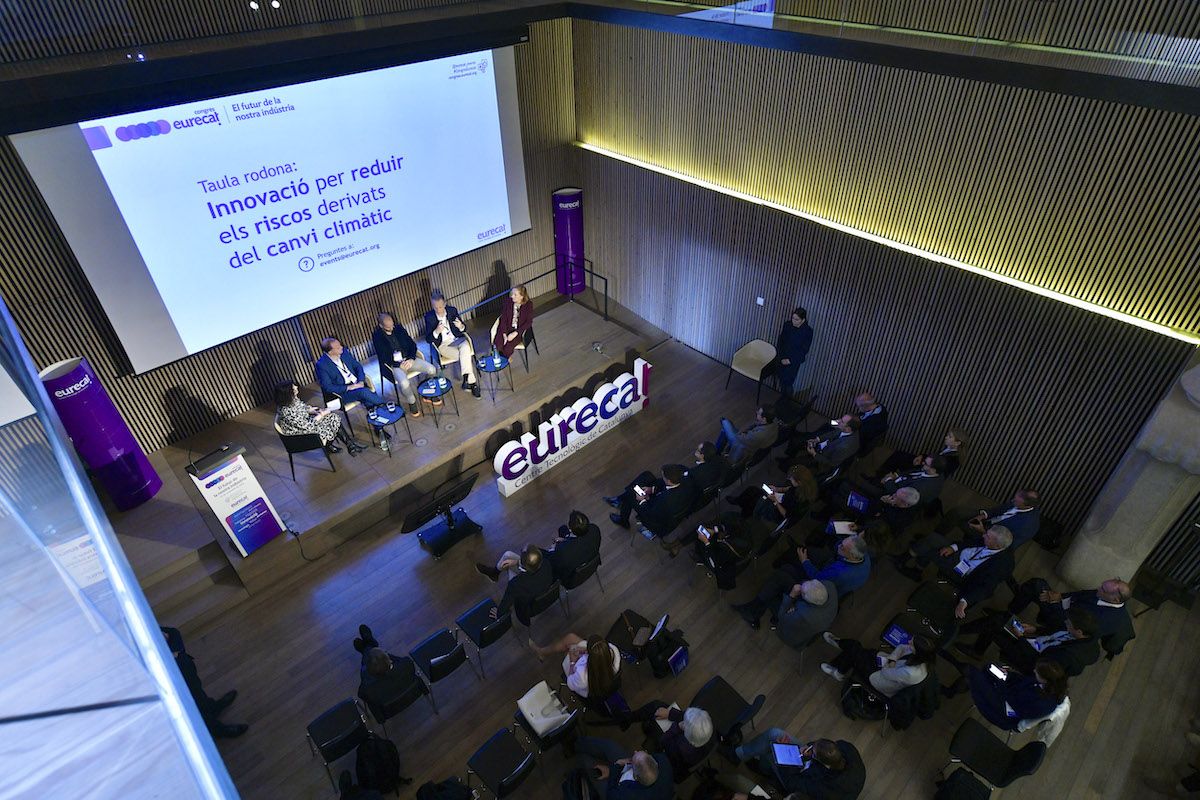
All this reindustrialization becomes more urgent with a climate crisis that already affects the daily lives of many companies such as Familia Torres, Baleària, and Fluidra, protagonists of the second round table of the congress organized by Eurecat to discuss the future of Catalan companies. In the case of the winery in Vilafranca del Penedès, the increase in temperatures and the lack of rain hits their operations hard, losing quality and reducing their production. "Climate change is a reality that is greatly affecting the primary sector, which cannot be delocalized. It is an obligation to reduce the impact and be as sustainable as possible. And through innovation, we will achieve it," defended Mireia Torres, Director of Innovation and Knowledge at Familia Torres.
For Familia Torres, the increase in temperatures and the lack of rain hit their operations hard, losing quality and reducing their production.This family business has been taking measures for years to reduce its carbon footprint, with the installation of photovoltaic panels and the use of biomass, but also by betting on regenerative viticulture and on varieties more resistant to an increasingly aggressive climate.Values that consumers increasingly appreciate, even if they mean a higher price, as Alberto Pérez de Simon has also stated: "20 years ago, nobody would be willing to pay an extra cent for the environment, now things have changed."
Where water scarcity also affects is in other sectors that allocate it to leisure uses such as swimming pools. At Fluidra, they work to reduce water consumption, but they also see an opportunity in higher temperatures, being able to increase revenues from increasingly less cold countries like Germany or Canada. These new market opportunities are also detected by Baleària, with routes affected in a Mediterranean that is increasing its temperature and suffering more intense storms. The shipping company sees that it will be easier to operate in other areas of the world, such as the Caribbean. "We have to adapt to this. Our assets are on the sea and we can change routes," said Baleària's Head of Energy Transition, Javier Cervera.
And AI?
In any current debate, the analysis of how artificial intelligence (AI) affects, in this case, an industry that not only has to be more local and less polluting but also more technological, cannot be missing. The conference featured the participation of professor and writer José María Lasalle, who warned that the greatest risk of AI is the creation of new gaps, especially, more inequality. Lasalle also defended that this technology will serve to improve competitiveness, replacing human work in some tasks and complementing it in others, but that a balance must be found so that workers' skills grow and are not eclipsed.
Therefore, he defended that ethics should be present from the origin in the conception of any technology. "We must be able to identify an AI that is not hostile to human beings, trustworthy and robust in terms of purpose. What do I want it for? To make human beings better? Well, let's say so. AI has to help us make human beings become creators, it is so innovative and so powerful, that not seeing it is a civilizational clumsiness," he explained.
Add The New Barcelona Post as your preferred Google source for free
Stay informed with the latest news.
