--- When you enter a bar, do you pay attention to the music playing?
--- No. In fact, I hate it when there's music in bars because music asks me to stop and listen to it. And being here talking to you and at the same time hearing this in the background (he makes a face), I can't. It irritates me a lot to hear music.
--- Rather than not listening to it.
--- No, it just irritates me to hear it. And especially music that is made only to be heard.
--- Therefore, that background music we play at dinners...
--- Horrible. I never play music at dinners. And in the car, for example, I'm unable to listen to it, because there's a lot of noise.
--- Oh, but I love listening to it in the car!
--- No! Forbidden! You'll go to hell!
--- I understand that for you, the act of listening to music must be exclusively that, listening.
--- Yes, because the person who made that music made it with the intention of it being listened to. Music asks me to listen to it, and that's what I do.
--- What is your first memory related to music?
--- At the Liceu at 6 years old going to see Norma. My parents took me and my sisters. It was an afternoon performance, on a Sunday, and Montserrat Caballé was singing. I remember perfectly that I fell asleep.
--- It didn't captivate you at all.
--- No.
--- Is imposing music on children at home the fastest way for it not to work out?
--- It depends. I wouldn't dare to say that. Each person is a world. My example leads to this conclusion, but I know many people to whom it was imposed as children and they are delighted. When I was 11 years old and said "I never want to go back to the conservatory because this is horrible," I was not delighted. But now I am grateful that my mother took me there when I was 6.
--- Do your sisters share the same passion for music as you?
--- It's that thing about music, that we were educated exactly the same, but then each one goes their own way. In my case, my relationship with music is for life. It's like a marriage.

--- Have you met anyone for whom music doesn't evoke any emotion?
--- That person doesn't exist. What I hate most are imposters. That attitude of "I don't like music" is a pose. There is no one for whom music doesn't appeal in one way or another, with greater or lesser intensity.
--- Do you listen to music every day?
--- Daily I study music, which is different. My relationship with music now is not so much "I'm going to listen to it," but rather I study it. For example, when I have to give a lecture, I study because I have to constantly tell people things. And there are people who have come to listen to me many times and always want to know something new. That's why I need to keep searching and re-searching again and again.
--- And when it comes to works you already know, do they still surprise you? Do you always find something new?
--- Always. Especially in great music. There is infinite, unfathomable music. For example, Parsifal, which is being performed these days at the Liceu. This work is unfathomable.
--- And long! 5 hours of opera.
--- And long, indeed.
--- How do you prepare someone who has never been to the opera to see Parsifal?
--- You can't. I remember as a child going to see Tristan (Tristan und Isolde), which is also a very long and very complicated opera, and hearing my father tell my mother "we are teaching the children a lesson." And he was absolutely right! To go and listen to certain types of music, you need to prepare yourself, know what you are going to see and why you are going to see it.
--- With mainstream, pop, fast-consumption music, is all this not necessary?
--- Look, now we are preparing a program for TV3 called Això no és una cançó and it's precisely about pop music.
--- I want to know more!
--- It's a class of 15 students, aged between 20 and 25, and they are all fantastic musicians. One plays the piano, another the cello, one comes from hip hop, another from heavy metal, another from classical and doesn't want to hear about anything else, and there's also an opera singer. They all come from very diverse musical backgrounds, but they are all very good. And we take an iconic pop, rock, or soul song and we dissect it and study it completely. And there are songs that lend themselves to telling many things.

--- Like what?
--- For example, Respect by Aretha Franklin. Beyond the music itself, which we also explain and develop, there is a whole story of Aretha Franklin as a black woman claiming her rights. Music is always music.
--- What do you mean?
--- Well, you can go see Parsifal and a C is written exactly in the same place where the C of Viva La Vida by Coldplay is written. Therefore, from this point of view, everything is music. Then there are musics that are more or less technically complex, but the end of the road is always: What does this music say to you? How does this music transform you? How does this music challenge you? How will it make you better? Viva La Vida is just four chords, it's very simple.
--- And it has become a whole anthem! Tell me another song.
--- I won't tell you more because I'm not sure if I can say it.
--- Why in life are silences so uncomfortable and in music they are so important?
--- Because when you study the notes you also study their equivalents in silence. Daniel Barenboim says something very beautiful: that the two most important notes of a concert are always the silence before starting and the silence after finishing. And I quite agree, because silence is part of music.
--- Which opera has the most beautiful silences?
--- I think that listening to silence is listening to Mahler. Or to Bruckner. It is the total consummation of music.
--- When your father died of Alzheimer's, when he did so for the second time, because you say the first was when he was diagnosed, you explain that he became the Bolero de Ravel. Why?
--- It happens to me with all things in life, that everything has a musical explanation. When my wife called me and said: "come, he's dying" I remember being on the landing at home, before entering the apartment and hearing the cadence of his breathing. Because there is a moment when the body rebels, it doesn't want to die, it clings to life. And I listened to that cadence (he intones the Bolero de Ravel), stronger and stronger. Each time he was dying more and each time it was stronger. And my father died in the collapse of the fortissimo of the Bolero de Ravel. And then came the maximum silence. And this happens to me with everything.
--- Did your father like Bolero de Ravel?
--- My father was not a musical man. My mother was the one who had the passion, the one who listened to opera on the radio and wanted to play and sing, but she didn't have the opportunity to do so.
--- Is there a song for your mother too?
--- Yes, but she may not like me saying it.
--- During the mourning for your father's death you wrote a beautiful book El amor te hará inmortal (Ara Llibres) where you talk about pain and loss traveling to the past and reviewing great myths of music. Did it help you?
--- It was a bit like when Amy Winehouse was asked: "And why don't you make more songs?", and she said "I just know how to make songs about the things that happen to me." Well, the same thing happens to me. When I write or do something it must be because it speaks to me personally. I'm not interested in the future at all. I have always wanted to go to the past. I would go see Beethoven, I would go talk to Freddie Mercury, I would go listen to Schubert play the piano.
--- What would you say to Freddie Mercury if you could talk to him?
--- I would thank him. I would ask him if I'm doing my job well. My dream is to die and that when this happens I can meet the people to whom I have dedicated my life and that they tell me: "fuck Ramón, you didn't do so badly."
--- Have you gone to see Queen without Freddie Mercury singing?
--- I have gone to see Queen with Freddie Mercury singing! At the Miniestadi, in 1986. I had just met the woman who would later become my wife and I remember that I had the albums A Day at the Races and A Night at the Opera and I was totally fascinated.
--- What Queen song moves you?
--- It's complicated, but maybe I would say Bohemian Rhapsody. The first day I heard it I didn't understand anything. And I started to study it to try to find out what all this was about. And since Freddie Mercury was a very good musician, there are some things that are explained in the lyrics, but most things in this song are explained in the music. And this moves me.

--- Is it true that you have a photo of Beethoven on your nightstand?
--- Yes. Beethoven is like my God. Berlioz said that everyone must have the right to choose their gods, that no one can impose them on you. And he said that there should be four, because tables have four legs. And when I started to make the list of my four gods I realized that only Beethoven appeared, so my table has only one leg, but it's very thick.
--- Have you thought about the music you want to be played on the day of your funeral?
--- I don't want there to be music.
--- Do you think that at funerals there shouldn't be music?
--- Maybe yes, but this is very personal. I would like what happened to Verdi to happen to me, who in his will wrote that he didn't want music, only an Ave Maria, but in the end it was inevitable. When the coffin passed through the streets of Milan, people started to sing Va, pensiero (Nabucco). For me, if they let me choose, I will say that I don't want them to play music.
--- Does music heal?
--- Music does everything. It heals, it makes you sick, it makes you fall in love, it makes you angry... It has the power to do anything. Maybe it doesn't have the power to heal, but it has the power to make you believe you are healing. Since music has such a personal relationship with people, if you are sick, you will normally put on sad music.
--- Do we like to flagellate ourselves?
--- It's because you need someone to listen to you. The only person who will always listen to you is music.
--- As if it were your friend?
Exactly. Music is the only friend who will always be faithful to you, will always be by your side. On the fourth day of feeling bad, if you call a friend, in the end they will say: "Cris is calling again to tell me her misfortunes." But music will always listen to you. When you are sad, it is not you who chooses the music you want to listen to. It is the music that chooses you, the one that listens to you.
--- What music do you listen to when you're sad?
--- Beethoven's last quartets. They have a very special depth of soul. And they help me think a lot, they comfort me.
--- Is it true that you never get angry?
--- It's true, I never get angry. Because once I got very angry with a person and they didn't deserve it. Neither him nor I. And I decided that I would never get angry with anyone again. And if someone does something wrong to me, I think, well, that's it.
--- But there must be things that drive you crazy, that bother you.
--- Yes, but they no longer irritate me, they don't excite me. It's not worth it.
--- What trip has marked your life?
--- There's a trip I make every year. I go to Vienna to Beethoven's tomb and talk to him and then I go to London to see Van Gogh's Sunflowers at the National Gallery.
--- Every year?
--- Yes, it's my therapy. I go to the central cemetery in Vienna, to the composers' corner, where they all are: Strauss and Schubert ---next to Beethoven, because that was his dream---, the monument to Mozart, because no one knows where he is buried... And I sit there and we chat. And with the Sunflowers I do the same. I go to the National Gallery at dusk when the tourists are already tired of wandering around and the museum empties. And on my bench, in front of the painting, I sit and tell Van Gogh what I told Ludwig (Beethoven) the day before.
--- Do you go alone or accompanied?
--- Alone, accompanied, I couldn't do it.

--- How have you experienced the Ramon Gener phenomenon? Do you like it?
--- I've come to like it a lot and that's very dangerous.
--- Why is it addictive?
--- There's a danger that at some point you might think you're better than others. And no.
--- How did this thing of yours with José Corbacho come about?
--- It was born at a private event. He has a production company and organizes many events. I hosted one at the Tívoli and Corbacho saw me and said: "we have to do something together." And we started writing. First it was a show just with me, but then we made it for both of us and Love, Love, Love was born, as well as a friendship that I cherish very much because I love him a lot.
--- Tomorrow [June 10] you will be at the Tívoli. Why only one performance?
--- Because we have horrible schedules and calendars and it's very difficult to coordinate with Corbacho, with me, with the band. Getting everyone together is a drama! But it makes me very happy to do it because we have a good time, we laugh and we listen to a lot of music that, perhaps, is a piece of the soundtrack of your life...
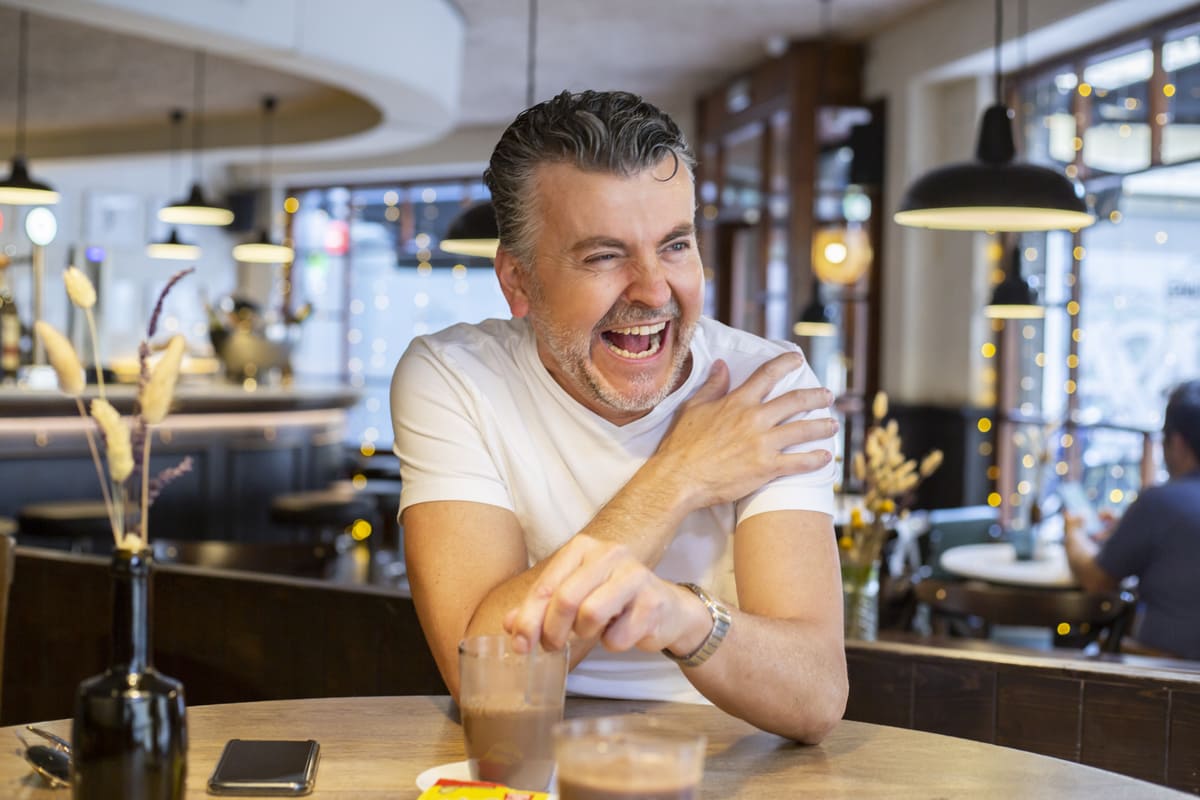
--- How do you like to drink your ColaCao?
--- With lumps (he answers while finishing the last sip). I already drank it like that when I was little and I still do now.
Add The New Barcelona Post as your preferred Google source for free
Stay informed with the latest news.