
There is a technological ecosystem beyond Barcelona. In the border city of Portbou, a Renfe digital competence center has been launched, the seventh of all those it has distributed throughout Spain and the first to be located in Catalonia. In operation since last April, the team is made up of four workers, all of them recent graduates, led by engineer Isabel Sierra. They are dedicated to testing and verifying the quality of the railway group's websites and mobile applications, such as those used to buy tickets or to communicate with train drivers.
This is what Carlos and Marcos say in front of their computers, full of information too complicated to interpret for most mortals. They are 23 and 20 years old, respectively, and this is their first job. They were studying the higher-level degree cycle in Web App Development at the Cendrasos Institute in Figueres when the Renfe call opened. More than 100 resumes were received and nine students were selected, who were trained for two months. Four of them, three boys and one girl, were finally chosen to start the Portbou center, operated by the Logirail subsidiary.
Since then, they have begun to manage digital projects requested by the railway operator, often in collaboration with the other digital competence centers located throughout the rest of Spain, while continuing to study to be able to take on more assignments in the future. They are dedicated to Quality Assurance and Testing, that is, to preventing and detecting incidents in Renfe's different applications in advance, as well as verifying that everything works well and guaranteeing a good experience before the end user uses them. "We are like a user who knows a lot about the app and looks for any errors it may have," the two young people point out.
They test issues such as whether the application can be accessed without problems or whether it executes the orders it has programmed, with the difficulty of having to understand something as complex as the railway sector, discovering requirements such as temporary speed limits on the tracks. "Come on, the opposite of a web developer," they hasten to clarify. In fact, they work closely with another Renfe digital center, the one in Miranda de Ebro (Burgos), specialized in programming, whose products they review to ensure they work correctly.
Carlos and Marcos live in Figueres and take a Regional train every day to get to the center of Portbou, located a few steps from the tracks where the train drops them off. They are clear that in their hometown they would not have found any job related to the digital world and would have had to start looking, at the very least, in Girona. Furthermore, to join the Renfe center, they were not asked for previous experience, something that prevents many of their classmates from finding a first job beyond internships.
The Portbou center is picking up pace during its first months of operation, with the forecast of doubling the workforce by 2025Their boss has been testing software for different appsand websites, "as if it were a quality office," she remarks, and she has had to travel much further to reach Portbou. In her case, she moved from Medellín, Colombia, where she had worked in different companies until she received an offer via LinkedIn to direct the Renfe center. After passing the selection process, she came alone to a place she had never heard of and does not deny that the shock was hard, but she acknowledges that everything improved when her family followed her a few months later.
After finishing the works in February, following an investment of 260,000 euros, the center is gaining momentum during its first months of operation, with the forecast of doubling the workforce next year. It is also contemplated to take on more digital projects that the railway operator may have, as well as to open up to collaborate with other companies. For this, the hackathon they organized at the end of October to publicize the center was key, with some thirty students from the Cendrasos Institute of Figueres and the University of Girona (UdG). "We want to promote young talent and give life to Portbou," Sierra emphasizes, for which they have the fundamental support of the mayor, Gael Rodríguez. Known for being the youngest in all of Spain, Rodríguez mobilized from the outset to attract Renfe's investment to his municipality.

Digitalization against depopulation
Beyond advancing in the modernization of its operations, Renfe has launched digital competence centers like the one led by Sierra with the aim of generating quality employment for young people in depopulated areas, a phenomenon that occurs not only in Teruel, but also in municipalities on the Catalan coast such as Portbou.
You only need to walk through its center any day to see the number of empty premises and homes, a circumstance that is further aggravated in its case by being a city that has been left out of everything.
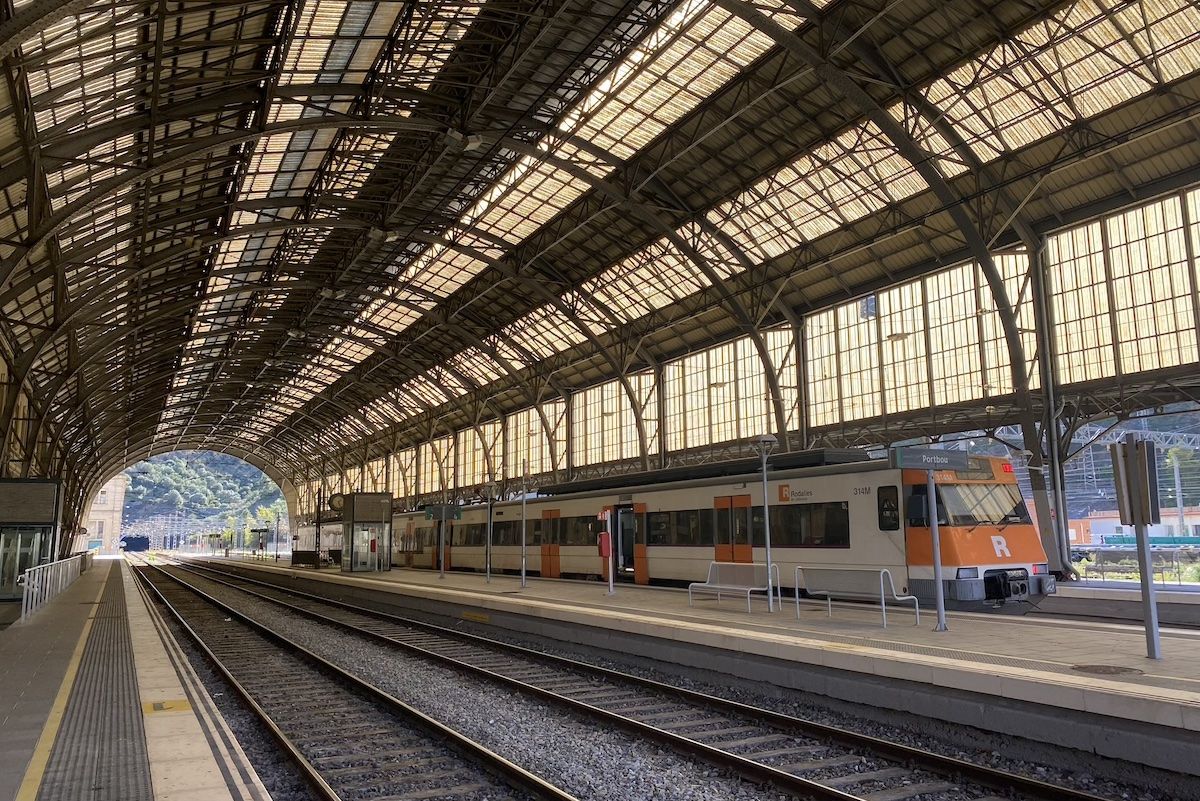
With that will, since 2021, Renfe has chosen locations with railway tradition to locate the new centers, as is the case in Portbou with its station, with a canopy reminiscent of that of Estació de França. In addition to those in Portbou and Miranda de Ebro, there are those in Alcázar de San Juan (Ciudad Real), specialized in robotics and artificial intelligence (AI); Teruel, in infrastructure maintenance; Monforte de Lemos (Lugo), in cybersecurity, and Linares (Jaén) and Mérida (Badajoz), in customer service.
Add The New Barcelona Post as your preferred Google source for free
Stay informed with the latest news.
