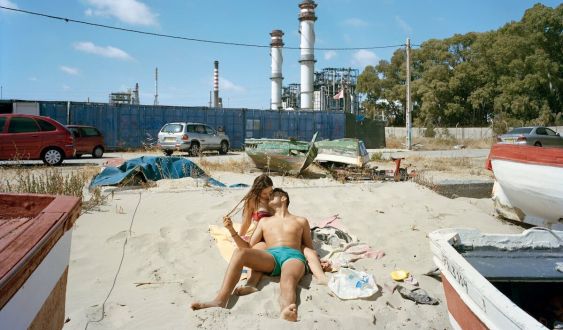
Txema Salvans has spent 15 years traveling the Mediterranean coast, from Barcelona to Algeciras, like a studious anthropologist, observing those who seek a moment of peace looking closely at the sea, to portray what is there if we turn our backs to the horizon. "Sometimes I think that perhaps the strange one, or the most mistaken, is me. It's as strange for someone to sunbathe in a cement factory as it is for a photographer to spend 15 years taking photographs in that same place. Both options are equally dystopian," he comments.
Like in the cinema, when one suddenly turns around and observes the faces of the audience, full of ridiculous expressions, the photographer seeks the limit between the banal and the absurd of the scenes in what Joan Fontcuberta defines as "a balance between critical thinking and the poetic sense of humor." And in Perfect Day, Salvans, with his characteristic formal and conceptual style, where irony is necessary to understand the magnitude of the tragedy, questions the stereotypes derived from the overexploitation of the Mediterranean coast from the territory of everyday life and through our particular social behaviors.
Although the photographs were originally published in a photobook edited in the midst of the pandemic by the British publisher Mack —whose success was exceptional—, Pepe Font de Mora, director of Foto Colectania, bets on the value of the series in exhibition format. 49 are the pieces that make up the exhibition on the Mediterranean, whose key lies in the fact that the sea is never seen, to provide the viewer with that feeling of strangeness and desolation heightened by the appearance of isolated people within the images.
49 are the pieces that make up the exhibition on the Mediterranean, whose key lies in the fact that the sea is never seenEven the title, Perfect Day, it is more than a simple allusion to Lou Reed's well-known song. "We are the result of the reproductive success of our ancestors. Our self-awareness, the ability to project ourselves in time and to think in abstract terms is another singularity. Therefore, the fact of being alive and also being self-aware is almost a miracle; regardless of one's situation, it is aperfect dayin biological terms," says Salvans about his particular ideology. That is why the photographs also have that magic of the precise moment, of waiting until clicking and capturing the soul of the instant.
When we are faced with one of the snapshots, it must be us, the spectators, who decide whether they seem like tragedy or comedy to us, what character we want to assign them according to how they challenge us, because they leave us suspended on the tightrope walker's wire without a net. It is, as we have already said, the human presence that confers the dramatic dimension to the scene.
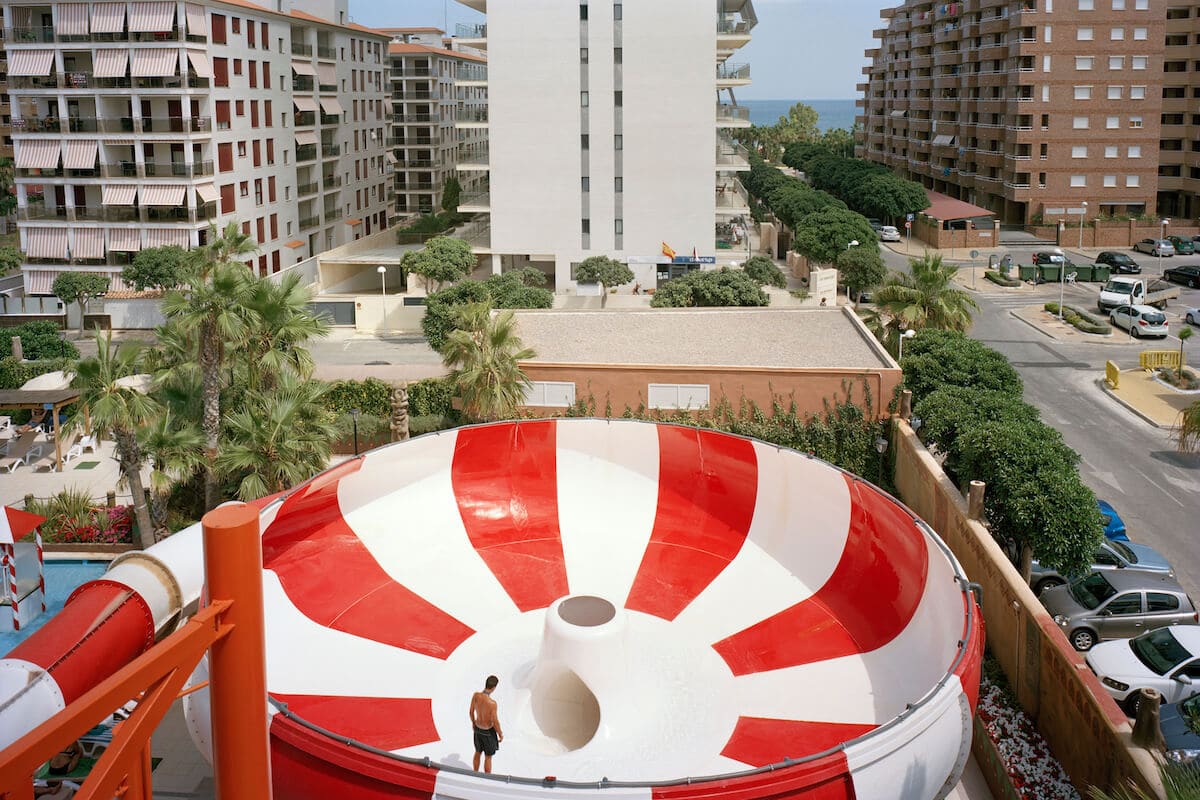
Thus we find ourselves before the couple in an affectionate attitude in San Roque, with the chimneys of a refinery and the closing fences in the background, which rather than an idyllic image evokes a post-apocalyptic space, accompanied by a caption that reads: "According to the World Health Organization, La Línea de la Concepción, near the Gibraltar refinery, has the worst air quality in Spain." Or that of a water park in Marina d'Or, in the middle of tall buildings, far from the sea, in a kind of nonsense, with a solitary figure at the top of the slide who, at first we understand is about to jump, until we read: "A poorly designed attraction forces an operator to be kept to push people going down on a float down the next slide." The height of absurdity.
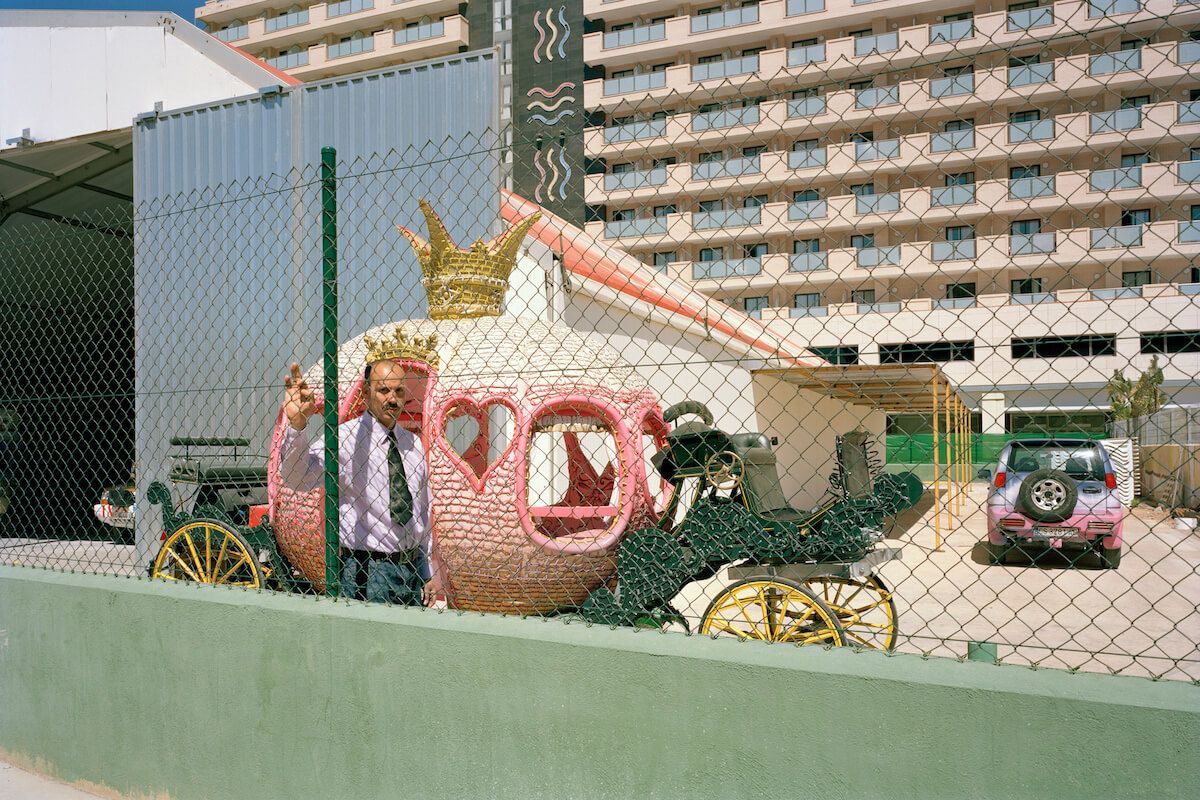
And that's when we see that princess carriage, at the back of an apartment block, with that mustachioed man who appears behind the fence, which suggests to us that he is waiting for sunset and for the fairy godmother to turn him into a princess and leave behind the ashes of the story. Although this ---look at the photo and draw your own conclusions--- is a totally personal interpretation.
Faced with the snapshots, it must be us, the spectators, who decide whether they seem like tragedy or comedy to us"Photography is a state of mind, it allows me to experience intellectual pleasure, observe the complexity of our species, be alone, wander and remain in a state of contemplation that frees me from the need to be the protagonist of my own life. And that is a great relief," Txema Salvans concludes.
When I recall my childhood summers, I remember watching one of the reruns of Verano Azul that made me dream of a family vacation in a coastal apartment. My parents, at that time, worked in a tourist complex next to the beach, so they fled from anything that reminded them of their work, while I spent summer afternoons on the burning asphalt of the square in front of our house, and grew old enough to take the bus with my friends and spend the day at the beach. I, who have never known how to swim and have to wear total sunblock due to the whiteness of my skin. But there I was, searching for that dreamed moment of my own idealized Verano Azul. Seeing Txema Salvans' photos, I realize I could perfectly appear in one of them.
Add The New Barcelona Post as your preferred Google source for free
Stay informed with the latest news.
