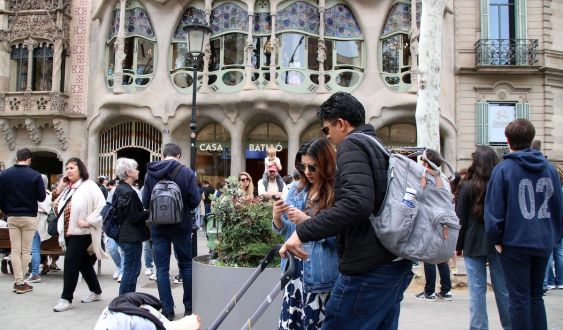
The luxury brands that hundreds of tourists enter daily once again place Paseo de Gràcia as the most expensive shopping street in Spain, a category it achieved in 2023 by surpassing Madrid's Serrano. Fashion, jewelry, accessories, perfumery, and many more stores place the rent of the Barcelona avenue at 261 euros per square meter.
Near Paseo de Gràcia, Portal de l'Àngel remains one of the main shopping streets at the state level, and the fourth in rent. Behind Paseo de Gràcia is Serrano, with 257 euros per square meter, and Madrid's Gran Vía, with 255, which Portal de l'Àngel closely follows with a rent of 253 euros per square meter.
Furthermore, Paseo de Gràcia is one of the high street segment shopping streets with the fewest available spaces: only 3% of its premises are vacant, while availability on Serrano street is 4%; on Gran Vía, 6%, and on Portal de l'Àngel, 7%.
With Paseo de Gràcia and Portal de l'Àngel at the forefront, Barcelona's main commercial arteries go further, and add up to a total of 540 commercial premises, with more than 273,700 square meters for retail. Of the total, only 12 establishments are vacant, with 7,600 square meters.
Thus, only 2% of the premises in Barcelona's main areas are available, according to an analysis by JLL that has X-rayed Spanish retail and identified more than 2,000 commercial premises in Madrid and Barcelona. Of these, almost 1,200 are located on major shopping streets and belong to about 800 owners, who have them leased to some 700 tenants.
The analysis has also revealed that there are differences between assets in Barcelona and those in Madrid, especially regarding size. While in Madrid 4% have more than 2,500 meters, in Barcelona only 1% of the premises reach this surface area. However, in the Catalan capital there are more medium-sized establishments: 30% have between 500 and 2,500 square meters, a figure that stands at 19% in the case of Madrid.
These main arteries continue to grow, after a 2024 during which the number of openings on the main Spanish commercial streets grew by 9%, with 80 new establishments. According to JLL, this growth was driven by international tourism, by the increase in consumer confidence and the key role of the physical store in operators' strategy.
The low level of availability in high street and the escalation of rents "are clear indicators of the market's reactivation and the attractiveness of the main Spanish commercial hubs for operators," as defended by the director of Leasing Advisory at JLL Spain, Adriana Gorri. In this context, the real estate services company predicts that retail sales will continue to grow throughout 2025, which will keep the momentum of rents in the main Barcelona arteries on the rise.
Add The New Barcelona Post as your preferred Google source for free
Stay informed with the latest news.
