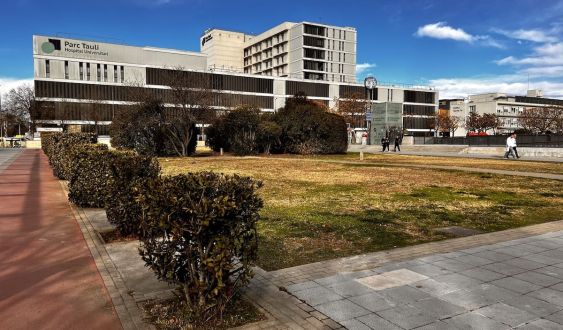
The company Eodyne Systems, a spin-off of Pompeu Fabra University (UPF), uses virtual reality and artificial intelligence (AI) to accelerate the recovery of patients in the ICU and thus reduce costs for the hospital. It does so through software that allows them to do arm exercises from bed to reduce the cognitive sequelae they may develop as a result of their hospitalization. This technology has been tested for the first time in 20 critical patients at the Parc Taulí University Hospital in Sabadell, managing to reduce the average stay by 1.3 days per patient and make it more pleasant.
Through a camera with computer vision, the patient's arm movements are detected, replicated on a screen where personalized exercises are proposed to work on aspects such as mobility, memory, or attention. The hospitalized person has to solve gamified problems such as pointing to flowers in the same order as a bee has done or touching fish of a certain color. All of this is always set in an attractive environment such as the beach or the countryside, with the aim of reducing the stress suffered in the ICU.
The pilot test was made possible thanks to a 70,000 euro grant from Acció. Eodyne Systems has updated a virtual reality prototype that Parc Taulí had previously developed and tested on about 70 critical patients. With the support of Acció, the company has turned it into a product, with the forecast of being able to implement it in more hospitals within two years.
Eodyne Systems began developing its virtual reality and AI system for patients who had suffered a stroke, also with the aim of accelerating recovery. Born in 2014, the company began commercializing this product in 2016 and is currently installed in more than 100 hospitals, mainly Spanish, but also in European countries ---Portugal, France, Italy, Netherlands, Belgium, Germany, Sweden, and Romania---, the United States, Brazil, Mexico, Argentina, and India. The company has a staff of 16 employees.
As they applied their device to more centers, they detected new needs, such as the recovery of patients in the ICU or making it possible for patients to use their technology at home, a demand accelerated by COVID. Currently, the adaptation to mobile phones and personal computers is being tested with patients at Bellvitge Hospital with Roche. In addition, the company, based in Poblenou, is working to adapt its system to patients with cerebral palsy and traumatic brain injury, as well as to develop a new device for patients with chronic pain. It also wants to work in the future with patients with dementia and Alzheimer's.
Add The New Barcelona Post as your preferred Google source for free
Stay informed with the latest news.
