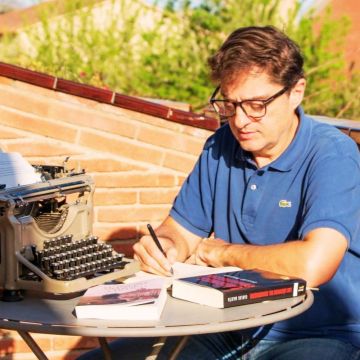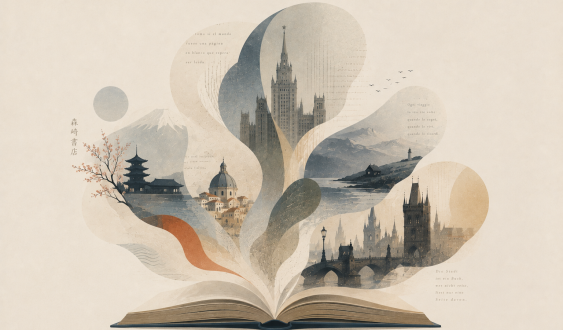
There are seasons when planes take off without us. Whether due to a lack of free days, a (too) tight budget, or the simple exhaustion of mending a broken heart, sometimes holidays remain an abstract wish while we observe the asphalt from the same old window. However, I have a method of escape that requires no passports, no airport queues, and no hand luggage: the literary journey.
Literature has always had this physical capacity to alter our perception of the environment. A good story can make us smell the saltpeter of a Mediterranean coast, feel the humidity of the jungle on our skin, or perceive the sound of the icy wind crashing against the windows of a mountain cabin. But not all literary maps are drawn with the same ink nor do they lead us to the same destination.
On the one hand, there are novels that act as emotional guides to real cities, allowing us to walk their streets with the precision of a local inhabitant. On the other hand, there are books that dare to found invented geographies, impassable valleys, and mythical territories so overwhelming and tangible that, upon closing the cover, it's hard to believe they don't exist in the physical world.
That's why some of my friends who know my love for reading are not surprised when, upon indicating their destination, I recommend a book to accompany them. So, if you're staying in the city this year, The New Barcelona Post, and yours truly, propose a ten-stop route: five real cities to stroll through and five imagined destinations from which you won't want to return.
Open the first page and happy travels.
We begin by traveling to Tokyo with the title My Days at the Morisaki Bookshop by Satoshi Yagishawa (Navona Editorial). This short novel takes us to Jinbōchō, the district of bookstores and publishers —a paradise for readers like us— in Tokyo, where the Morisaki bookshop is located. This small family business of second-hand books is the destination of Takako, a twenty-five-year-old woman whose life collapses when her partner (and colleague) confesses that he will marry another woman. Devastated and heartbroken, she accepts the invitation of her eccentric uncle Satoru to move for free to the upper floor of the bookshop in exchange for helping him attend the store. Under this premise, a story of family discovery, recomposition and recovery, and love for books is cooked. Of the small things that can happen in a neighborhood bookshop far from the hustle and bustle of a big city. It is an ideal recommendation for those looking for an intimate, restorative, and cozy getaway through the most leisurely and authentic corners of the Japanese capital.
"An ideal recommendation for those looking for an intimate, restorative, and cozy getaway through the most leisurely and authentic corners of the Japanese capital"
Although the next recommendation may come to the reader like a garlic soup recipe to a chef, it cannot be denied that, to discover Naples, the writer Elena Ferrante is one of the best. My Brilliant Friend (Ed. La Campana) is the first volume of the Two Friends saga, and narrates the story of friendship between two women who grow up in a poor neighborhood of the city. Beyond its faithful portrait of post-war Italy, the novel stands out for exploring without idealizing the chiaroscuro of the female bond: loyalty, rivalry, deep love, envy, and the search for identity. You will feel the suffocating heat of the southern summer, the clatter of dishes and arguments between balconies, the dust of the street and the salty breeze that comes from the port of the Tyrrhenian Sea. And, in addition, if it falls short, there are three more volumes to follow the story. It is a perfect book for lovers of Mediterranean light, passionate drama, and deep cultural immersion. And at this point, and for once, allow me to go off script and not fail to recommend the film that director Paolo Sorrentino dedicated to the city under the title Parthenope (2024). An absolute delight.

The title I bring next was one of those recommendations born from long conversations about books in a kitchen, when talking about well-rounded novels led by characters as endearing as Count Rostov. And since it is not one of the best times to travel to the country, I cannot help but propose A Gentleman in Moscow by Amor Towles (Ed. Àmsterdam). The story of Count Alexander Rostov, who in 1922 is condemned by a Bolshevik tribunal to lifelong house arrest in Moscow's luxurious Metropol Hotel, is a journey through an existence that seems encapsulated, but which, as happens with books, is lived through all those other characters who do have contact with the outside world. Over more than four decades, while the Soviet Union goes through historical convulsions —from the Stalinist purges to the Cold War—, Rostov transforms the hotel's corridors and lounges into a universe full of purpose and dignity. The novel is a refined lesson in resilience that demonstrates how true freedom, culture, and generosity can flourish even within the narrowest limits. Let this be my small tribute to the particular count who recommended it to me.
"A refined lesson in resilience that demonstrates how true freedom, culture, and generosity can flourish even within the narrowest limits"
Another of the idealized destinations, and even more so these days of unbearable heat, is Iceland. The subgenre called Scandinoir is well known, and that's why it's best to recommend the debut of author Eva Björg Ægisdóttir with The Creak on the Stairs (Ed. Principal dels Llibres). A police series set on the Akranes peninsula that follows Inspector Elma, who returns to her hometown after a painful breakup seeking the calm of the Icelandic coast. A corpse next to the local lighthouse, an investigation that unearths childhood traumas, abuses, and old secrets that the neighbors preferred to keep buried, all amidst lava fields, polar winds, and the sound of the raging sea. The author captures this melancholic and imposing beauty of the north where the landscape dictates the rhythm of daily life. And it could be said that it is a novel where the inhospitable and frozen environment of Iceland reflects the coldness and moral cracks of the community itself. Winner of awards such as the CWA New Blood Dagger and the Storytel, it belongs to the Forbidden Iceland series. The ultimate getaway if you need to psychologically escape the suffocating urban heat and take refuge in the polar cold.
And to close this first part about real places, the recommendation I made to a good friend who was traveling to Prague: The Golem by Gustav Meyrink (Ed. Més Llibres). I have always argued that in summer one should read gothic horror novels, because there is a monster, a lot of night, and a lot of rain. Narrated from the perspective of Athanasius Pernath, a gem cutter who suffers from amnesia and lives in the claustrophobic Jewish quarter of Prague, the novel immerses the reader in a labyrinth of visions, mystery, and mysticism. Unlike the traditional myth of Rabbi Loew, here the clay creature is not a physical monster, but a spectral and intangible presence that embodies every thirty-three years in the city's alleys, personifying the collective soul, repressed anxiety, and the dark impulses of the ghetto's inhabitants. The novel stands out for its dreamlike and suffocating atmosphere, where late 19th-century Prague ceases to be a mere setting to become a living, dark, and initiatory entity. Furthermore, this is a full-fledged classic that should never be underestimated. It will be an indispensable journey for those fascinated by medieval architecture, urban legends, and mystery.
TO BE CONTINUED…
Add The New Barcelona Post as your preferred Google source for free
Stay informed with the latest news.