[dropcap letter="V"]
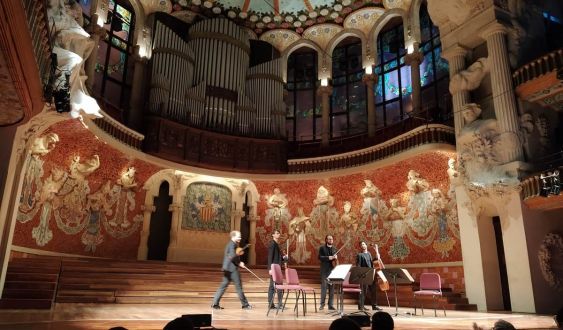
olving to the Palau de la Música is returning to that marvelous cave where musical affections are projected and aroused. After passing the controls and the pertinent prophylactic measures, at the entrance, we find ourselves enclosed in our own breath. The mask makes us aware of the privilege of being able to witness, despite everything, a quality musical performance. The ontological difference between being and existing, between hearing and feeling, will be imposed. The young members of the Goldmund Quartet, manifestly happy in their presentation, are not oblivious to all this. They belong to the latest generations of highly prepared musicians - like the Catalan Quartet Gerhard or Cosmos Quartet, also programmed during the summer - who will have to incorporate into their professional and personal evolution the new conditions in which music reverberates.
The legitimate tendency to accommodation - a predilection of human biology, which seeks to perpetuate itself - does not easily align with the uncertainty of these times, and the belief in constant progress threatens to be unmasked by the return to what was unthinkable until recently. New confinements, new deprivations of liberty. It is not a comforting idea, but the truth is that the explicit statement of the conditioning factors also invites us to consider the impact on our emotional reality, to understand life from the anchoring in the present moment. Music sounds in an inescapable, intimate temporality; and immediately a more resounding magic, a more powerful rootedness is perceived. The reduced capacity, for security reasons, emphasizes that feeling of privilege. It is reminiscent of attending a private rehearsal, where musicians exchange impressions inter pares, and reveal to a select few the "truth" of music.
Due to their dedication and passion, musicians behave like mirrors of the best in each of us.The members of the Goldmund Quartet demonstrated exquisite tact in the gallant games of a Joseph Haydn full of nuances. The balance, charming throughout the Quartet in F minor, Op. 20, No. 5, makes us forget the mask. Time flows, in effect, according to the measure suggested from the stage. Even silence is heard, with a rare kindness. We scandalously savor it between movements, without a cascade of telltale coughs daring to break the recess that would always allow the assimilation of what has been heard, and the predisposition to listen to what follows. The slow movement is aAdagiowith which it is impossible not to empathize, an anthem that seems to well up from within, like a reminiscent breeze. Although contained, the emotion of the musicians on stage is evident, given the gift of being so again. For their dedication and passion, they behave as mirrors of the best in each of us.
[subscribe_newsletter_esp]
The final movement, in fugue, allows Haydn to celebrate the glorious past in the present, projecting himself forward through his marked expressiveness, which Mozart and Beethoven would later take up. At the Palau, however, the piece performed next was The smile of the flamboyant wings, by Dobrinka Tabakova. Inspired by a painting by Joan Miró and written for the Goldmund Quartet, it suggests the false loop flapping - or boomerang effect - of an endless number of harmonic possibilities. Progressions that may recall the minimalism of Philip Glass, incorporating allusions to popular melodies, as Béla Bartók had done. The evocation of non-existent landscapes is done emotionally, with the experience of very real feelings or intuitions. This is also the case of the closing work, one of the most brilliant and disconcerting of the genre.
The return to the Palau is experienced as an occasion to turn inward and savor every inflection, every nuance, every silenceTheString Quartet No. 6 in F minorof Felix Mendelssohn, composed shortly after the death of his beloved sister Fanny and shortly before his own, delves into the Schubertian coexistence of beauty and horror. Trepidant and sharp in its first two movements -with voices that emerge unexpectedly or confirm the most inauspicious impressions- it has a balsamic third movement, insufficient for the tragedy that is brewing. Nevertheless, the last movement advances heroically, from emphatic outbursts. As if facing destiny and embracing it, in a musical embodiment of what Nietzsche would allude to through the expressionlove of fateThe strangely changing designs of an exceptional normality, which hints that the truth of the spectacle does not happen outside. The return to the Palau, masked, is experienced as an occasion to turn inward and savor each inflection, each nuance, each silence. More aware of breathing, of affections, of the wonder that is the live musical experience.
Add The New Barcelona Post as your preferred Google source for free
Stay informed with the latest news.
