Knowledge transfer is one of Catalonia's pending subjects, but also one of its inhabitants'. It is not only necessary to favor the information flow from universities to companies, but also to the general public. Scientific dissemination becomes key in a complex geopolitical moment, where various realities coexist, all extremely polarized. Biases, microaggressions, or abuses can go unnoticed in certain situations without adequate information. To fight against disinformation and demonstrate that knowledge transfer is not always boring, Open Brains, the Catalan neuroscience dissemination company, based in Barcelona, was born.
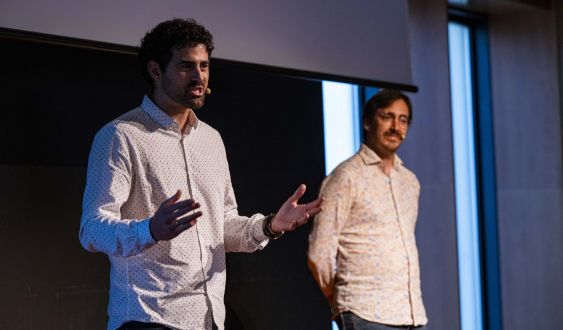
Its founders, Daniel Duque and David Bestué, are doctors in cognitive and experimental neuroscience, with experience in international research centers. They met at the Brain Circuits and Behavior laboratory at IDIBAPS (Barcelona) and decided to join forces to bring neuroscience closer to society. Duque assures in a conversation with The New Barcelona Post that his dream had always been "to buy a yellow bus, convert it into a mobile laboratory, and travel the world disseminating." Although the expert's idea was a utopia, it was the impetus that led him to start creating Open Brains. Currently, the company works with workshops and activities to make neuroscientific concepts understandable in a simple way. But they do not only seek knowledge per se, but they touch on complicated topics and put their audience in situations that bring out their intrinsic biases. Only in this way do they truly manage to influence society.
These activities, carried out by the two entrepreneurs, as for now only they are part of the company, are aimed at two branches: the first are educational centers and the second are companies. "From the beginning, we were very clear that we had to reach schools," says Bestué. Currently, they have between 150 and 200 workshops a year in schools and have proven that their work is effective in making young people reflect. Beyond concepts, Open Brains is dedicated to carrying out activities, games designed for reflection or even to put participants in everyday situations that —without them realizing it— perpetuate biases. At the end of the activity, the entrepreneurs open a reflective debate, without "having the magic recipe," expresses Duque, but "with space to talk about what they have just experienced," he specifies.
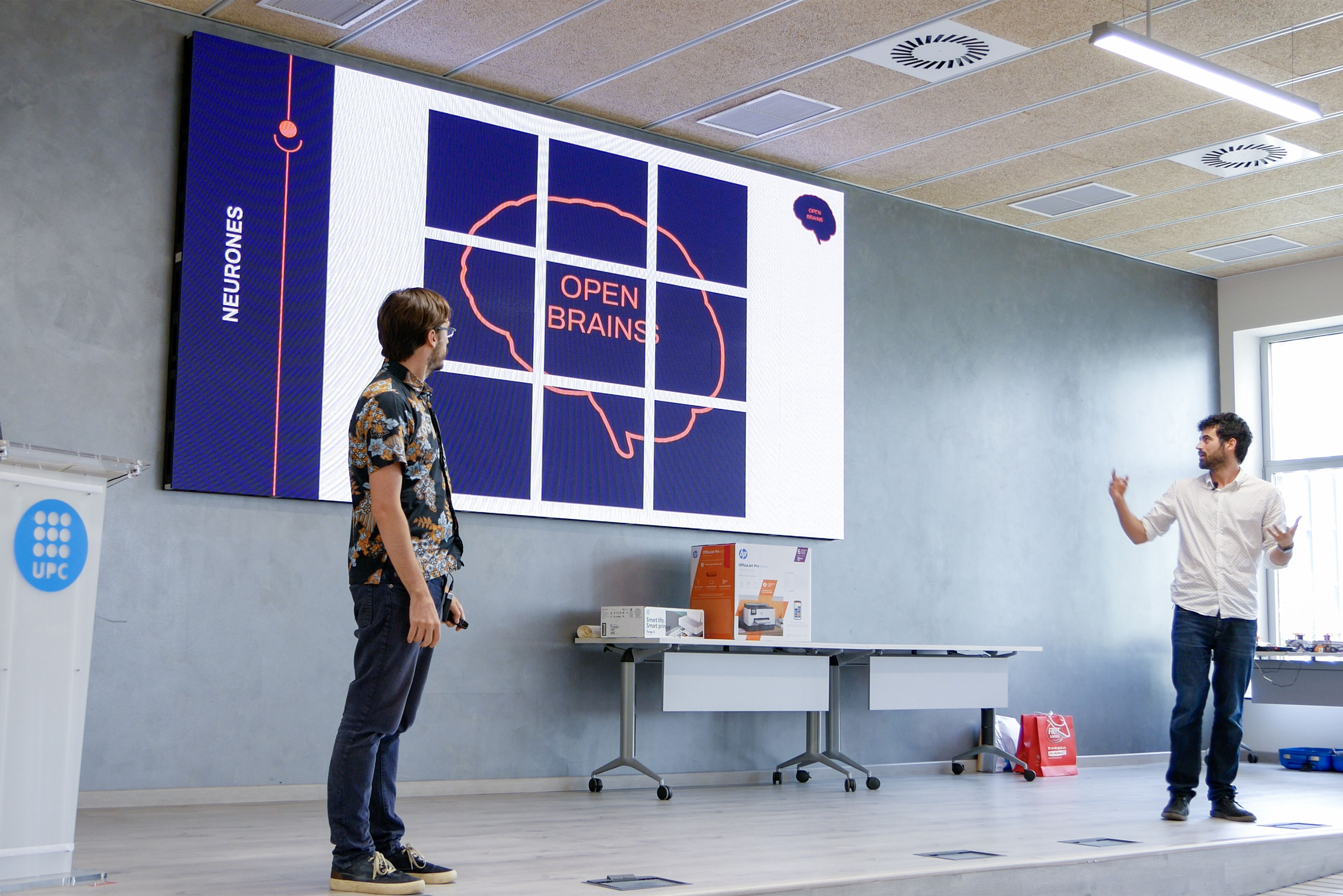
Open Brains —which for now only operates in Catalonia— takes neuroscience beyond training and turns it into an experience through its products. From a game designed to make the functioning of the brain tangible in a playful and accessible way, to workshops that explain social biases with science. In addition, they also have their catalog of shows designed to bring scientific knowledge to the general public with an experiential and entertaining format, far from the conventional academic lecture. With these two formats, Open Brains reinforces its desire to make neuroscience an accessible, rigorous, and at the same time, fun tool.
A new perspective for the business world
Although educational centers are always grateful and activities can help young people act differently in some situations, the reality is that Open Brains is also a business that needs expansion. For this reason, the entrepreneurs thought of a branch for their company that would be dedicated to helping other companies. "We do personalized corporate courses," explains Bestué. In this way, a company can contact Open Brains and request one of their workshops. From there, the entrepreneurs go to the company's headquarters and teach the class they have been asked for, in the same way as in schools, but for the staff. As for the type of companies they serve, there is a great variety. Bestué assures that they cannot make a profile because they have had large companies like Nestlé, with hundreds of employees, but start-ups with a dozen people have also contacted them.
In parallel, one of the new courses that Open Brains wants to launch comes at a time of clear need. The rise of the far right and social polarization has led them to create a new project called Create and Resist. These workshops seek to foster critical thinking through science, like all their work, but they are aimed at helping to identify everything that is happening and how it should be combated. Once again, Duque and Bestué want to demonstrate that with a good scientific basis, many social behaviors can be explained and, therefore, by having an explanation, that aspect can be changed or improved. These courses, according to the details given by the entrepreneurs, will not only be aimed at educational centers or companies that pay for them, but there is a willingness to take them to libraries or community centers to reach a larger number of participants.
In short, Catalonia has in Open Brains an example that knowledge transfer does not have to be synonymous with boredom or remain confined to research centers. Duque and Bestué have shown that, with scientific rigor and a desire to disseminate, it can reach both classrooms and boardrooms, and that neuroscience can be a useful tool to detect biases, combat disinformation, and foster critical thinking in an increasingly polarized social context. With projects like Create and Resist, the company demonstrates that its ambition goes beyond business: it is about truly influencing how Catalan society thinks and reacts.
Add The New Barcelona Post as your preferred Google source for free
Stay informed with the latest news.