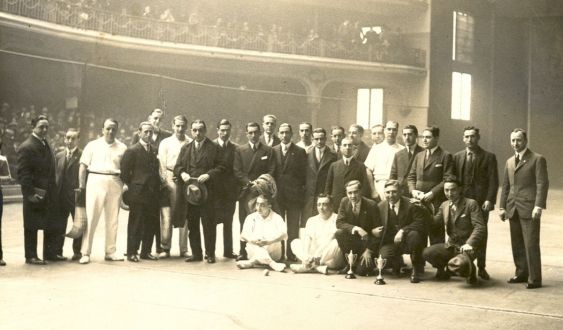
In 1920s Barcelona, crowded bullrings and football fields entertained many Sunday hours for Barcelona residents. But as explained in the book Los frontones industriales de Barcelona. Los clubes amateurs, by Damià Mor, the city also had thirteen frontons, large courts where the game known as Basque pelota was played. While some played, others placed money bets predicting results. This Basque-origin sports discipline comprises a dozen modalities, among which, cesta punta, ---jai alai in Euskera language--- is one of the most modern, whose practice led to the creation in Barcelona of the first pelota club in Spain, Club Vasconia. It was in 1924, thanks to the impulse of textile businessman and player Manuel Balet y Crous, who was its first president and who that same year also founded the Federació Catalana de Pilota.
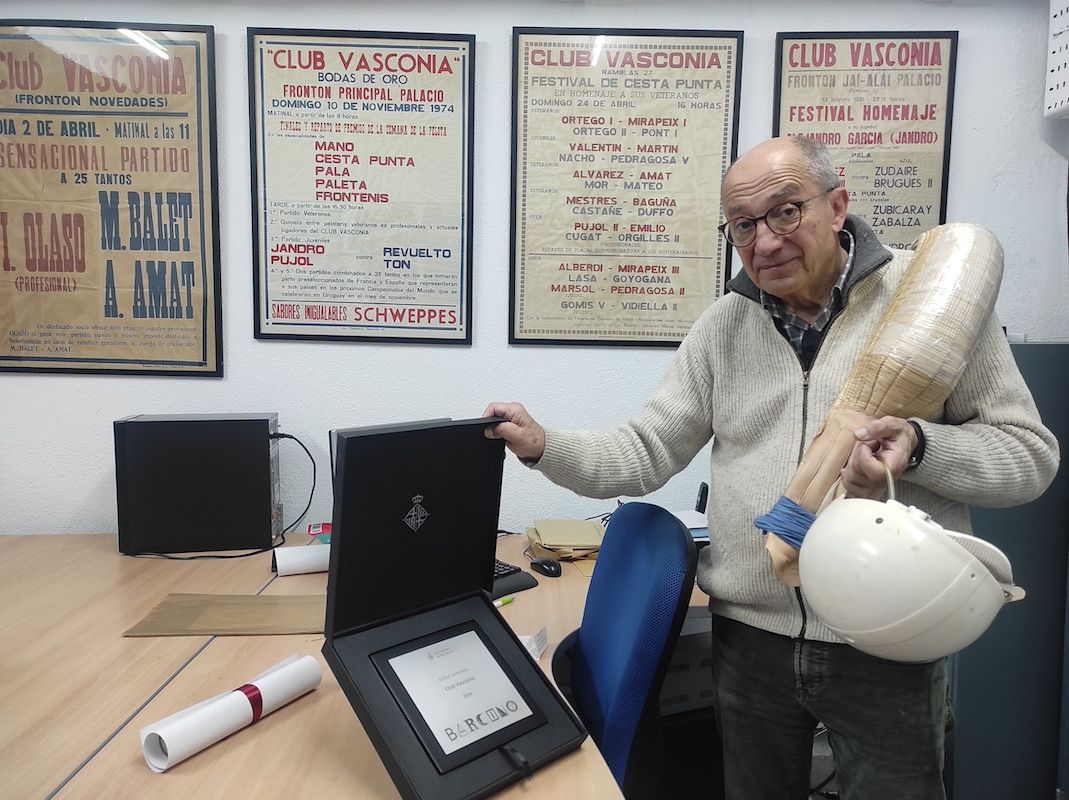
The club was born from a split from the Real Sociedad del Deporte Vasco. With Vasconia began a long history in Barcelona of sporting successes and of associationism among the families who have accompanied elite players to national and international championships. The hundred years of Club Vasconia have earned it a distinction from the Barcelona City Council this year in recognition of its trajectory as a centenary entity linked to the city.
In a Saló de Cent full of public, the now former president of Club Vasconia, Carles Pedragosa, collected the award from the mayor, Jaume Collboni. "Our city can boast of keeping its history alive, precisely, thanks to entities like yours," said the mayor in his speech before the representatives of the eleven centenary entities and institutions distinguished this year.
The pulse of this Barcelona associationism, in the case of Club Vasconia, has a very special sound. It is that of its pelota, which can exceed two hundred kilometers per hour from when the player throws it, collected and propelled from an elongated and concave wicker basket, until it hits the frontis (the front wall of the fronton) or goes to the rebound. Those who practice cesta punta say they have discovered a "surprising and very gratifying" sport, as player and Club Vasconia member Mariona Canyís points out.
For the Catalan Pilota Federation, the Vasconia Club is the cradle of the cesta. It is an indirect game between two players, or between two pairs, in which a leather ball is thrown against a wall (frontis) and the opponent (player, or a pair) has to throw it back against the wall before the ball bounces twice on the ground. The modalities within this sport differ depending on whether the ball is returned with the hand (bare hand or with protections) or with a pala, paleta, share, remonte or, in the case of the modality practiced at the Vasconia club, with the cesta.
The cesta, in reality, is a leather glove sewn to a structure of chestnut rods with wicker, leaving a tight and concave shape very similar to that of a basket. These cestas are still made by hand today, as are the balls, which have a hard rubber or resin core wrapped with very strong string and covered by two layers of hand-stitched kid leather, properly treated to acquire a spherical shape.
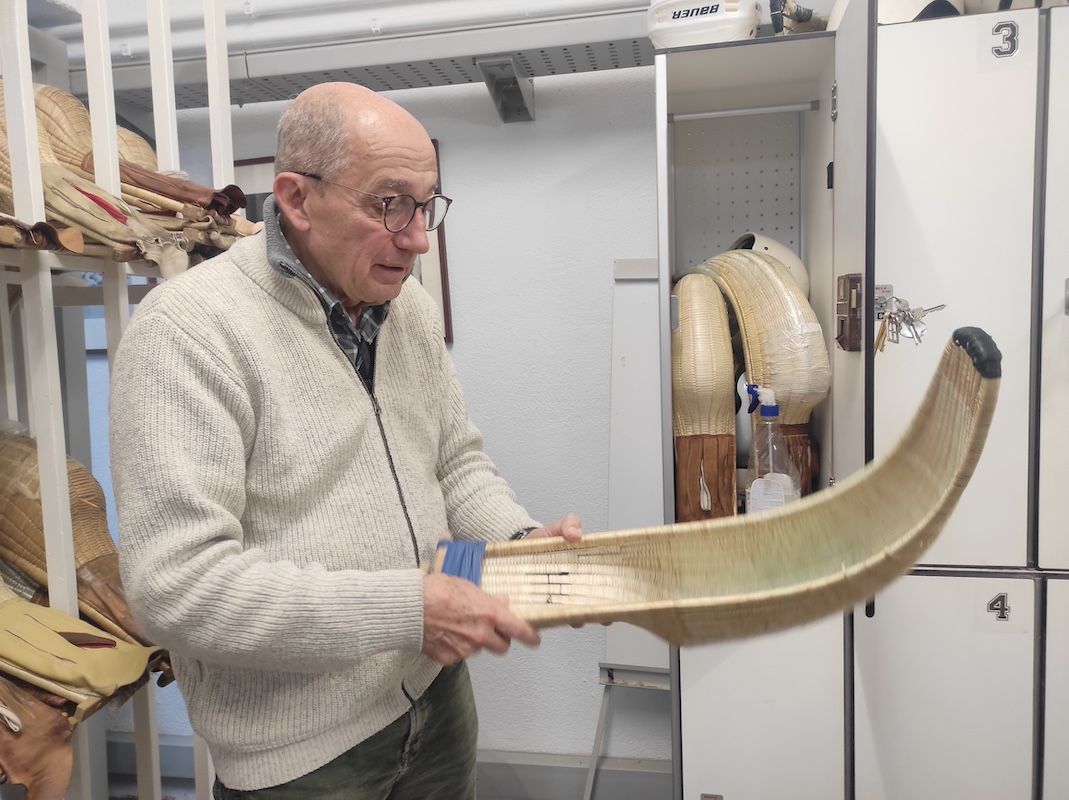
Learning cesta punta, according to those who master this sport, requires patience, perseverance, and will. For its practice, a special physical condition is not essential. It is a very technical sport, of a similar level to golf or basketball, where good posture and placement make the game more efficient, multiplying physical strength or push.
School in Vall d'Hebron
On Fridays, at 2 PM, Carles Pedragosa along with other companions from his veteran cesta punta group have the court reserved for playing, at the facilities of the Centre Municipal de Pilota Olímpics de Vall d'Hebron. But afterwards, once a week, Carles returns to the same court, this time as a coach, because he is one of the teachers for the starting players. Who better than someone who was only six years old when he started playing and who still today, at 75, continues to do so weekly with colleagues from a group that ---he says--- numbers about thirty, although only about half play. The rest ---Carles explains--- "you could say they are more of a WhatsApp group to stay up to date, where we share news and videos from Euskal Telebista or links to competitions that are uploaded to Youtube."
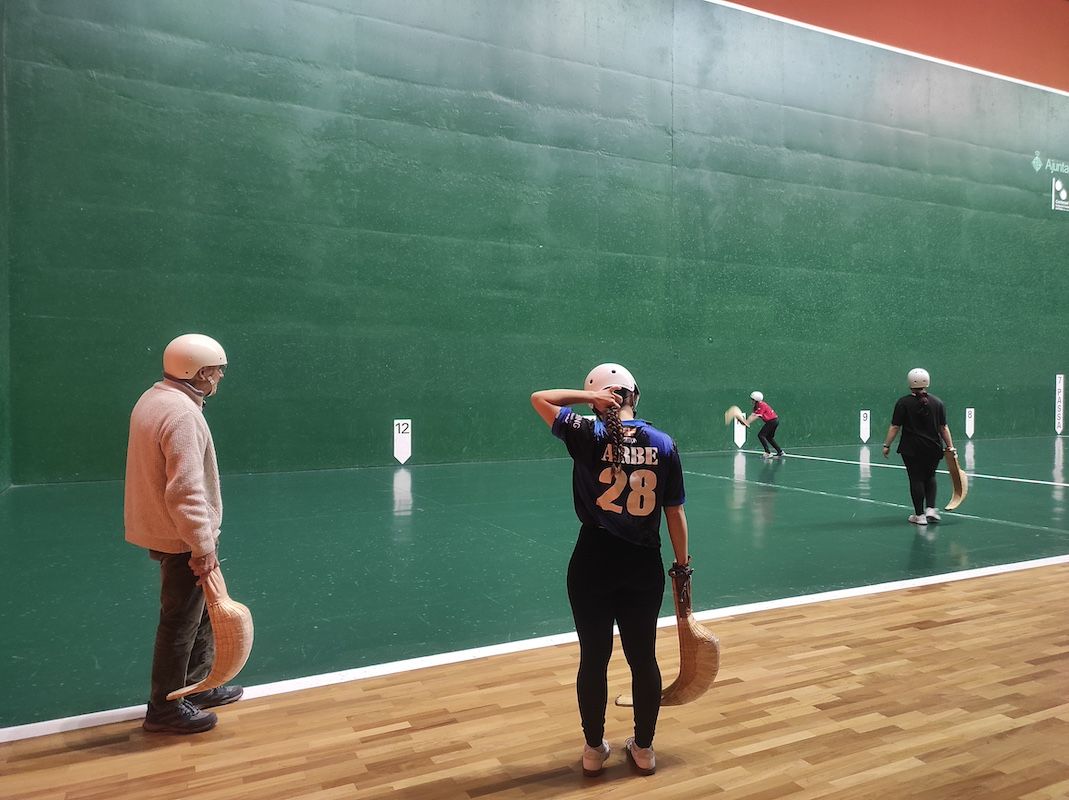
In addition to the school for new promises of this sport, who are being trained to compete in community, state, and international tournaments, Club Vasconia managed to enter the Barcelona City Council's Escola Esport Ciutat program. Through this, the club organizes two open days for boys and girls from schools close to the facilities where they have their court to play. Nearly 400 children come through, who can, in this way, see and try the different modalities of Basque pelota. "They are students between nine and 15 years old, among whom we are especially interested in those who practice several sports, because it is in those cases that they may not have yet found the sport that truly captivates them, and this would be an opportunity for cesta punta," explains Pedragosa.
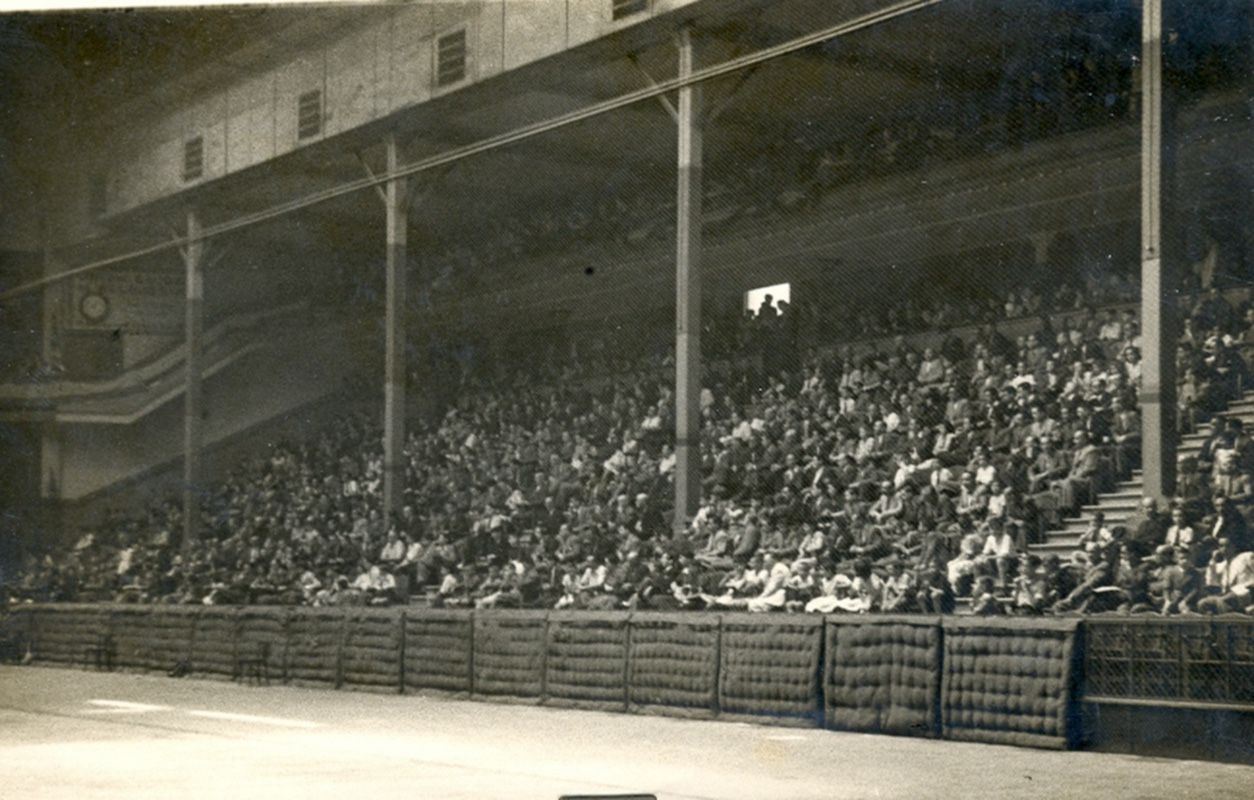
He was six years old when he played for the first time. He lived on Rambla de Catalunya, very close to the Novedades fronton, a magnificent facility that, in the late 1940s, combined professional players with amateur pelotaris. The building was in the space between Gran Via, Paseo de Gràcia, and Casp street, today owned by Zara. One Sunday afternoon, Carles's father, who had in mind finding a sport for his four children to practice, discovered that fronton. On Sunday afternoons, professional matches were held there, and mornings were for the players of Club Vasconia. That ball game left them "impressed, by the sound of the ball and the speed of the game," explains Carles Pedragosa. He was the youngest of the four brothers ---the eldest, Salvador, 88 years old today, still plays---, and when his father and his three brothers began to practice cesta punta, he basically accompanied them.
But the Three Kings brought him a small cesta to play with, which he still keeps and sometimes retrieves to practice with small children. With that first child-sized cesta, he entertained himself by throwing the ball. "I couldn't miss, because, if I did, I lost five minutes to cover the 64-meter court," Pedragosa recalls.
But all those solo ball entertainments, and watching his father and brothers play every week, meant that, at ten years old, he was already competing with older people in the third category. And he took advantage of any place and moment to send the ball against a wall with his cesta. He had broken a window in the gallery of his house that way. And he remembers very specially the emotion of a nun from the Concepcionistas school where he did preschool ---Mother Eufèmia--- when one day she saw him in the patio playing Basque pelota. "She was from the Basque Country and was so moved seeing me play cesta, that on Saturdays, which was the day symbolic medals were given to the young students who had stood out the most during the week, she always gave me two," the student recalls.
In fact, in the Euskera language, Jalai Alai, one of the names for Basque pelota, means joyful party. It is clear that cesta punta is a very dynamic, energetic, minority, and very familiar game. And it is the young promises who train in the learning school in the afternoons at the Ègora Olímpics pavilion, who are taking over in this already more than centenary institution, dean of pelota clubs, and all the tradition that is perpetuated with it.
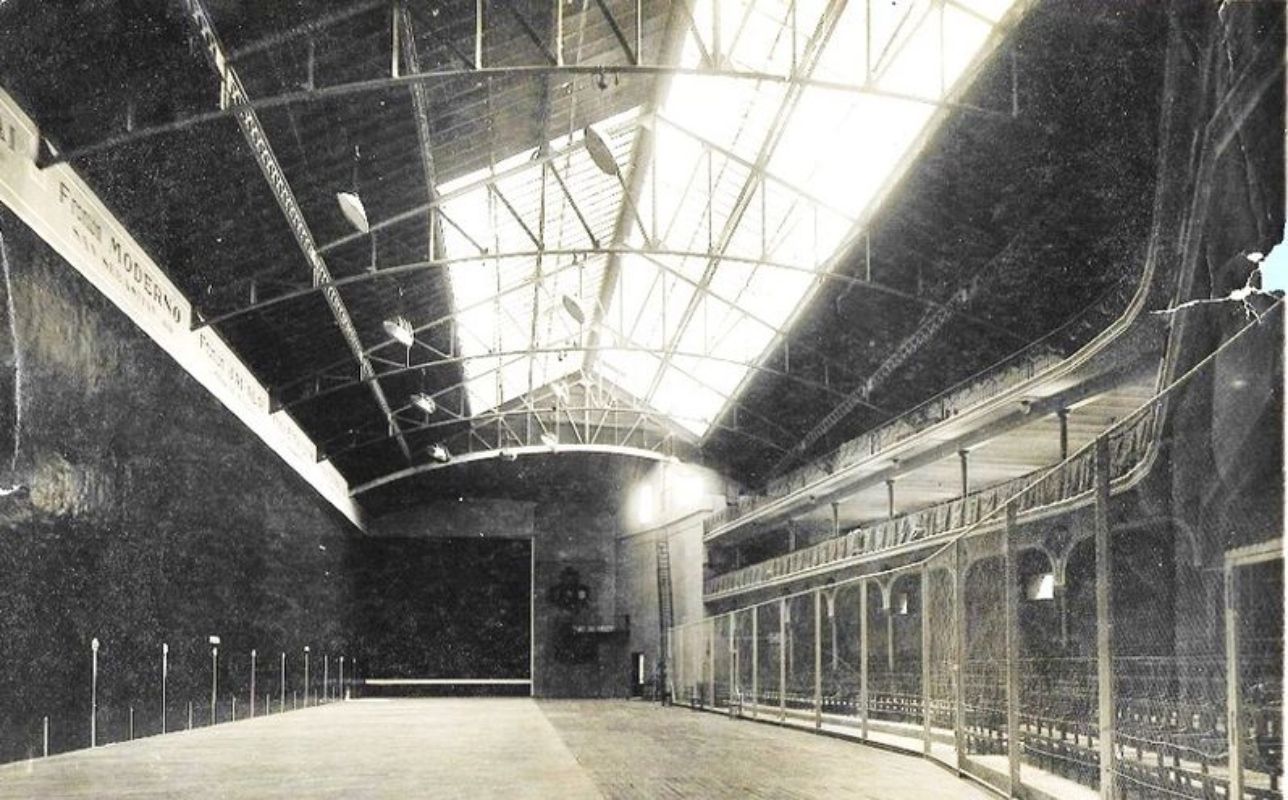
In Barcelona, the first industrial long fronton was the Frontón Barcelonès, which opened in 1893, on the corner of Diputació and Sicília streets. It was designed by the architect Enric Sagnier. Three years later, the Condal would be built, between Balmes and Rosselló, and already in the 20th century, the Principal would open, located above the Teatre Principal, on Las Ramblas; the Novedades, on Gran Via street; the Txiqui-Alai, in Bonsuccés square, where girls began to play, with rackets; the Sol y Sombra, on the corner of Gran Vía and Marina street; the Colón, on Las Ramblas, and a few more.
In 1952, brothers Joaquim and Manuel Balet ---sons of the founder of Club Vasconia--- were proclaimed world champions in cesta punta in San Sebastián. And in 1968, this discipline was an exhibition sport at the Olympic Games in Mexico, a country where there are very powerful teams. In fact, France, Mexico, and Spain ---with a very notable presence of Barcelona players---, and also the United States, are the countries that have led international competitions.
In the Olympic milestone in Mexico, brothers Eduard and Josep Maria Mirapeix won a gold medal. Despite being only an exhibition sport, the press of the time reported the feat of the Catalan players in large headlines, and the City Council under Mayor Josep Maria Porcioles awarded them the city's medal. Now, 57 years later, cesta punta has once again received recognition from the Barcelona consistory. With each basket, from their court in Vall d'Hebrón, the players of Club Vasconia accumulate medals and continue to fuel a deeply rooted passion.
Add The New Barcelona Post as your preferred Google source for free
Stay informed with the latest news.
