Sustainability has become a cross-cutting challenge for all sectors. However, in the case of tourism, it takes on special relevance due to its great impact at different levels: environmental, social ---both for being a labor-intensive activity and for its effects on the local population---, urban planning, etc. Sustainability, in the case of tourism, therefore, depends on the balance of multiple factors.
Under this premise, the hotel chain Ohtels has drawn up a sustainability plan that recently received the support of the Institut Català de Finances (ICF), whose priority is to finance this type of green investment. Specifically, the public body has helped finance, under more favorable conditions than those offered by the market, the installation of 200 photovoltaic panels (100KWp) at the La Hacienda de La Pineda hotel (Vila-Seca), distributed between the building's roof, the outdoor parking pergolas, and the roof.
Commitment to renewables
In addition, electric vehicle chargers have also been installed, and in 2022, the hotel's central air conditioning unit, which is the most important source of electricity consumption, was replaced with high-efficiency systems. The chain's commitment to sustainability and renewable energies already has a certain track record and, in total, it has 2,680 photovoltaic panels ---nine of its 13 hotels have them---, which are equivalent to 220 kW of power and annually generate 1.5GWh, representing a saving of 1,500 tons of CO2 per year.
"On a single high-season day, we have around 3,500 families staying in our establishments. This means that each day of maximum occupancy we generate an impact equivalent to that of a family for almost 10 years. We use this data as a reference to be aware of how relevant our environmental footprint is," explains Quim Oliva, Ohtels project director.
Horizon 2032
Ohtels launched its sustainability plan in 2022 with the goal of completing it in a decade. The group has set itself the goal of generating no waste in its activity by 2032 and, to this end, is reducing packaging in its hotels and offices. Regarding food waste, Ohtels collaborates in all its establishments with the app Too Good To Go to give an outlet to the surpluses from its restaurants.
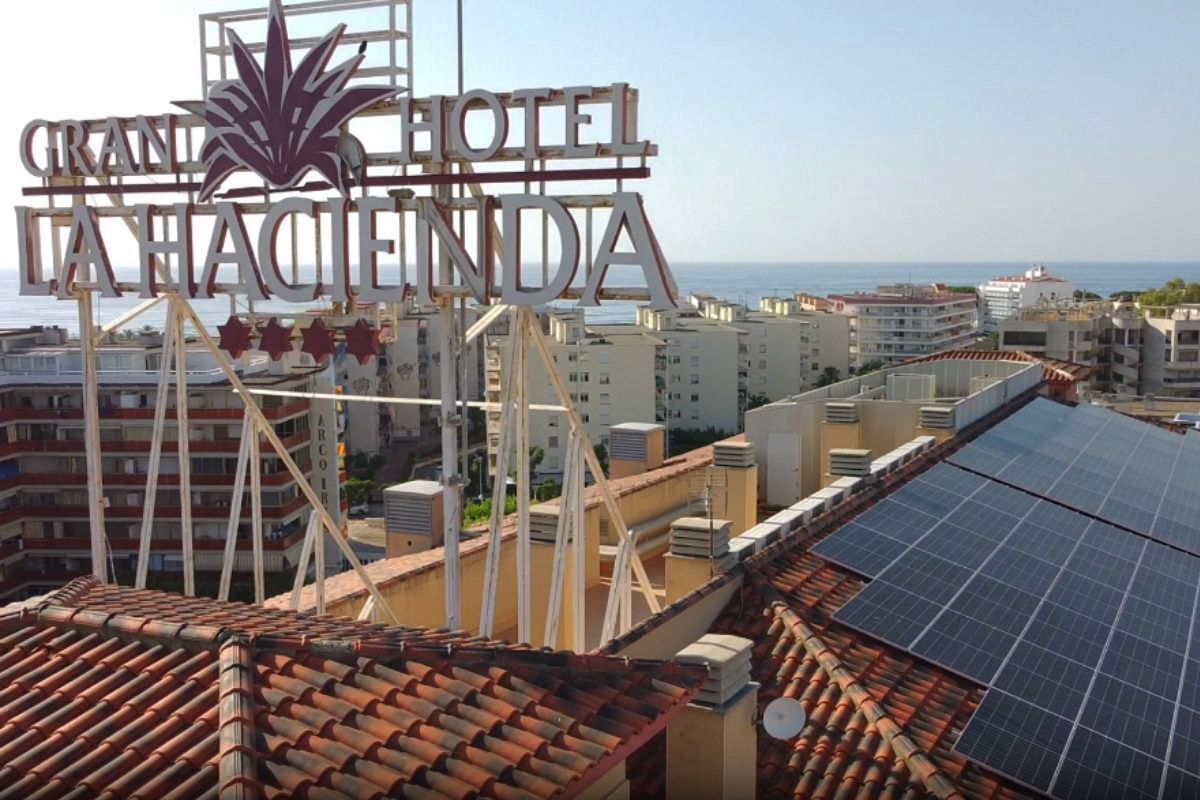
Another of Ohtels' commitments is "to reduce energy dependence by up to 50%" by 2032 through the optimization of facility use, investment in more efficient technologies, and the production of renewable energy. "We try to convey and involve customers in this entire process through communication and entertainment activities, in which we give them advice on how to reduce food waste and be more efficient in their use of electricity, and we try to make them aware of the harm caused by plastic pollution in the Mediterranean."
The company currently has an annual turnover of 65 million euros and employs 1,500 peopleOhtels was born in 1986 with the construction of the Belvedere hotel in Salou. In 2002, it built its second establishment, the Vil·la Romana, also in the municipality, and from that moment on, it began to specialize in the administration of third-party hotels and to expand along the Costa Daurada. In 2014, it took over the management of a hotel in Andalusia, and since then, the group has expanded geographically throughout that region, reaching a total of 13 hotels under the Ohtels brand.
Currently, the company bills 65 million euros annually and employs 1,500 people. "We have returned to pre-pandemic occupancy levels, but with a very large increase in costs," says the Ohtels project director. Looking ahead, the group aims to continue investing in its establishments to keep them updated and improve their sustainability.
Credit investment for efficiency and sustainability projects grows
In 2022, the Institut Català de Finances (ICF) approved a strategic plan for the 2022-2025 period that places environmental, social, and governance objectives at the center of its actions. In this sense, the roadmap of the Catalan public banking entity prioritizes promoting the financing of projects aimed at mitigating or adapting to the effects of climate change. The objective of the strategic plan is that at least 35% of new activity be considered sustainable.
"Now more than ever, the transition towards an economic model more respectful of the environment and society is an urgent and real necessity. The ICF Group is not oblivious to these issues. The financial sector has a key role in this process, and we are part of the solution. Because, as a public financial entity, ethical and responsible management is part of our raison d'être. In this sense, we have two major sustainable challenges for the coming years: to accompany the business fabric in the transition towards a sustainable business model and to integrate sustainability criteria transversally into the ICF Group's management model," explains the entity's CEO, Vanessa Servera.
In 2022, the ICF financed more than 470 companies, for a total amount of 479 million euros. Of that volume, 159 million euros were allocated to finance projects that promote energy efficiency, the green economy, and sustainability; 38 million euros for social rental housing projects, and 2 million euros for projects related to culture, health, people care, and life sciences. In total, 145 operations related to the environment and 105 related to the social sphere have been formalized.
Add The New Barcelona Post as your preferred Google source for free
Stay informed with the latest news.